
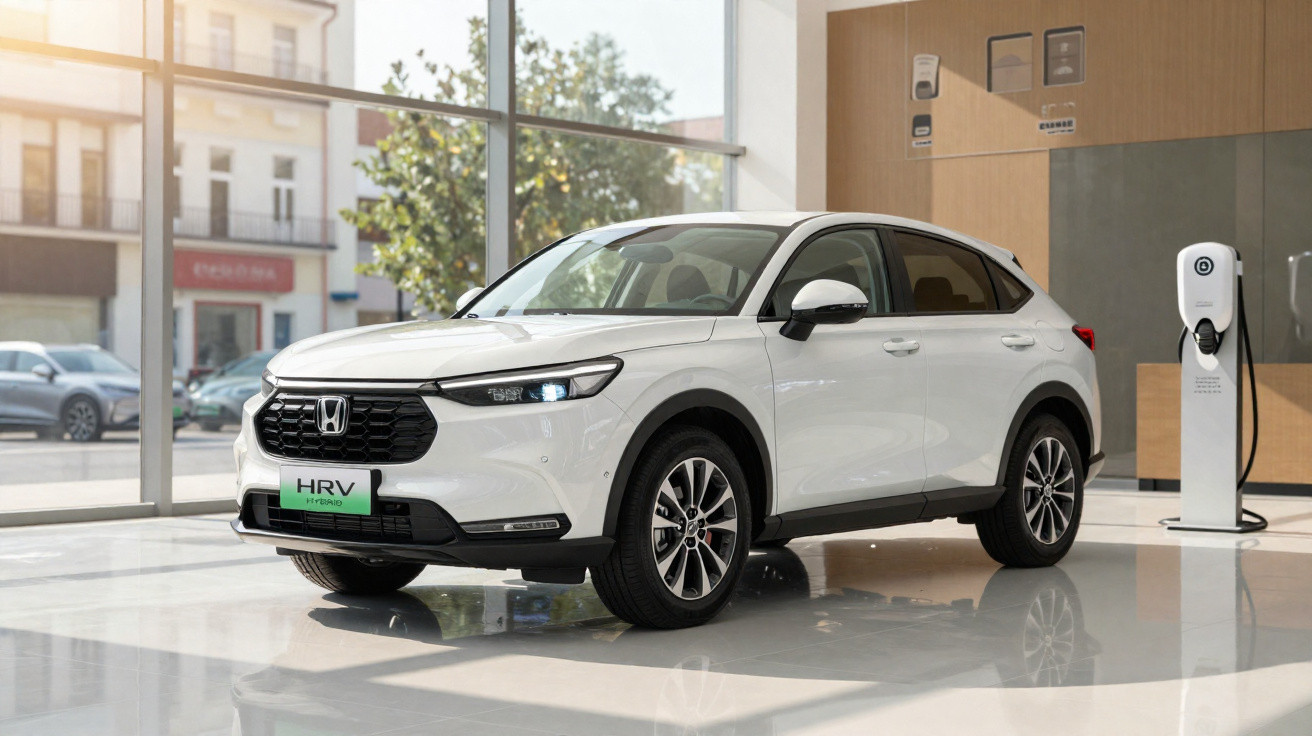
Having already been driven by Miguel Dias in Germany, the Honda HR-V has now arrived on the Portuguese market - a good reason for us to spend time again with Honda’s new Japanese SUV at the model’s launch event in Portugal.
With this generation, Honda places the new HR-V slightly above its predecessor, positioning it between the B-SUV and C-SUV classes.
While this “dual positioning” lets Honda compete in two segments with a single model, it also brings added pressure - and a longer list of competitors for the Japanese SUV.
In Honda’s view, the HR-V goes up against cars such as the Toyota C-HR, Volkswagen T-Roc and Nissan Qashqai, while also rubbing shoulders with premium alternatives like the BMW X1 or the Volvo XC40.
Does it meet expectations? This first brief encounter has already given us an initial sense of where it stands.
European look
Whether you look at the exterior - and especially the cabin - it’s clear Honda wants the HR-V’s styling to feel closer to European tastes.
From my point of view, Honda has pulled it off, particularly inside. The slightly “chaotic” feel that sometimes marked Japanese offerings has been replaced by a calmer, more “serene” approach, clearly influenced by the well-executed and widely praised Honda e.
Ergonomics also score well. The HR-V keeps a number of physical controls, which makes day-to-day use of the climate control, the radio and the far more up-to-date infotainment system much easier.
Finally, while the build quality is up there with the best in the C-SUV class, the materials are mostly hard - at least in the Elegance version we drove - which nudges the HR-V’s perceived ambience closer to B-SUV territory than to C-SUV rivals.
There’s no shortage of space
If there’s one area where the Honda HR-V continues to lead the way - just like its predecessor - it’s interior room, particularly in the rear seats.
Yes, the sloping roofline slightly reduces headroom for taller passengers, but when it comes to legroom the HR-V is in a “league of its own”.
Even with the front seats pushed as far back as possible, there’s still more than enough space behind. Part of that has been achieved “at the expense” of the boot, which is down to 319 l (304 l in the Lifestyle version due to the sound system) compared with the far more generous 470 l of the previous HR-V.
Even so, this first contact left me with a strong feeling that the HR-V’s practicality more than meets the needs of a young family - what’s missing now is a fuller test to carry out, once and for all, the “proof of the pudding”.
Efficiency above all
As Miguel had already mentioned in the video, the new HR-V is offered only with the e:HEV hybrid powertrain, using the same operating concept we already know from models such as the Jazz.
A 100% electric version is also planned for next year, and purely combustion-only variants are completely off the table.
So we have 131 cv of maximum power and 253 Nm of maximum torque, both delivered by the traction electric motor. However, the HR-V has two additional motors: a second electric motor (generator) and a 1.5-litre i-VTEC petrol engine (Atkinson cycle). Transmission duties are handled by what Honda calls an e-CVT (despite the fact that, technically, there is no gearbox).
In real-world use, the 131 cv provides “brisk” enough performance, but the real highlight is being able to drive for a large part of the time using only the electric motor, which is “fed” by the petrol engine that, most of the time, works as a generator.
The end result is very low fuel consumption. At a gentle pace along Lisbon’s avenues, the trip computer showed just 2.8 l/100 km, and even once I moved onto faster roads the average didn’t go beyond 4.6 l/100 km.
Of course, the distance covered in this first drive on Portuguese roads wasn’t extensive, but as a first impression these figures look promising.
Another advantage of this system is how smoothly it operates - at least until we “wake up” the combustion engine.
Even though the transmission has a fixed ratio (as in an electric vehicle), when you demand more from the drivetrain the petrol engine’s behaviour recalls other cars fitted with a CVT: it revs up to higher engine speeds and makes itself heard, which can be a little irritating, yet without a corresponding, direct link to the increase in road speed.
Comfort is the priority
During this first contact with the Honda HR-V on Portuguese roads, I was able to confirm what Miguel had already said after driving it in Germany: comfort is the watchword.
Consistently predictable and secure, the HR-V offers steering that is accurate, direct and nicely weighted, although the suspension cannot always prevent some body roll in corners when driven at a higher pace.
At more moderate speeds, the Honda HR-V feels planted, comfort levels are high, and only tyre roar “spoils” an experience that is not only easy but can even be relaxing - as long as the combustion engine isn’t asked to step in.
How much does it cost?
With around 7300 units sold in Portugal since 1999, the Honda HR-V arrives in our country in this third generation with three trim levels: Elegance, Advance and Lifestyle.
Shared across the range are items such as Full LED headlights, adaptive cruise control, front and rear parking sensors, 18" alloy wheels, a 7" instrument panel and a 9" central screen with Apple Car Play and Android Auto.
Also standard on every HR-V are Honda’s “Magic Seats”, five years’ warranty with no mileage limit, five years of roadside assistance, and metallic paint.
| Version | Price |
|---|---|
| Elegance | 34 500 € |
| Advance | 37 500 € |
| Lifestyle | 41 000 € |

Comments
No comments yet. Be the first to comment!
Leave a Comment