
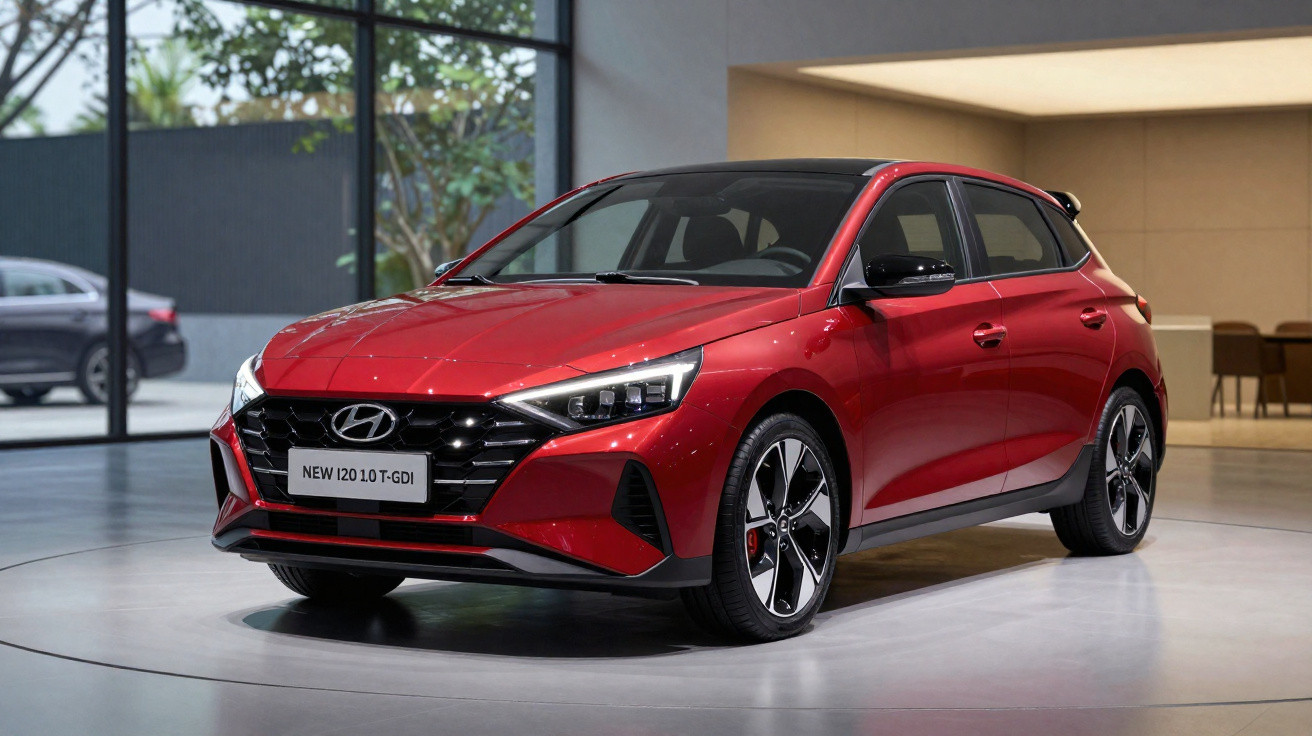
Take a proper look at it… the new Hyundai i20 is a far more eye-catching thing than the model it replaces, isn’t it? I’ll admit that, in the metal, it made a stronger - and more positive - impression on me than it did in photos.
Now in its third generation, Hyundai’s South Korean supermini has ditched the old car’s restraint and its emphasis on horizontal lines. In its place you get a shape that’s noticeably more dynamic, sportier and… simply more interesting. Hyundai labels this approach “Sensuous Sportiness”, leaning on pronounced creases, sharp edges and bolder graphic touches - the “Z” motif in the rear lights is a good example. It’s undeniably a busier, more energetic design, but it stops short of becoming overdone or overly decorative.
That look is helped along by improved proportions, too: it’s lower and wider than before. The effect is amplified by the generously sized wheels on my test car (215/45 R17) and by the black roof. A two-tone body is optional on the Style and standard on the Style Plus, and it makes the i20 appear even closer to the road than it actually is.
More style, inside as well
The same push for a sportier feel carries through into the cabin, which is visually more assertive than the previous i20 and gives a better first impression. A big part of that comes from the 10,25″ digital instrument cluster, which is crisp and easy on the eye - even if I’m not especially keen on the “instruments” styling in Comfort mode. That display is matched by an infotainment screen of the same size and resolution, and it feels more responsive and more pleasant to use than earlier versions.
Once you’ve settled into the driver’s seat - it’s on the firm side but comfortable, with decent support - you start to notice the materials. The surfaces within reach are all hard plastics, and they’re not always the nicest to touch. Yes, it’s a supermini, but a Peugeot 208, for instance, looks and feels a step up in this respect. One highlight is the steering wheel, trimmed in a pleasing synthetic leather; its diameter and thickness feel spot on, and the grip is genuinely good.
In the rear, there’s a notably generous amount of space, both for legs and headroom. That said, the closeness of your head to the point where the door frame meets the roof won’t be comfortable for everyone. The central tunnel is barely raised, which helps when you do need to carry three in the back - it’s not the ideal car for that job, but the middle passenger will complain less than they would in some rival models.
The new Hyundai i20 also offers one of the biggest boots in its class, with 352 l of capacity, although loading isn’t perfect. If you’re lifting in heavier or bulkier items, the job is made harder by the fact that the opening sits on a higher plane than the boot floor itself.
Sporty looks, sporty dynamics?
A firm verdict will have to wait a little longer. This first driving encounter with the new Hyundai i20 was short, and it took place in rather irritating weather… it never stopped raining. That meant there wasn’t the time or space to explore the car’s dynamics in real depth.
Even so, the early signs are very encouraging. It doesn’t grab you instantly or entertain in the way a Ford Fiesta can, but the new Hyundai i20 covers ground with real competence without ever feeling dull. It encourages you to get on with it, it’s nimble, and the front axle responds quickly to what you ask of it. What’s missing is a more talkative steering feel - it’s accurate, but not especially communicative.
Given how (very) wet the roads were, it was impressive how well it held off understeer when the pace picked up. And when it finally did start to push wide, it did so progressively - typically when you were effectively crushing the accelerator rather than simply pressing it.
The damping does lean towards the firm end of the spectrum - a Renault Clio, for example, rounds off rougher surfaces more effectively without giving anything away dynamically - but I’m not convinced it’s all down to suspension tuning. Once again, those large wheels may be playing their part.
If there was one area that stood out above the rest, it was braking. It feels as though Hyundai’s engineers have managed to remove any slack or sponginess from the pedal action. The initial bite is strong and sharp without being abrupt, and it’s easy to modulate - a setup that inspires genuine confidence and a strong sense of safety.
Only 100 cv? It feels like more
Another high point is this car’s drivetrain: the 1.0 T-GDI with 100 cv paired with the 7DCT, the seven-speed dual-clutch gearbox. The match works extremely well, with the 7DCT seeming to know exactly which ratio it ought to be in. That’s true in Comfort and Eco (where the throttle becomes… anaemic), but in Sport its behaviour is less convincing.
In Sport, flatten the accelerator on a straight and it will hold a gear until it’s almost on the limiter, which is entertaining in its own way. In quicker driving - without going over the top - that eagerness to chase higher revs sometimes means it hangs on to a lower gear longer than it should, keeping the engine spinning faster than necessary without delivering quicker, smoother or more enjoyable progress.
The throttle mapping in Sport also deserves another look. The right-hand pedal is certainly more sensitive, but it’s less progressive; it can feel as though you access the engine’s full “power of fire” within the first few degrees of pedal movement.
The 1.0 T-GDi is a familiar unit, but I have to say it has rarely felt as healthy as it does in this iteration. It isn’t the most refined engine, nor does it have the best voice - it always sounds hoarse and industrial - yet it feels eager and energetic, particularly in the mid-range, to the point that it seems to offer more than the claimed 100 cv.
It also has enough muscle to sustain higher cruising speeds, including on the motorway, where the new i20 proved impressively stable.
If there’s a criticism to level at the new model on the move, it’s refinement. Find rougher tarmac and road noise rises beyond what you’d ideally want. Yes, it’s a supermini, but some competitors are quieter - the Peugeot 208, for example.
Anything else?
The car I drove was a Style, which adds desirable extras such as automatic air conditioning, those stylish (and large) 17″ alloys and, as an option, the two-tone bodywork. That sits alongside equipment fitted to every new i20, including wireless Apple CarPlay and Android Auto, plus active safety kit such as autonomous emergency braking and lane keep assist (LKA).
As mentioned when pricing was announced, the new Hyundai i20 is actually cheaper than its predecessor in equivalent versions, despite offering more and better equipment. For this Hyundai i20 1.0 T-GDI Style 7DCT, prices start at 19 400 euros, which looks very competitive given what’s included.
Comments
No comments yet. Be the first to comment!
Leave a Comment