
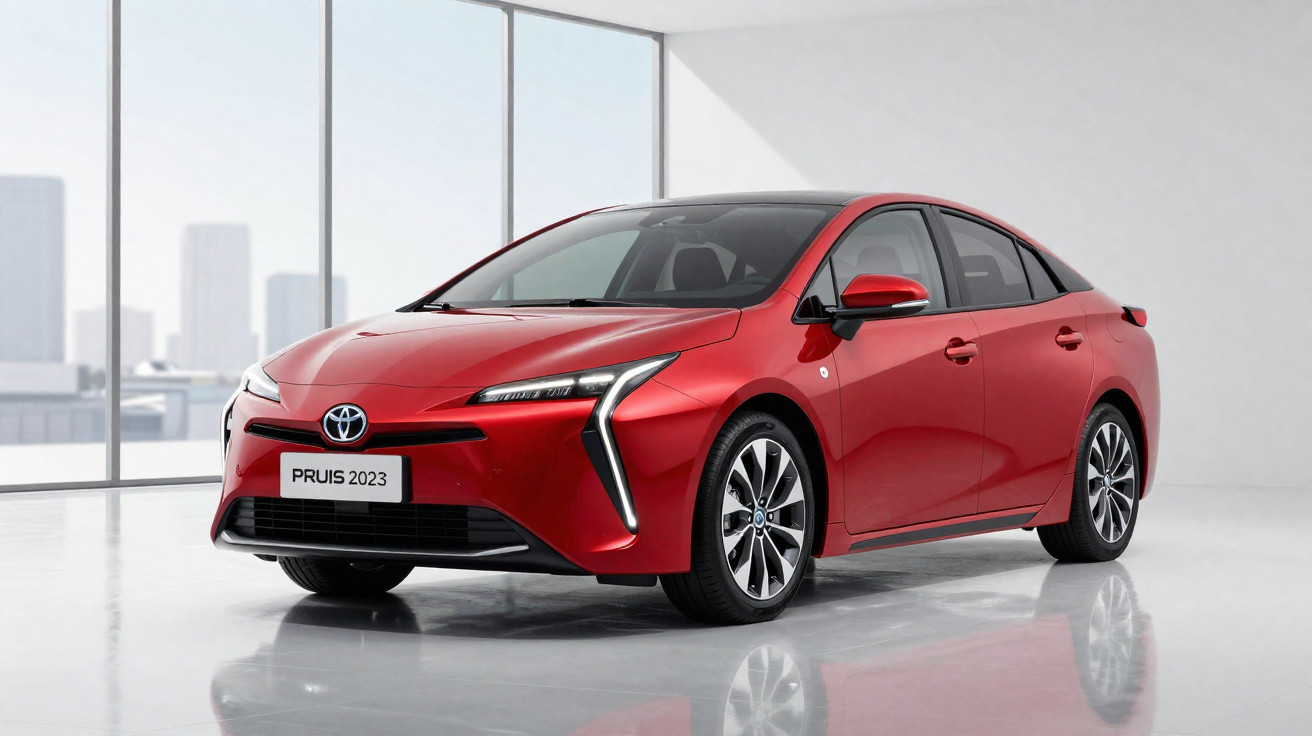
The Prius turns its back on its past and “injects” a refreshing dose of performance and emotion.
More than 25 years have passed since the first Toyota Prius arrived in the USA and Japan, created with a clear target: cut fuel consumption by 50% compared with other cars in the same segment.
With the second (2003) and third (2009) generations, the Prius remained a highly rational choice thanks to its impressively low consumption, but that success also cemented its reputation as something more dull than exciting.
Then Akio Toyoda, the head of the Japanese giant, laid down a simple rule: Toyota would build no more boring cars. With the fourth-generation Prius (2016), the shift began. It debuted the GA-C platform, which improved the “conversation” between driver, car and tarmac, yet the exterior styling still felt rather inhibiting, and the engine/transmission pairing still had room to move on.
No more taxis!
After more than five million units since the original Prius, the fifth generation is set to transform the public’s view of one of the best-known cars on the planet. The project’s chief engineer, Satoki Oya, told me with a discreet smile:
“I was asked to make a Prius that broke away from the taxi image and that people would sigh over when they saw it on the street”.
Satoki Oya, chief engineer of the Toyota Prius
That ambition is now embodied in the 2023 Toyota Prius, which in Europe will be offered only as a plug-in hybrid (externally chargeable). It is a strategic choice: in the previous generation, the two hybrid powertrains had already reached similar registration levels across the “old continent”, even though in other regions it will continue to be sold as a self-charging hybrid (HEV) as well.
Oya-san also supports the decision by pointing to Toyota’s wide spread of hybrids in Europe’s C-segment: the Corolla, the Corolla Cross and the C-HR.
Shorter, lower and wider
The new Prius looks genuinely sharp not only because the lines are cleaner, but mainly because the proportions have changed. It sits 5 cm lower and is 2.2 cm wider, and it is also 4.5 cm shorter, even though the wheelbase has been stretched by 5 cm (promising gains in cabin space). The wheels are pushed closer to the corners of the body - the silhouette now reads as far more dynamic, even sporty.
The most intriguing detail in profile is a line that runs almost uninterrupted from the nose of the bonnet to the end of the roof. The highest point of the body has moved rearwards too: instead of sitting above the front seats, it now peaks around the roof area over the second row.
Sporty exterior design constrains the cabin
Once inside - with a little care required to avoid brushing your head on the lower roof, the trade-off for the Prius’s sportier stance - rear passengers benefit from extra legroom. Because the rear bench sits higher than the front seats, there is also a theatre-style “amphitheatre” effect that gives occupants a better view out, which matters because the side glass area is quite narrow.
In the rear footwell, the central floor intrusion is moderate, allowing a decent amount of movement and space, particularly for the middle passenger.
Headroom is not outstanding, but it does not shrink as much as you might expect, because the body has dropped more at the front than at the rear. Anyone up to 1.80 m tall should not need to worry about unintentional contact with the headlining.
The rear window is also very slim and, combined with the very wide rear pillars (the kind you might expect on a coupé), it significantly harms rearward visibility. For that reason, the new Toyota Prius uses a rear digital camera that feeds an image to the interior mirror, offering an alternative to the limited view from the conventional mirror.
Infotainment makes a leap forward
We “entered” the new Toyota Prius through the rear doors, but we are now up front - where there is good news and bad news.
Starting with the positives, the central infotainment display is a large horizontal 12.3″ screen with excellent resolution and brightness, and graphics that feel far more modern than what Toyota offered until quite recently. It also includes Android Auto and Apple CarPlay connectivity.
Build quality feels reassuring too, even if soft-touch materials are not dominant - something that would lift the perceived overall quality. Still on the plus side, the climate controls use physical buttons. And the front windows are double-glazed, a feature more typical of higher segments, which helps keep the cabin quiet, as we will see later.
Areas that still need work
On the downside, Toyota again uses the dashboard layout first seen in the bZ4x electric model. It suffers from too many hard plastics and, more importantly, it forces the driver to focus and refocus their eyes too often on any journey because of the screen placement and the distances between the displays, and between the displays and the driver. The instrument panel, in particular, deserves criticism.
Much more power - and a longer “zero-emissions” range
This third generation of Toyota’s plug-in hybrid system is based on the fifth generation of its hybrid architecture. The petrol engine grows from 1.8 l to 2.0 l, with output rising from 98 cv and 142 Nm to 152 cv and 190 Nm.
The electric motor is also far stronger: 120 kW (163 cv) versus 53 kW (71 cv) - plus a further 23 kW (31 cv) from the generator. That explains the leap in total system output: from 122 cv to 223 cv.
One key change is the deletion of the clutch between the two electric machines (the main motor and the generator), which previously allowed both to contribute to moving the car. The new main electric motor no longer needs that “assistance” because it is so much more powerful.
More significant still is the adoption of a new, larger 13.6 kWh battery in place of the previous 8.8 kWh pack. This is crucial to the increase in electric-only range, which rises from 45 km to 69 km (provisional and not yet homologated, although Toyota believes it could end up higher).
Thanks to more advanced chemistry (the same as used in the RAV4 PHEV battery), the pack delivers 50% more capacity with 30% fewer cells (72 instead of 96). Energy density is higher, it takes up the same space, and it weighs roughly the same as the smaller battery it replaces.
Oya-san would not disclose the precise lithium-ion chemistry (the Japanese are always very reserved when it comes to technical detail…), but he did tell me that “the electrolytes are denser than in the previous battery”. The only downside of the larger capacity is that it will take longer to charge - there are no miracles here.
An unexpectedly engaging drive
My first dynamic experience with the new Toyota Prius took place around Athens (Greece), mostly on coastal secondary roads and inland routes, many of them quite twisty.
The Prius’s improved stability is immediately noticeable. That comes from its lower and wider stance, but also from a stiffer structure - there is a new crossmember at the rear axle, which is now independent with a multi-link arrangement. That extra rigidity has also allowed the dampers to retain a degree of comfort.
However, with 19” wheels - the previous generation never went beyond 15” - and 195/50 tyres on the car I drove, sharper bumps we encountered became more pronounced thumps for those on board. It may be sensible to choose a slightly taller tyre sidewall and drop a wheel size - 195/60 and 17″.
The small steering wheel (positioned below the instrumentation, with a semi-head up display style as seen on Peugeot models) makes the driver feel more connected. Yet it is the ease and precision of turn-in, the very tightly controlled body roll, and the strong response from the powertrain that would make anyone question whether they were really driving a Prius.
6.8 s from 0 to 100 km/h… a Prius?
The very positive “shock” of driving the new Prius - and just how far it stands from its predecessor - is most obvious in outright performance: it has around 100 cv more than before (give or take).
The new Prius cuts more than four seconds (!) from the classic 0–100 km/h sprint - 6.8s versus 11.1s - and top speed (still limited) rises by 15 km/h to 177 km/h.
Acceleration and in-gear response are also helped by a much better (and now, finally, acceptable) match between the noise made by the petrol engine and the actual rate of acceleration, even while retaining the continuously variable transmission as an “intermediary”.
Naturally, the petrol engine is quieter partly thanks to better cabin sound insulation, but mainly because it is far more powerful and therefore works much less hard during demanding acceleration. The much stronger and ever-present electric motor also plays a major role.
It really is true: the new Toyota Prius rejects its own past, and after driving this generation it is hard to imagine anyone calling it a “taxi” or “grandad car” again.
When does it arrive and how much will it cost?
I would be remiss not to mention consumption, which has always been the key argument that persuaded almost all of the five million customers who have bought one. As with the electric range, the official average fuel consumption is still going through homologation.
The car weighs 50 kg more than before and its aerodynamic coefficient is similar - it has a worse Cx, but a smaller frontal area. The counterbalance comes from the larger displacement and higher output, which enable lighter throttle loads, alongside stronger electric drive and the longer electric range.
As a result, Toyota is targeting around 0.8 litres for the first 100 kilometres (so long as there is charge in the “battery”, of course). In our case, we recorded 3.9 l/100 km, but not only was the test route a little longer, it also involved pushing the plug-in hybrid system harder to assess its response.
Estimated pricing for Portugal should be around 46 500 euros (confirmation will come later) and arrival is expected at the start of summer.
Comments
No comments yet. Be the first to comment!
Leave a Comment