
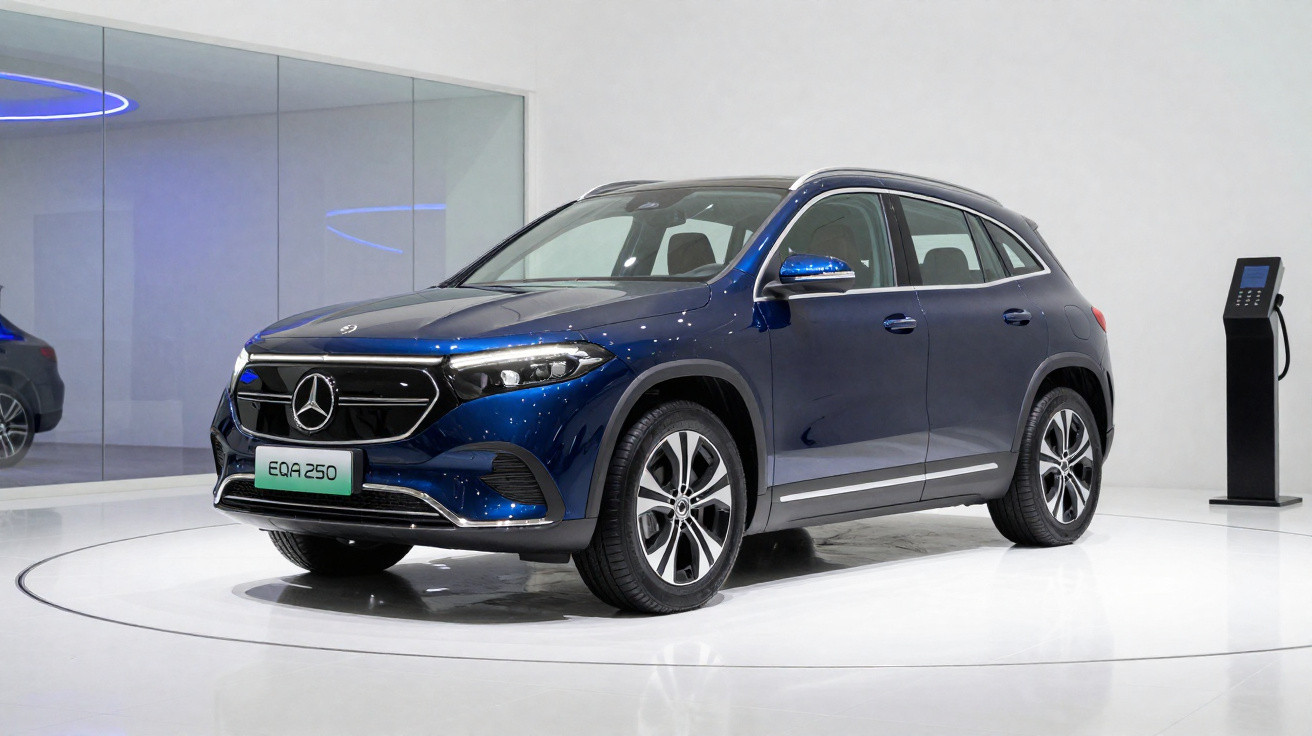
The EQ family is set to arrive in force this year, and the compact Mercedes-Benz EQA looks like one of the strongest sales prospects - even with its high price, expected to start at around €50,000 (estimated) in Portugal.
BMW and Audi were quicker to launch their first fully electric models, but Mercedes-Benz intends to claw back ground in 2021 with no fewer than four new EQ vehicles: EQA, EQB, EQE and EQS. In the timeline - and also by segment size - the EQA comes first, and I had the chance to drive it briefly this week in Madrid.
Before getting behind the wheel, it is worth noting what visually separates it from the GLA, the combustion-engined crossover with which it shares the MFA-II platform, almost all exterior dimensions, the wheelbase and the 200 mm SUV-style ground clearance. In other words, this is not yet the first Mercedes built on a platform created specifically for electric cars; that milestone arrives closer to the end of the year with the range-topping EQS.
Up front, the Mercedes-Benz EQA features a closed grille with a black backing and the star placed centrally. Even more striking is the horizontal fibre-optic light strip that links the daytime running lights, while LED headlamps sit at the far ends of both the front and rear.
At the back, the number plate has moved from the tailgate to the bumper. You can also spot small blue accents inside the rear light units and, if you look very closely, the active shutters in the lower section of the front bumper - they stay closed whenever cooling airflow is not required (and those needs are lower than in a combustion car).
Similar, yet different
The standard suspension is independent on all four wheels, with a multi-link set-up at the rear (adaptive electronic dampers can be specified as an option). Compared with the GLA, Mercedes has revised the damper, spring, bushing and anti-roll bar settings to deliver road manners that feel close to the combustion versions - even though the Mercedes-Benz EQA 250 weighs 370 kg more than a GLA 220 d with the same power.
In fact, the EQA’s dynamic development focused heavily on these chassis calibrations. As Jochen Eck (who leads the compact-model test team at Mercedes-Benz) explained to me, “aerodynamics could be fully tuned virtually, since this platform has been extensively tested over the years and across the launch of several body styles”.
My driving time with the Mercedes-Benz EQA 250 took place in the Spanish capital after the early-January snowstorm had passed and the roads had shed the white layer that even saw some locals enjoying ski runs down the Paseo de la Castellana. It meant 1300 km on the road to link the two Iberian capitals in a single day, but it was the safest way to travel (no airports and no aeroplanes…) and, with the chance to touch, get in, sit down and drive the new EQA, the effort was more than justified.
Inside, the cabin gives a reassuring impression of solid build quality. Ahead of the driver sit two 10,25” tablet-style screens (7” on entry versions), mounted side by side in a single horizontal sweep. The left display acts as the instrument cluster (with a wattmeter in place of a rev counter, naturally), while the right screen runs the infotainment system - including menus to show charging options, energy flows and consumption.
As with the larger EQC, you can tell the tunnel beneath the centre console is bulkier than it needs to be because it was originally designed to house a gearbox in combustion models; here it is largely empty. Also notable are the five turbine-style air vents. Depending on trim, there may be blue and rose-gold accents, and the dashboard panel in front of the passenger can be backlit - a first for a Mercedes-Benz.
Higher rear floor and smaller boot
The 66,5 kWh battery pack sits under the floor, but beneath the second row it is taller because it is stacked in two layers. That packaging creates the first meaningful change in the compact SUV’s cabin.
Rear passengers sit with their legs and feet slightly higher than usual. There is a benefit, though: the centre tunnel in that area is lower - or, even if it is not actually lower, it feels that way because the floor around it is raised.
The other clear difference is boot capacity. It measures 340 litres, which is 95 litres less than a GLA 220 d, for example, because the boot floor has had to be raised as well (electronic components live underneath).
Beyond that, passenger space is essentially unchanged - which means five people can travel, although the middle rear seat remains tighter - and the rear backrests still fold in a 40:20:40 split. A Volkswagen ID.4, a potential rival, is plainly roomier and feels more “open” inside because it was designed from the outset on a dedicated electric-car platform. On the other hand, the Mercedes-Benz EQA delivers a higher perceived overall interior quality.
On-board luxuries
The driver is treated to a list of features that are not especially common in this size class if you judge purely by dimensions (less surprising when you consider the price…). Voice control is available, as is an optional augmented-reality head-up display, plus an instrument cluster with four display styles (Modern Classic, Sport, Progressive, Discreet). The visuals also respond to how you drive: during a harder acceleration, for instance, the display turns white.
Even at entry level, the Mercedes-Benz EQA comes with high-performance LED headlamps with adaptive high-beam assist, an electrically opening and closing tailgate, 18″ alloy wheels, 64-colour ambient lighting, a twin cupholder, plush seats with four-way adjustable lumbar support, a reversing camera, a leather multi-function sport steering wheel, the MBUX infotainment system and navigation with “electric intelligence” (it warns if a charging stop is needed on your planned route, points out charging stations along the way and estimates how long you should stop depending on each station’s charging power).
Front-wheel drive or 4×4 (later) for the Mercedes-Benz EQA
On the thick-rimmed steering wheel with its flattened lower section, there are paddles that let you set the level of energy recuperation on deceleration. The left paddle increases it and the right reduces it, across levels D+, D, D- and D–, listed from weakest to strongest. In these modes, the electric motors act as alternators, turning mechanical rotation into electrical energy to replenish the battery - which is covered by an eight-year or 160 000 km warranty - while the car is moving.
When sales begin, this spring, the Mercedes-Benz EQA will initially be offered only with a 190 cv (140 kW) electric motor producing 375 Nm and driving the front wheels - exactly the version I drove. Mounted on the front axle, it is an asynchronous unit packaged alongside the single-speed reduction gear, differential, cooling system and electronics.
A few months later, a 4×4 version will arrive. It adds a second motor at the rear (synchronous), for a combined output equal to or above 272 cv (200 kW), and it will use a larger battery (as well as a few aerodynamic tweaks), because range rises to more than 500 km. Torque distribution between the axles is controlled automatically and can be adjusted up to 100 times per second, with priority given to rear-wheel drive whenever possible, since the rear motor is more efficient.
Driving with one pedal
From the first kilometres, the EQA stands out for how quiet it is inside, even by the already high standards of electric cars. At the same time, it becomes clear that the car’s responses vary significantly depending on the recuperation setting you choose.
It is easy to adopt “one-pedal” driving (using the accelerator only) in D–, once a little practice helps you judge distances so that slowing down is achieved simply by lifting off the right-hand pedal. In that stronger setting, do not be surprised if passengers nod forward slightly when you do so.
Of the available drive modes (Eco, Comfort, Sport and Individual), Sport is naturally the sharpest and most entertaining - although the Mercedes-Benz EQA 250 is not designed for outrageous straight-line performance.
Like most EVs, it surges with real force up to 70 km/h, but the 0-100 km/h time of 8,9s (slower than the 7,3 s required by the GLA 220 d) and a top speed of just 160 km/h - versus 219 km/h for the 220 d - make it clear this is no racing machine (and at two tonnes, it would not be easy). In truth, Comfort or Eco suit it better, particularly if you want a real-world range that does not fall too far short of the quoted 426 km (WLTP).
The steering feels accurate and communicative enough (though I would have liked a bigger difference between modes - especially Sport, which I found too light), while the brakes offer a more immediate initial bite than in some other electric cars.
The suspension cannot fully disguise the substantial battery mass, and the car feels a touch harsher in its reactions than a combustion-engined GLA, even if it is not uncomfortable on rougher tarmac. If surfaces are poor, choose Comfort or Eco and you will not be jolted too much.
Technical specifications
| Mercedes-Benz EQA 250 | |
|---|---|
| Electric motor | |
| Position | Front transverse |
| Power | 190 cv (140 kW) |
| Torque | 375 Nm |
| Battery | |
| Type | Lithium-ion |
| Capacity | 66,5 kWh (net) |
| Cells/Modules | 200/5 |
| Transmission | |
| Drive | Front-wheel drive |
| Gearbox | Single-speed reduction gear |
| Chassis | |
| Suspension | Front: independent MacPherson; Rear: independent multi-link. |
| Brakes | Front: ventilated discs; Rear: discs |
| Steering/Turning circle | Electric assistance; 11,4 m |
| Steering wheel turns | 2,6 |
| Dimensions and capacities | |
| Length x Width x Height | 4,463 m x 1,849 m x 1,62 m |
| Wheelbase | 2,729 m |
| Boot | 340-1320 l |
| Weight | 2040 kg |
| Tyres | 215/60 R18 |
| Performance, consumption, emissions | |
| Top speed | 160 km/h |
| 0-100 km/h | 8,9s |
| Combined consumption | 15,7 kWh/100 km |
| Combined CO₂ emissions | 0 g/km |
| Maximum range (combined) | 426 km |
| Charging | |
| Charging times | 10-100% on AC (max.) 11 kW: 5h45min; 10-80% on DC (max.) 100 kW: 30 minutes. |
Comments
No comments yet. Be the first to comment!
Leave a Comment