
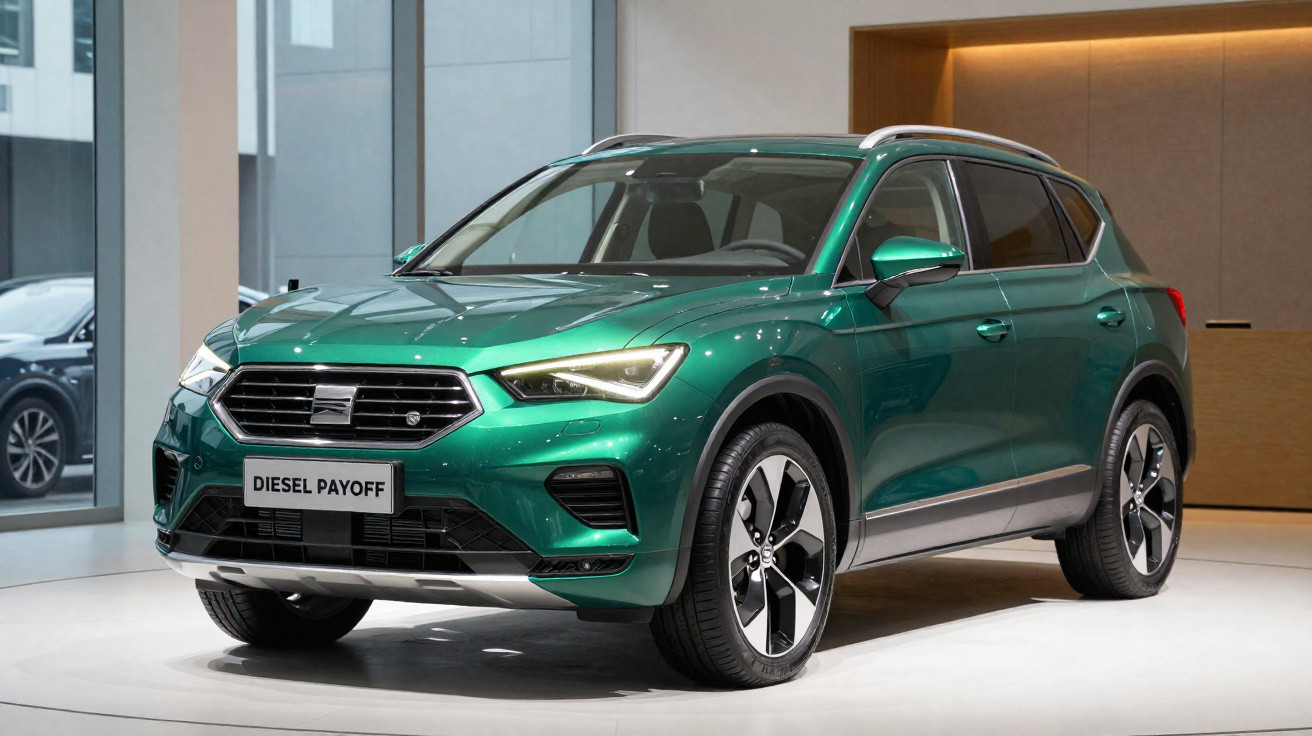
Not long ago, Guilherme Costa put the SEAT Tarraco to the test with the 1.5 TSI 150 hp, and raised the obvious question: could that petrol engine make you forget the 2.0 TDI with similar power, typically the default choice in a large SUV like the Tarraco?
To put any remaining doubts to bed, we’ve now driven the SEAT Tarraco with… the 2.0 TDI 150 hp, of course.
So, does the “tradition” still hold- and is this the ideal engine for SEAT’s flagship SUV? In the next few lines, we’ll try to answer exactly that.
Does Diesel still pay off?
As Guilherme pointed out when testing the Tarraco with the 1.5 TSI, big SUVs have traditionally gone hand-in-hand with diesel engines- and after spending time with this 2.0 TDI version, I was quickly reminded why.
It’s not that the 1.5 TSI falls short (it actually performs very convincingly), but the truth is the 2.0 TDI feels purpose-built for the kind of driving the Tarraco is meant to do.
With almost five metres in length and more than 1.8 m in width, the SEAT Tarraco is far from the ideal tool for urban pottering. It’s designed to “devour” miles on open roads.
And in that environment, the 2.0 TDI with 150 hp and 340 Nm is “like a fish in water”, delivering relaxed, brisk progress and- above all- strong efficiency.
During my time with the Tarraco, it was easy to keep consumption between 6 and 6.5 l/100 km on the road, and even around town it didn’t climb much beyond 7 l/100 km.
When I decided to try to improve my score in the “Eco Trainer” (the on-board menu that assesses your driving), I even saw the trip computer showing 5 to 5.5 l/100 km averages- without having to crawl along.
Smooth and progressive in the way it delivers its power, the 2.0 TDI is well matched to the six-speed manual gearbox. The ratios are sensibly chosen, the shift action is comfortable (less mechanical and sporty than, for instance, the Ford Kuga’s), and it naturally encourages the kind of driving the Tarraco seems to prefer: unhurried, easy-going progress.
Comfortable and designed for the family
Given its exterior footprint, it’s no surprise the SEAT Tarraco offers generous interior space and makes smart use of it.
In the rear, there’s more than enough room for two adults to travel comfortably. It also adds useful touches such as USB ports and air vents in the centre console, plus very handy fold-out tables on the backs of the front seats.
As for the boot, just like the petrol Tarraco, this one was also in five-seat configuration, which means a 760-litre luggage compartment- a decidedly generous figure for a family holiday.
On the move, this SUV’s defining traits are predictability, stability and security. It’s capable when the road gets twisty, yet from inside the SEAT Tarraco it can feel like you’re travelling in a “protective cocoon”, such is its ability to help you tune out the traffic around you.
A flagship by merit
Well assembled and finished with quality materials, the SEAT Tarraco’s cabin shows that form and function can work together.
Tasked with introducing SEAT’s new design language inside and out, the Tarraco delivers strong ergonomics while still keeping the ever-useful touch controls.
The infotainment system is comprehensive, straightforward and intuitive to operate (as is typical in SEAT models), and it includes a welcome rotary knob for adjusting the audio volume.
Equipment levels are also very complete, ranging from gadgets like Apple CarPlay and Android Auto to a long list of safety and driver-assistance systems.
Highlights include automatic emergency braking, lane departure warning, traffic sign recognition, blind-spot monitoring, and adaptive cruise control- which, incidentally, works very well in fog.
Is it the right car for me?
Comfortable, very spacious and well equipped, the SEAT Tarraco fully deserves a spot on the shortlist for anyone shopping for a family SUV.
As for choosing between the 2.0 TDI 150 hp and the 1.5 TSI with the same output, it’s more a matter of the calculator than anything else. You need to look at how many kilometres you do each year (and the types of roads and driving conditions involved) to judge whether the diesel engine makes sense.
That’s because, even though in Xcellence trim (the same specification as the other Tarraco we tested) the price difference is around 1,700 euros in favour of the petrol engine, you also need to factor in the higher annual IUC charge the diesel Tarraco will pay.
Putting the financial side to one side and returning to the question that prompted this test, I have to admit the 2.0 TDI “pairs” extremely well with the SEAT Tarraco.
Efficient by nature, it helps the SEAT Tarraco disguise its weight convincingly, without forcing the driver into an excessive number of stops at the pumps.
And while it’s true diesel engines aren’t viewed as positively as they once were, it’s also true that if you want reasonably low consumption in a model with the Tarraco’s size and mass, there are only two routes: a diesel engine or a plug-in hybrid- and the latter, to achieve those figures, will require frequent visits to a charger.
So, while the second option doesn’t arrive- the Tarraco PHEV has already been shown to us, but it only reaches Portugal in 2021- the first continues to “do the honours”, ensuring the Spanish flagship remains a serious contender in a very competitive segment.
Comments
No comments yet. Be the first to comment!
Leave a Comment