
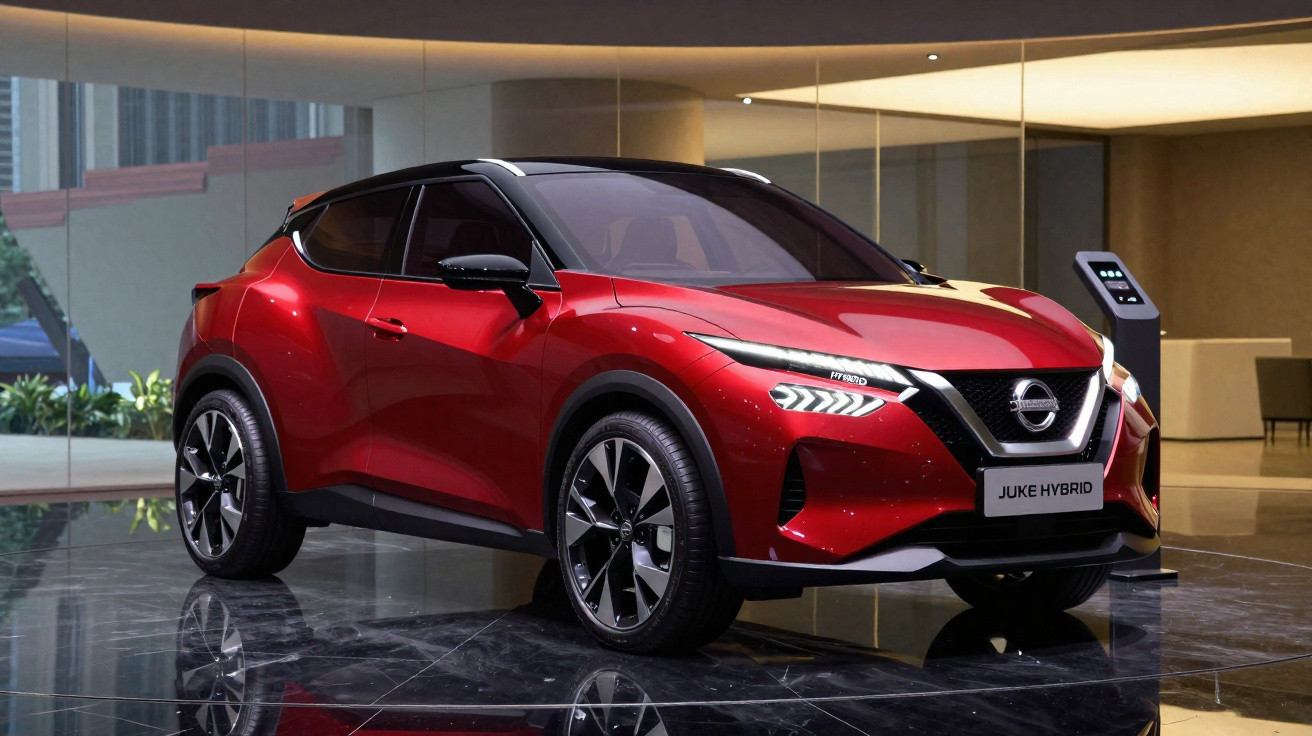
The Nissan Juke Hybrid not only introduces a brand-new hybrid powertrain; Nissan also used the moment to "refresh" the Japanese crossover in several areas.
Exterior updates to the Nissan Juke Hybrid
Up front there’s a new bumper designed to improve aerodynamic performance. The grille has been reworked to look closer to that of the all-electric Ariya crossover, and the latest Nissan badge now takes pride of place. Round the back, a redesigned spoiler is also part of the update.
Even so, the headline change is the new hybrid powertrain, which promises lower fuel consumption and also becomes the most powerful engine option in the current Juke generation.
Diogo Teixeira has already driven the Juke Hybrid in Barcelona, Spain, and shares everything about this new variant.
The hybrid powertrain
Launched in 2019, the second-generation Nissan Juke had, until now, only been offered with one petrol engine: the 1.0 DIG-T with 114 hp. At last, the line-up gains a second option, with the Juke Hybrid positioning itself as the range-topper.
The hybrid setup isn’t entirely new, however. By making the most of Alliance Renault Nissan Mitsubishi synergies, the Juke Hybrid adopts the same powertrain used in the Renault Clio E-Tech - a model that has already been through Razão Automóvel’s garage.
In practice, it pairs a naturally aspirated 1.6-litre inline four-cylinder engine producing 94 hp and 148 Nm with a 36 kW (49 hp) traction electric motor delivering 205 Nm. It also includes a 15 kW (20 hp) electric motor-generator, an inverter, and a liquid-cooled 1.2 kWh battery.
Multimode gearbox: how the transmission works
The most intriguing element of the Juke Hybrid’s drivetrain is its transmission: a low-friction multimode gearbox. It features four ratios for the combustion engine and two ratios for the electric motor, and it does without a conventional clutch. Instead, it uses dog clutches and does not rely on traditional synchroniser rings to change gear.
All told, the new Juke Hybrid claims a combined maximum output of 105 kW or 143 hp - 29 hp more than the 1.0 DIG-T. At the same time, Nissan states fuel consumption is up to 40% lower in the urban cycle and up to 20% lower in the combined cycle.
Electric running, battery packaging and e-Pedal
Because it’s a conventional hybrid (in this case, a series-parallel system), there’s no need to plug it in as you would a plug-in hybrid. The small battery - mounted under the boot - "steals" 68 litres of capacity, reducing it to 354 litres versus 422 litres in the combustion-only Juke, and it enables no more than 2–3 km of electric-only range.
That may not sound like much, but when combined with energy recuperation during deceleration and braking (to store electricity back into the battery), Nissan says that up to 80% of urban driving can be achieved with zero emissions. Helping that outcome, pull-aways are always in electric mode, and it can still reach 55 km/h.
The new Juke Hybrid also gains the e-Pedal feature, as found on the 100% electric Leaf, allowing you to manage the vehicle’s progress using only the accelerator pedal. Unlike the Leaf, though, e-Pedal in the Juke Hybrid never brings the crossover to a complete stop - it reduces speed down to 5 km/h - so you still need to use the brake pedal.
In Portugal
The new Nissan Juke Hybrid can already be ordered in Portugal, with prices starting at 32 700 euros. The version shown in the video is the better-equipped Tekna, with pricing from 35 100 euros.

Comments
No comments yet. Be the first to comment!
Leave a Comment