
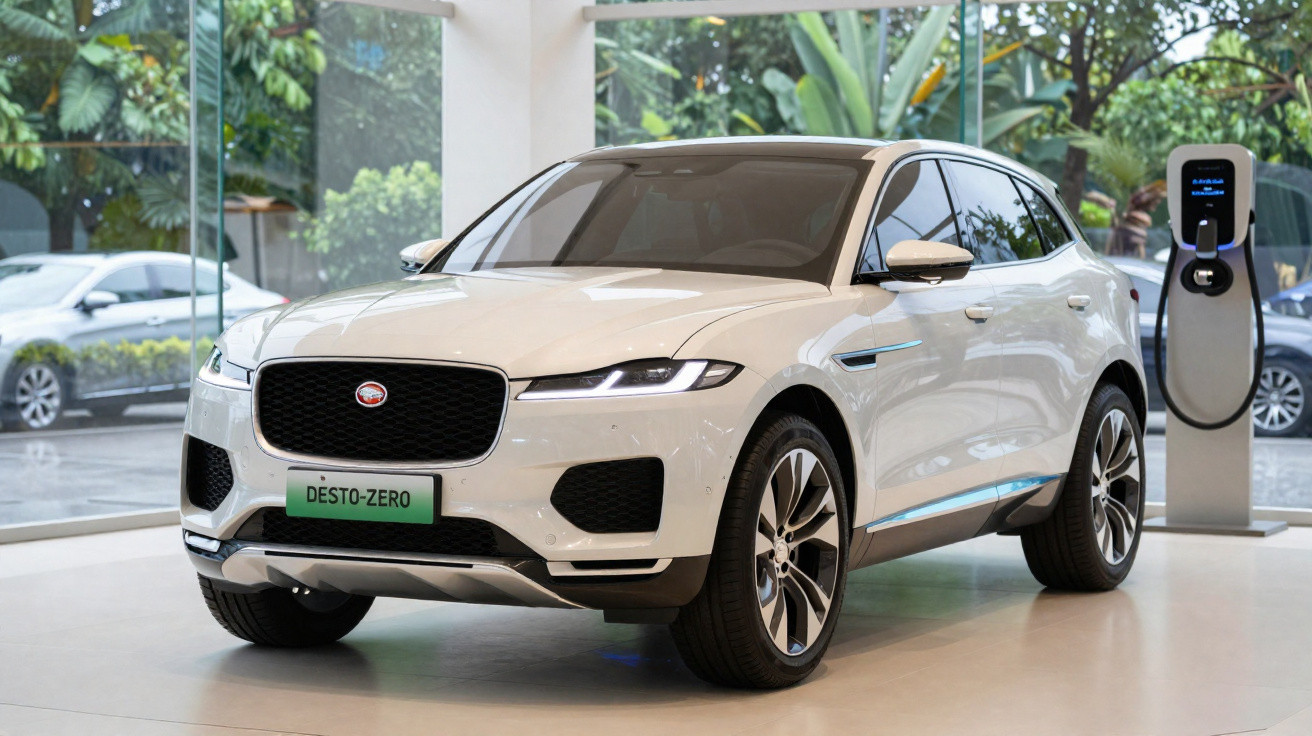
Electrification across the Jaguar Land Rover range
A commitment had been made by Jaguar Land Rover’s former Chief Executive, Ralph Speth - later replaced by Thierry Bolloré - that the entire line-up would be electrified by the end of 2020. That pledge has been delivered: as this year closes, every model in the group now offers an electrified option, whether as a plug-in hybrid or, at minimum, a mild-hybrid.
For a business that was previously so reliant on Diesel powertrains - especially Land Rover, where more than 90% of sales were diesel models - this shift is a pivotal one as it prepares for a demanding future, particularly around cutting CO₂ emissions.
Missing the targets that have been set leads to fines that can escalate to very substantial sums. Jaguar Land Rover is, in fact, among those that will not be able to meet the imposed goals, and it has already set aside close to 100 million euros to cover the penalty.
Plug-in hybrid disruption and the 2021 launch schedule
This comes even after an accelerated push to add plug-in hybrid variants across almost all ranges. Even so, discrepancies identified in the CO₂ emissions of its more affordable, potentially high-volume plug-in hybrids - the Land Rover Discovery Sport P300e and Range Rover Evoque P300e - forced the company to pause sales of both and carry out fresh re-certification. As a result, the number of units sold ended up far below initial expectations, undermining the year-end figures.
Despite this costly setback, Jaguar Land Rover is relaxed about 2021 - even though the calculations become more demanding - because, by the end of the first quarter, it expects to have on sale all the new models revealed during the final months of 2020.
Alongside the aforementioned Land Rover Discovery Sport P300e and Range Rover Evoque P300e, the British group has also unveiled the Range Rover Velar P400e, the Jaguar F-Pace P400e, the Jaguar E-Pace P300e and the Land Rover Defender P400e. These join the already familiar Range Rover and Range Rover Sport, also offered in P400e form.
In Portugal
Portugal’s State Budget for 2021 (OE 2021) sparked significant controversy over the tax advantages (autonomous taxation) granted to hybrids and plug-in hybrids, as well as the ISV (Vehicle Tax) “discounts” applied to them.
From January, to qualify for the incentives and the reduced ISV burden (up to -60%), all hybrids and plug-in hybrids must provide an electric-only range of more than 50 km and CO₂ emissions below 50 g/km. This may create added challenges for the commercial prospects of several models that do not meet those criteria.
In the case of Land Rover and Range Rover, only the larger (and more expensive) models appear to fall outside the new rules - specifically the Defender, plus the Range Rover and Range Rover Sport.
All the others comply with the various approved requirements, posting emissions under 50 g/km and electric ranges spanning from 52-57 km for the Jaguar F-Pace and Range Rover Velar, up to 62-77 km for the Land Rover Defender Sport, Range Rover Evoque and Jaguar E-Pace.
Destination Zero
Tackling CO₂ emissions is not limited to the increasing electrification of the vehicles themselves - the group says it has reduced CO₂ emissions from its vehicles by 50% over the last 10 years. Jaguar Land Rover is also progressing with Destination Zero, a holistic programme that aims not only to reach carbon neutrality, but also to drive accidents to zero and even eliminate… traffic jams - in these last two cases largely through the evolution of advanced driver-assistance systems that will ultimately lead to fully autonomous vehicles.
To achieve carbon neutrality, Jaguar Land Rover has been putting circular-economy principles into practice. This is clear in product development processes, where reuse and recycling are taking a more central role, alongside the introduction of new sustainable materials, while the company also seeks to eliminate waste generated in production.
Among several more targeted actions, Jaguar Land Rover has introduced an aluminium recycling programme, reflecting how extensively the material is used across many models. Aluminium is recovered not only from end-of-life vehicles, but also from other sources such as soft drinks cans; this approach cuts CO₂ emissions by 27%. Also within recycling, a partnership with BASF makes it possible to convert plastic waste into high-grade material to be used in future vehicles.
The energy required for its plants is also increasingly coming from renewable sources. At its Wolverhampton engine facility, for instance, 21 thousand solar panels have been installed. Jaguar Land Rover is also already manufacturing batteries for its growing number of electrified models at Hams Hall.


Comments
No comments yet. Be the first to comment!
Leave a Comment