
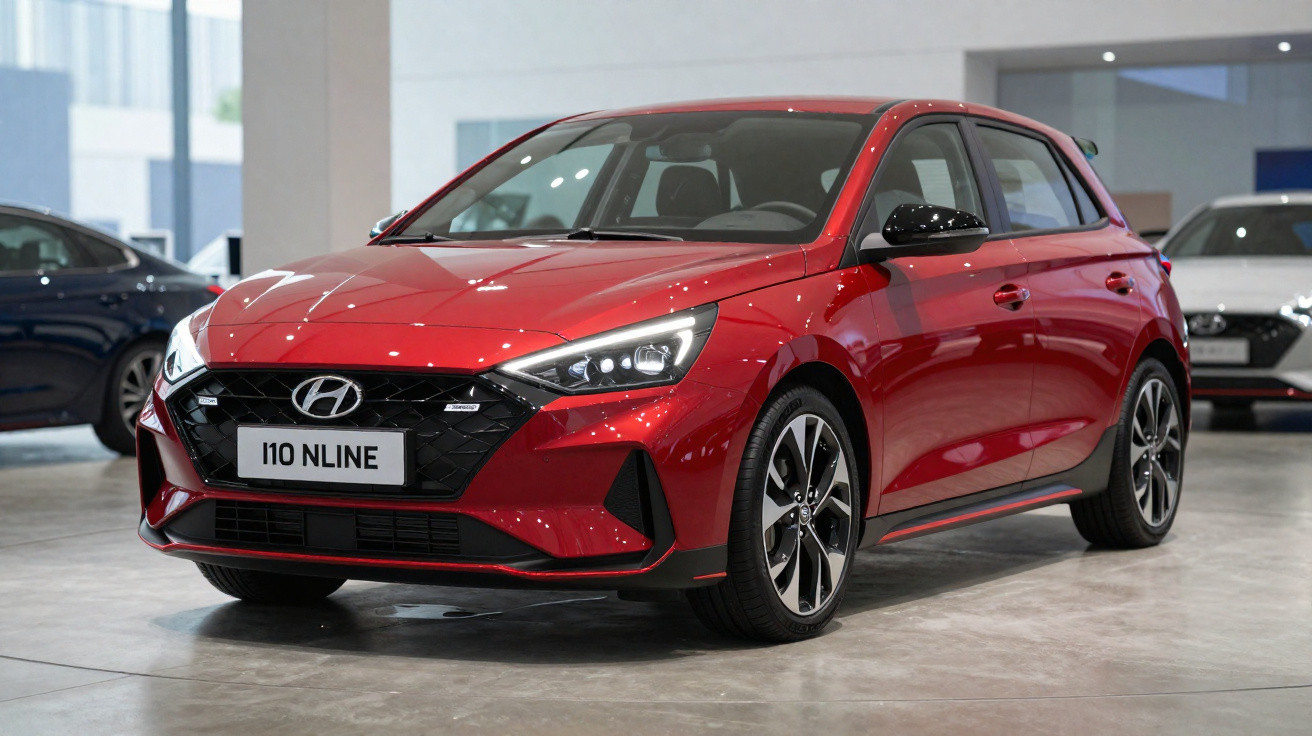
It’s an N Line, it’s not an N, it’s an N Line, it’s not an N… That was the mantra I kept repeating to myself to keep my expectations in check about the Hyundai i10 N Line and what this feisty little city car could realistically deliver.
And it’s easy to see why the confusion starts: just look at it. Next to the rest of the i10 range, the N Line gains a welcome shot of visual attitude-most notably the reshaped bumper with its distinctive LED daytime running lights-and a set of striking 16-inch alloy wheels. It could pass for a Volkswagen up! GTI challenger, but it isn’t.
Even though it sits at the top of the line-up for power and pace-100 hp and 0–100 km/h in 10.5s-and even with dedicated (firmer) suspension, it still falls just short of being a true pocket rocket. Especially when it comes to how it drives.
On tighter, twistier roads-where small cars typically shine-the i10 N Line wins you over at first with strong traction and the way the front axle reacts immediately to direction changes. The brakes also impress: plenty of bite, and a really well-judged pedal that inspires real confidence when you lean on it.
Push on with a “teeth-clenched” sort of pace, though, and the i10’s limits appear quickly. The front end can start to feel too sharp, largely because the steering is overly light (particularly around the first few degrees of input) and doesn’t communicate much feel. Add more body roll than you’d expect, plus less-than-perfect tarmac, and you can end up unsettling the little i10-almost as if you’re asking it to give more than it has.
What’s missing is that extra layer of dynamic polish you find in other pocket rockets. I also wanted a more engaged rear axle, not only to help tuck the nose into a corner, but to lift the level of interaction-and even the… fun.
Back off slightly and the controls and chassis start working together more naturally. Driven that way, the i10 N Line flows along the road better while still keeping up a brisk pace. So it isn’t a pocket rocket, but…
…it’s, surprisingly, a capable long-distance cruiser
That became clear almost by accident when I had to cover more than 300 km, nearly non-stop, during my time with the Hyundai i10 N Line. City cars are rarely convincing on longer runs, yet-as João Delfim Tomé had already noticed in his first drive of the new i10-this one feels like it belongs a class above.
The N Line follows the same logic, with the bonus of those eager 100 hp on tap-100 hp that work wonders. I’ll go further and make it official: “From now on, every city car must have at least 100 hp”.
It isn’t just the headline power figure either. The 172 Nm available at 1500 rpm gives the i10 N Line (just over 1000 kg with the driver on board) genuinely convincing shove-more convincing than the 10.5s sprint suggests. And that performance slots neatly into strengths already present in the wider i10 range, which are unusual in this segment: namely, the car’s composure once you leave town behind.
That combination of abilities lets you tackle longer motorway stints with confidence, or overtake that lorry on an A-road without too much second-guessing-all while maintaining perfectly acceptable levels of refinement and comfort.
On the motorway it felt more stable and more polished than I expected, even if the 1.0 T-GDI’s soundtrack isn’t exactly melodic-gruff, but more “raw spirit” than Brian Adams or Bonnie Tyler. On national roads, only sharper bumps really unsettled the little i10, and the seats didn’t punish my body even after several hours. They do, however, noticeably lack lateral support and under-thigh support.
Quick enough, yet not thirsty
Despite the (analogue) speedometer needle frequently climbing above 120 km/h on the motorway, plus a few more abrupt downshifts and full-throttle overtakes on A-roads, those 300+ km ended up at 5.5 l/100 km-not bad…
What the i10 N Line proves is that sensible fuel use doesn’t have to mean slow-going. While it was with me, the most powerful and quickest i10 returned figures from a little over 4 litres to under 7, depending on where and how it was driven. Yes, it drinks more than the 67 hp i10s-though not by as much as you might expect-and the extra flexibility and performance more than justify the gap.
Small on the outside…
…big on the inside. From the outside-narrow, short, but tall-you wouldn’t guess how much room Hyundai has carved out within the i10. Even in the back, two adults can travel comfortably, with generous headroom and legroom. And because there’s no transmission tunnel, squeezing in a third passenger isn’t an impossible task either.
That clever packaging continues in the boot: the quoted 252 l is among the best in the segment. It may not be the ideal vehicle for moving house, but it’s plenty for-why not?-taking advantage of the i10 N Line’s unexpectedly strong motorway manners and heading off for a mini-break.
Its main drawback is the step between the boot opening and the floor, plus another step created when you fold the rear seats. Other i10 versions get a movable boot floor that can level everything out, but the N Line doesn’t.
Is it the right car for me?
Even in this more aggressive N Line guise, the Hyundai i10 remains one of the benchmarks among city cars. Beyond its natural manoeuvrability and excellent use of interior space, the N Line brings a genuinely welcome performance boost thanks to the 1.0 T-GDI’s 100 hp-without heavily penalising consumption compared with the more modest 67 hp 1.0 MPi.
Those 100 hp play a big role in the i10 N Line’s unexpectedly strong showing once you step outside its natural habitat-namely, beyond city limits. Who would have thought a small city car could be a competent long-distance cruiser? In my view, this is the i10 to have.
It isn’t, unfortunately, the cheaper pocket rocket it initially seems to promise, but if you want a daily car with plenty of get-up-and-go, the i10 N Line is a very rewarding option.
The €17,100 asking price can feel a touch steep at first glance, and the three Euro NCAP stars may give some pause (the absence of certain more sophisticated driver assistance systems hurt the final rating). Still, when the choice is between an i10 N Line and a class-above model-since similar money can get you the entry versions of several superminis-and if outright space isn’t a hard requirement, this versatile, brisk city car becomes very tempting.
Comments
No comments yet. Be the first to comment!
Leave a Comment