
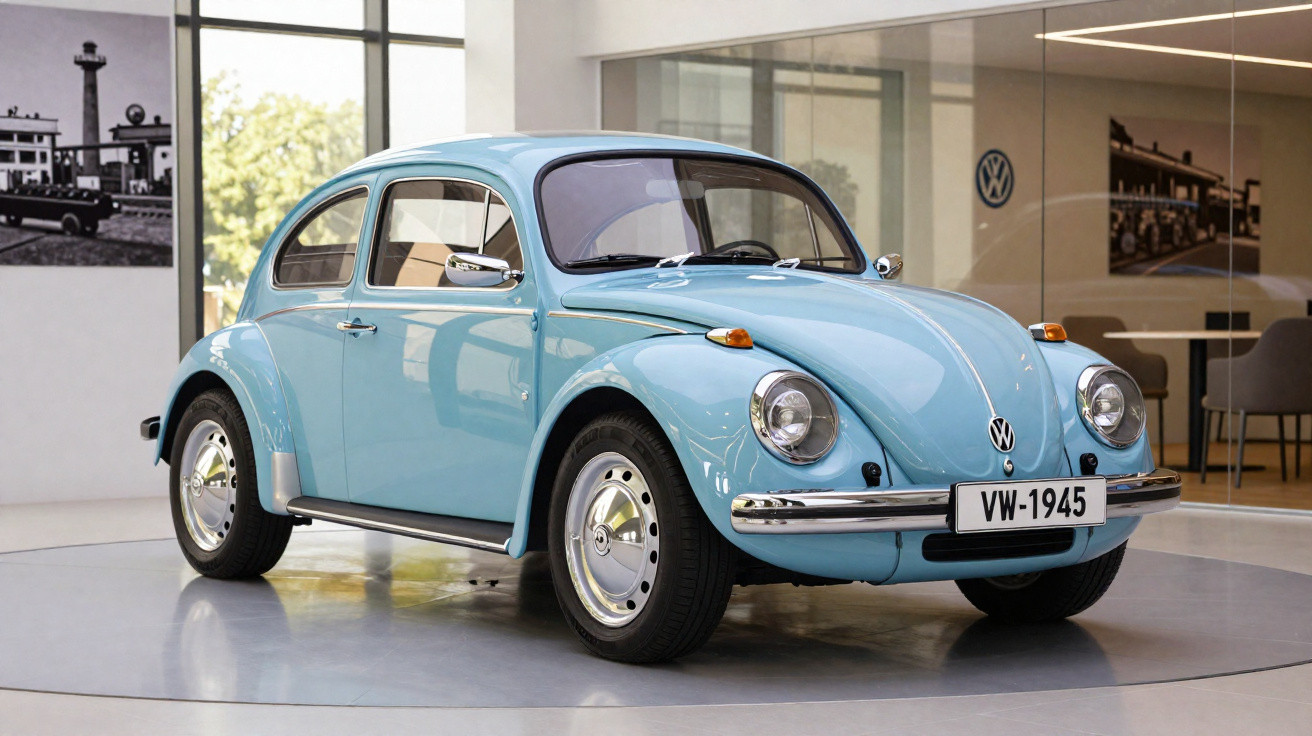
In 1945, the very year the Second World War came to an end, series production began of one of the most significant cars ever made: the Type 1, better known in the United Kingdom as the Beetle.
Wartime roots of the Type 1
From a technical standpoint, you could argue that Beetle production had started years earlier, in 1938, as the end point of a project launched by the National Socialist regime. However, manufacture of the “KdF-Wagen” was halted after 630 units had been built, because Wolfsburg was converted to armaments production in 1939, the year the Second World War began.
British control in 1945 and the restart of series production
Only when the war ended in 1945 did the Type 1 return to series manufacture, with the Wolfsburg plant coming under the control of British military forces from June 1945.
Rather than tearing the factory down - badly damaged after repeated wartime attacks - British pragmatism ultimately ensured its survival, above all due to the foresight and determined action of Major Ivan Hirst. His vision and ability to improvise made it possible to convert the site back to producing civilian cars, as originally intended. It was also the quickest way to meet the pressing transport needs in the area under British occupation.
And just how pressing were those needs? In August 1945, well before a single car had left the production lines, the British Military Government had already placed an order with Major Ivan Hirst’s Wolfsburg operation for 20 thousand vehicles.
There was no time to waste, even though this was a period marked by frequent shortages of raw materials (a situation that would drag on for several years) and strict rationing. The challenges did not stop at materials, either: there were also workforce issues - where to house workers and how to feed them.
Despite these harsh conditions, Major Ivan Hirst managed to bring the factory back to life and just days after Christmas 1945, on 27 December, the first Type 1 rolled off the production line. By the end of that year, 55 units had been built. The following year, shortages persisted - of raw materials, electrical power, and even staff - which held output to roughly 1000 vehicles per month.
The beginning of Volkswagen
Even so, ambition did not fade. Those responsible began laying the groundwork for future expansion, starting the transformation of what was then Volkswagenwerk GmbH into the Volkswagen we know today, by establishing sales and after-sales service. Beetle exports to other markets even began earlier, in 1947.
In reality, this early development of a civilian plant capable of mass-producing the Volkswagen Type 1 put Volkswagenwerk GmbH in a strong position when the German economy began to surge after the introduction of a new currency in 1949: the Deutsche Mark. The Wolfsburg factory also became a symbol of British political strategy for German territory, which viewed economic security and the population’s future prospects as key ingredients in building democratic structures.
The Volkswagen Type 1, the Beetle, would go on to become one of the most popular cars in history worldwide. Production of the original Beetle only ended in 2003, in Mexico - while in Wolfsburg, where it was first built, it finished on 1 July 1974 - reaching a total of 21 529 464 units, 15.8 million of them in Germany (spread across several German plants).
Comments
No comments yet. Be the first to comment!
Leave a Comment