
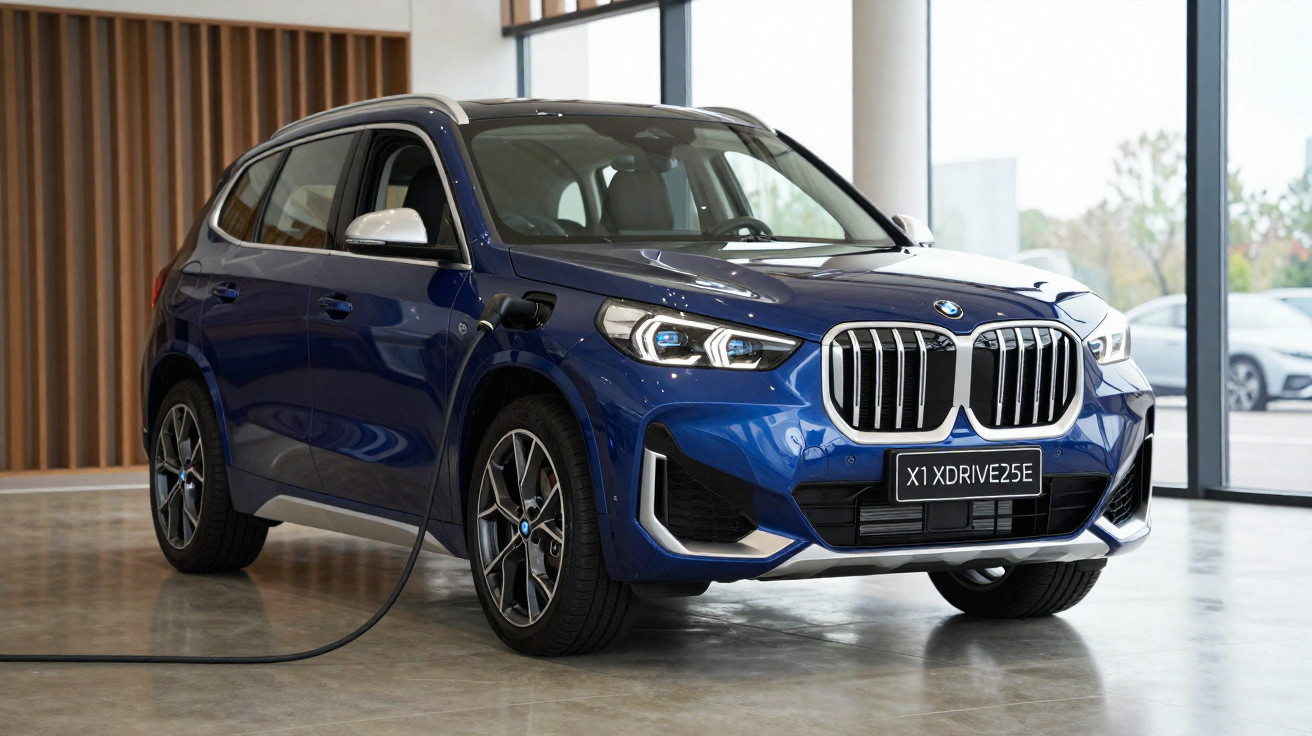
Arriving as part of the restyling rolled out across the entire range, the BMW X1 xDrive25e is, at once, the most powerful X1, the greenest, and one of the most economical.
After all, despite using two motors to deliver a combined maximum of 220 hp and 385 Nm, its quoted consumption sits at 1.7 l/100 km and emissions at 39 g/km.
It may be the cheapest to run on paper, but this plug-in hybrid starts at a hefty €49,350. Yes, a petrol X1 kicks off at €40,850 and there’s a Diesel from €39,270. But it’s also true that the first offers 136 hp and the second just 116 hp.
With that in mind, the nearest alternative within the German SUV’s line-up is the xDrive18d which, despite having only 150 hp, begins at €50,670. So the obvious question is this: even with the higher price, is the BMW X1 xDrive25e the one that delivers the best overall value? To find out, we put it to the test.
Discreet by nature
Just as with its “bigger brother”, the X3 xDrive30e, the X1 xDrive25e does a convincing job of hiding the fact it runs on a blend of electrons and octane.
In fact, when I collected it from the BMW car park, I had to look closely to tell it apart from other X1s-spotting details such as the subtle charging flap or the handful of badges that give the game away. Beyond that, the X1 xDrive25e is… an X1. Far removed from the more quirky look of the first generation, this second iteration of BMW’s smallest SUV adopts a more conventional, restrained and mature design.
And while it’s true I’ve always been a fan of the original’s rear-wheel-drive proportions-long bonnet and a cabin set further back-I have to admit this newer shape is more likely to appeal to “all tastes”.
Quality you can rely on
If picking out the X1 xDrive25e from the outside isn’t straightforward, the same applies inside. The differences are just as subtle and amount to little more than dedicated menus within the infotainment system and an extra button that lets you choose to drive in 100% electric mode.
Also very much in keeping with BMW is the standard of materials and build, something that becomes even clearer when you’re moving under electric power alone and the quiet isn’t broken by the ever-annoying creaks of cheap plastics.
As for space, this generation’s switch to front-wheel drive continues to pay dividends, and both front and rear occupants travel in comfort. The big difference versus other X1s is the boot: capacity drops from 505 litres to 450 litres, “courtesy” of the need to package the 10 kWh battery beneath the floor.
Has electrification delivered economy?
Given that the X1 xDrive25e claims the “title” of the most economical version in the range, it makes sense to start the driving assessment of the German SUV right here.
To begin with, the official 49 to 52 km electric range doesn’t seem far from reality. Over the test I managed around 41 km in 100% electric mode, without making any special effort to drive economically, and on mixed routes.
Once the battery is depleted and the combustion engine takes over, the X1 behaves like a conventional hybrid, with fuel use reflecting-quite faithfully-how you treat the accelerator pedal.
So, when I kept a light right foot, I recorded averages of 4.5 l/100 km on mixed driving. When I decided to explore the German SUV’s more dynamic side, that rose to between 7 and 7.5 l/100 km. Those are figures you’d more typically associate with Diesel models than with petrol cars weighing over 1,800 kg.
A final note for the smooth, almost imperceptible operation of the plug-in hybrid system, which switches between the combustion engine and the electric motors (almost) without you noticing.
Is it fun to drive?
From a dynamic standpoint, the X1 xDrive25e doesn’t try to be anything other than a BMW. Despite its 1,820 kg, the suspension keeps the body movements well in check (helped by ground clearance that’s slightly low for an SUV) and strikes a strong balance between comfort and handling.
Still on dynamics, the accurate and direct steering inspires confidence when “attacking corners”, and having four-wheel drive ensures traction whatever the circumstances. Even so, the overall character leans more towards effectiveness than outright entertainment.
Finally, on performance, it goes without saying that with 220 hp and 385 Nm the X1 more than holds its own, delivering brisk acceleration and strong in-gear response. In fact, even after the battery runs out, there’s still enough in reserve to get on with things in a pleasingly effortless way.
Is this the right car for me?
To the already well-known strengths of the BMW X1-such as build quality and its sound dynamic behaviour-the X1 xDrive25e adds another: the savings made possible by its plug-in hybrid system.
Is that enough to justify choosing it? Well, despite being one of the priciest powertrains, it remains true that along with delivering meaningful savings, the X1 xDrive25e is also the most powerful X1.
Against it is a boot that has sacrificed capacity to accommodate the batteries. However, since this isn’t exactly a “cardinal sin”, the X1 xDrive25e shapes up as a genuinely strong option to consider within the range of this understated German SUV.

Comments
No comments yet. Be the first to comment!
Leave a Comment