
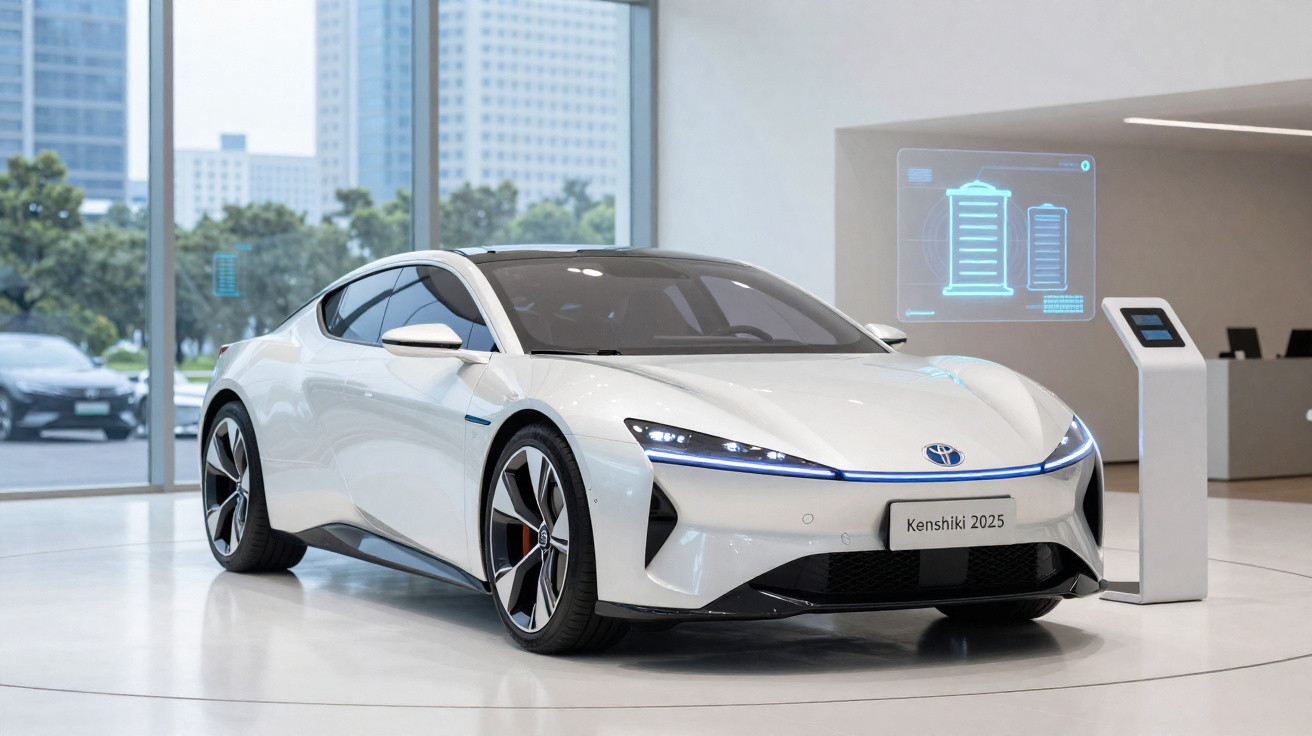
Once again, Toyota chose the Kenshiki Forum as the stage for unveiling the Japanese giant’s headline plans for the coming years. This year’s edition was defined by two major announcements: Toyota’s first 100% electric SUV and the start of sales for the second-generation Toyota Mirai, the hydrogen car - which will also be sold in Portugal.
Alongside the reveals of new models, Toyota also used the event to set out part of its longer-term direction, from sales expectations to the future of solid-state batteries - one of the most anticipated technologies of recent years.
60 more electrified models by 2025
Today, Toyota allocates 40% of its innovation and research budget to electrification. That includes new platforms, improvements to industrial processes, as well as batteries and electric motors.
That investment is expected to translate into the launch of 60 new electrified Toyota and Lexus models by 2025. The commitment comes from Koji Toyoshima, head of the ZEV Factory - the Toyota division leading development of “zero emissions” technologies.
According to Koji Toyoshima’s projections, in 2025, 90% of the models sold by Toyota in Europe will be electric or electrified (HEV and PHEV). Only 10% will be powered solely by an internal combustion engine.
Electrification for everyone
Akio Toyoda, Toyota’s CEO, has repeatedly argued that electrifying cars, on its own, is not enough. The technology must be made accessible to everyone - not only through new models, but also through new mobility services. Kinto, the division introduced in 2019, is presented as the clearest example of that stance.
For that reason, Toyota announced a strengthening of its partnerships this year. Beyond Subaru - with whom it will share the E-TNGA platform - Toyota confirmed at the Kenshiki Forum 2020 that it will continue to deepen collaboration with China’s CATL and BYD in the field of batteries.
Koji Toyoshima also stated that Toyota will keep working with Panasonic. At present, the Toyota–Panasonic partnership is focused on increasing industrial efficiency in battery production by up to 10x.
These partnerships will enable Toyota to achieve significant economies of scale, improve production efficiency and, ultimately, offer more competitive prices.
Solid-state batteries
Some specialists view solid-state batteries as one of the most significant advances in this technology since lithium-ion cells were introduced.
According to Koji Toyoshima, the wait should not be much longer. Toyota and Lexus plan to launch their first model featuring solid-state batteries from 2025.
Compared with conventional batteries, solid-state batteries bring several benefits: faster charging, higher energy density (more energy stored in smaller batteries) and improved durability.
Toyota says it is currently in the final stage of developing this technology, with only the last step remaining: production. The first model to use it is expected to be inspired by the Lexus LF-30, a prototype we have already seen “in the flesh”.
Zero emissions is not enough
However, Koji Toyoshima’s most important message at the Kenshiki Forum 2020 may have been that Toyota does not want only “zero emissions” vehicles. It wants to go further.
Toyota’s commitment to hydrogen (Fuel Cell) would allow cars equipped with this technology not only to produce no CO₂ emissions, but also to be capable of capturing CO₂ from the atmosphere. More than ever, Toyota is shaping its future not as a car brand, but as a mobility brand.
Comments
No comments yet. Be the first to comment!
Leave a Comment