
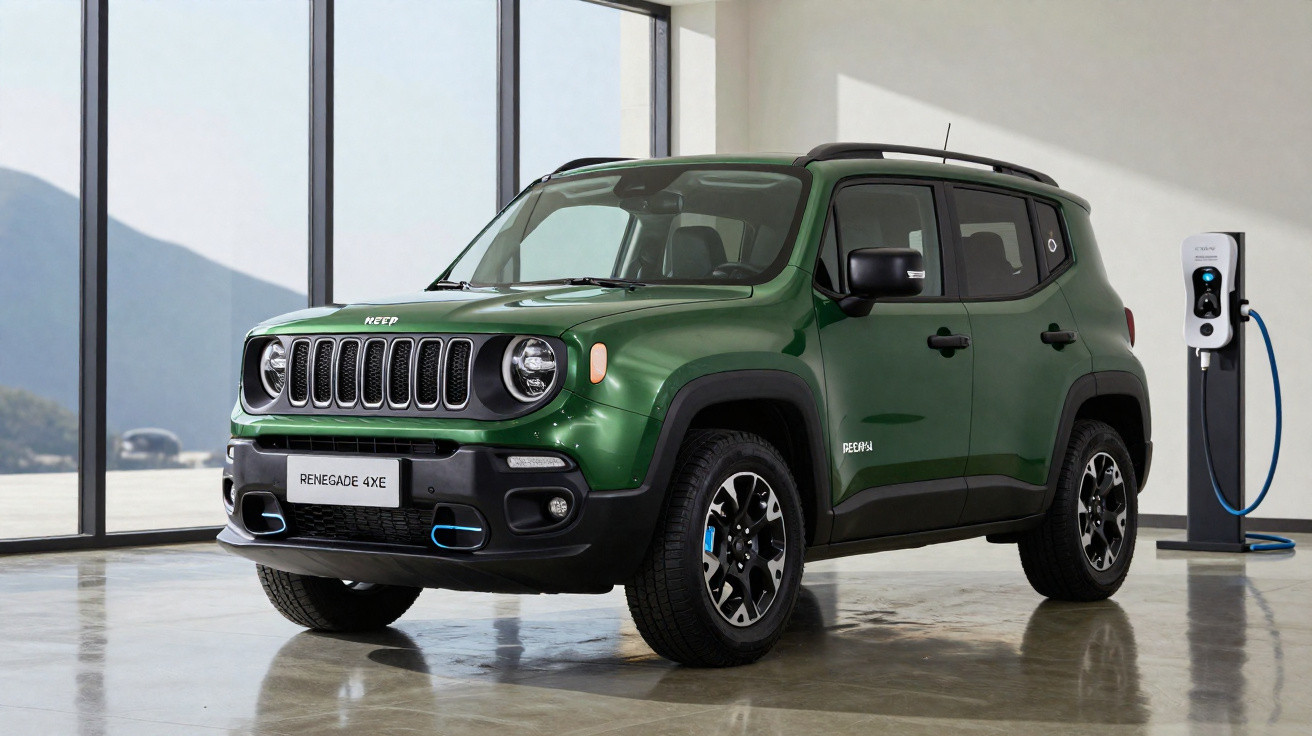
Back behind the wheel of a Jeep Renegade - this time in its electrified 4xe Trailhawk guise. Even though it still looks, inside and out, like much the same Renegade as any other, it quietly "hides" a sizeable slice of Jeep’s near future, as the brand pushes decisively towards electrification - and not even the iconic Wrangler is spared…
This new 4xe Trailhawk version of the American model with Italian roots aims to strengthen the case for what remains the segment’s finest Swiss Army knife: equally at home in town or picking its way along "goat tracks".
It is still, without question, the best climber in its class, but courtesy of its new plug-in hybrid powertrain it also gains new strengths - even if it goes about the job differently from other cars with the same kind of drivetrain.
That’s because Jeep chose to "split the difference": the combustion engine (a 1.3 Turbo with 180 cv, paired with a six-speed automatic gearbox) drives the front axle, while the electric motor (44 kW or 60 cv) powers the rear axle. There’s no mechanical link at all (no propshaft) between the two driven axles, unlike the old Renegade Trailhawk fitted with the Diesel engine.
The connection between the front and rear wheels is now virtual, with software responsible for coordinating the two power sources.
Off-road with "it"
What I can say is that the conversation between the two axles is spot-on, with no hesitation. The moment you leave the tarmac and start probing the smallest Jeep’s climbing talent, it’s clear it remains as capable as it was back when there was a mechanical connection between the engine/gearbox assembly and all four wheels.
I drove the same tracks and tackled the same obstacles in the 4xe that I had previously covered in the older 2.0 Multijet, and it cleared them with the same ease.
At the limit, though, it gives up a little to the previous Trailhawk 2.0 Multijet, because the 4xe’s off-road angles sit slightly below those of the 2.0 Multijet. I got audible confirmation of that at the crest of a steep ramp, where it became very clear the 4xe’s breakover angle is lower than the 2.0 Multijet’s - 18º versus 25º.
I also wanted to find out what happens when the battery runs out during this kind of driving, given the rear wheels are powered exclusively by the electric motor. In other words, without energy we would theoretically lose four-wheel drive and be left relying only on the front axle to carry on.
In practice, I never ran short of traction, because Jeep has covered that detail too. The Renegade 4xe Trailhawk has a second electric motor mounted at the front, mechanically connected to the combustion engine, acting as a generator. This means that, even with an empty battery, the rear electric motor always has some "juice" available, so traction is never missing when it matters most.
If the Renegade convinced across the board off-road, on the road the feelings are more mixed.
High performance, but…
On one hand, the 4xe Trailhawk is a small performance "monster" - the most powerful and quickest Renegade you can buy. Blending hydrocarbons with electrons delivers 240 cv of maximum combined power (70 cv more than the previous Diesel), and the rear electric motor serves up 250 Nm instantly.
Figures like that make the more than 1800 kg kerb weight (!) feel noticeably lighter, judging by how eagerly it lunges towards the horizon and how easily it holds high cruising speeds, even on climbs. It consistently feels quicker than the spec sheet suggests.
It certainly doesn’t lack "lungs", but given the Trailhawk’s brief as the off-road flagship, it’s less satisfying on tarmac. The steering remains too light (even in Sport mode) and there isn’t quite enough dynamic precision; the emphasis is on comfort - it is, genuinely, a very comfortable offering - rather than sharp handling.
That said, with driven axles at both ends, traction (or the lack of it) isn’t the issue, even if the mixed-use tyres complain readily - and loudly - when you start pushing on. Even so, you can sustain brisk pace, including on twisty roads. Credit, too, to the brakes: strong and bitey, with better pedal feel than in many other hybrids and electric cars.
The most economical Renegade I’ve tested to date
Perhaps the 1.6 Multijet with 130 cv still has something to say on fuel consumption - I haven’t yet had the chance to test it - but considering the 4xe Trailhawk, with 240 cv, is the quickest and most powerful Renegade, the 6,6 l/100 km overall average I recorded was a surprise.
Neither the old Trailhawk 2.0 Multijet nor the small-but-thirsty 1.0 Turbo with 120 cv managed a final average this low in my hands.
Of course, reaching that figure is only possible thanks to the electric side of the drivetrain. In electric mode, the 11,4 kWh battery lets you cover 40 km with relaxed driving and fairly easily, which isn’t far off the claimed 46 km.
And even though the rear electric motor has only 44 kW (60 cv), the immediate 250 Nm moves the more-than-1800 kg mass with surprising confidence, even allowing motorway speeds to be maintained with relative ease.
The only criticism? Somewhat ironically, total range. To "fit" all the electric hardware into its SUV, Jeep swapped the 48 l fuel tank used in petrol-only Renegades for a smaller 36,5 l unit. If you don’t charge the battery often, that can mean more frequent visits to the petrol station.
Is it the best ~~car~~ SUV for you?
Otherwise, it remains the Renegade we already know so well. Among compact SUVs, the Renegade continues to feel like the most SUV of the lot, helped by the driving experience: the blend of boxy shapes and a high seating position always gives the impression you’re at the wheel of something more substantial than it really is.
The sense of space is generous, even if there are rivals in the class that are genuinely roomier. And in this 4xe version, the boot - already a little below the class average - is smaller still, now at 330 l (versus 351 l in the other Renegades).
Even so, despite the (almost) unique appeal of this 4xe Trailhawk, it’s hard to justify at first glance unless you’re a committed off-road enthusiast… or a plug-in hybrid devotee. With pricing starting near 45 thousand euros, it’s expensive, on a par with plug-in hybrid SUVs from the class above - even taking the 240 cv output into account.
There is also a 4xe Limited version with 190 cv, which lowers the entry price to 41 thousand euros and doesn’t give up much in performance - even with 50 cv less - and it suits a more road-focused use case better.
All that said, it’s very easy to fall for the Jeep Renegade 4xe Trailhawk’s charms, imperfections and all. Even so, I have to admit the older 2.0 Multijet with 170 cv - slower, thirstier, and with a soundtrack reminiscent of an old Ford Transit - left a deeper mark. That’s entirely down to the driving experience: more direct, clearer communication channels between driver and machine, and more assured behaviour on tarmac.


Comments
No comments yet. Be the first to comment!
Leave a Comment