
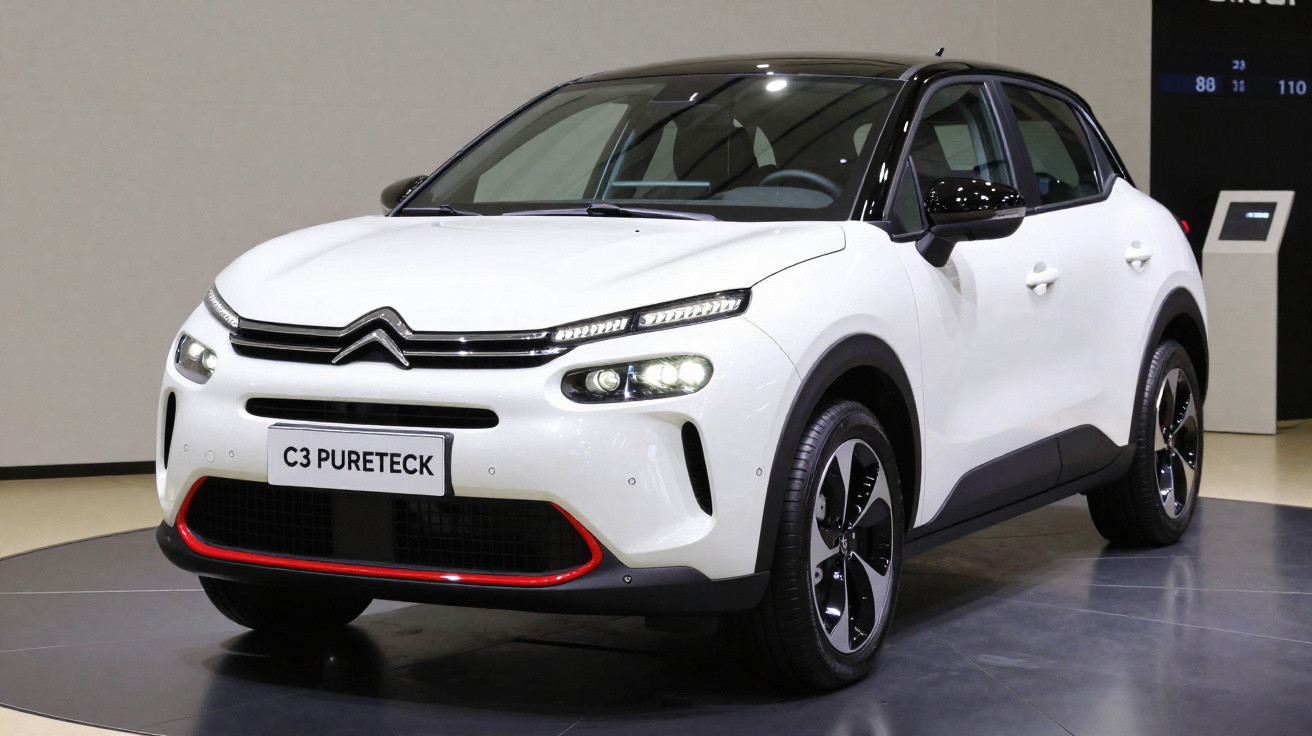
Guilherme has already covered almost everything that’s new on the refreshed Citroën C3 in the video he recorded in Madrid, Spain, during the model’s international launch.
Where I end up disagreeing with him is when the conversation turns to the styling changes Citroën has made to the C3. Compared with the C3 we knew, the differences are largely concentrated at the redesigned front end, and although it takes inspiration from the interesting CXperience, I’m sorry, but it doesn’t win me over.
The supermini now looks more heavily styled and angrier-very much a “everyone owes me and nobody pays me” vibe-instead of the more youthful, friendly face we were used to. In the end, it clashes with the rest of the design and even with the C3’s otherwise calm character.
The 1.2 PureTech 83 bhp: is it the right pick?
The most relevant point he makes concerns the engine in the C3 tested here: the 1.2 PureTech with 83 bhp (naturally aspirated, no turbo). Guilherme says the version he drove at the launch-the 1.2 PureTech with 110 bhp (with turbo)-is ultimately the better buy, even though it costs €1200 more than this 83 bhp car. I couldn’t agree more.
Why? It’s not only the extra performance-almost 4s quicker from 0–100 km/h and far more generous in everyday urge-but also because that performance uplift doesn’t translate into worse fuel consumption/emissions, whether on paper or in the real world. Officially, they’re separated by just 0.1 l/100 km and 1 g/km. In practice, while low consumption is possible-I managed to record under five litres at steady, moderate speeds-you can achieve the same kind of numbers easily in the 110 bhp version too.
What’s more, the 110 bhp version is the one that best matches the refreshed Citroën C3’s other attributes (which I ended up enjoying so much)-but we’ll get to that…
By contrast, this engine’s 83 bhp and 118 Nm feel short on reserves. To crest certain climbs or even to hold the legal maximum speed on the motorway (and not all of them are particularly flat), you’re forced either to press the accelerator harder or to “drop a gear” and work the three-cylinder more assertively. I have to admit, that can even be enjoyable, because there’s nothing inherently wrong with the engine itself-it remains interesting to explore and even to listen to.
The issue is the combination of 1055 kg-one of the lightest in the segment, yet it already seems a touch too much for the 1.2’s modest figures-and, above all, the somewhat long gearing in the transmission, which ends up diluting (even further) what these 83 bhp can deliver in acceleration and in-gear response.
On top of that, the five-speed manual gearbox isn’t as satisfying as it should be, mainly due to its very, very long throw. I “discovered” that after two notchy third-gear selections… when it felt like third had engaged, it hadn’t-there was still more forward movement needed on the lever.
A supermini that behaves like a long-distance cruiser
With this engine fitted, using the Citroën C3 ends up feeling largely confined to urban driving. Even if you can “work around” the long gearing by using more throttle or driving in a lower gear than you normally would, you can’t escape the manual gearbox action-which ultimately becomes my biggest criticism of the model.
And it’s a shame to be boxed into stop-start city traffic, because the Citroën C3 revealed, somewhat unexpectedly, very strong motorway-and-A-road manners-yet another reason to choose the 1.2 PureTech 110 bhp, which gives it the lungs it needs to take on that role comfortably. Yes, it’s still a supermini, but the C3 has a set of inherent traits that make it a highly capable long-distance car.
First, Citroën has been pushing hard on comfort, and in the C3 that focus is clear. You sit correctly positioned in large, substantial seats (trimmed in a pleasant fabric with some leather) that are genuinely comfortable-only it’s a pity they don’t offer more support-yet they can make longer stints behind the wheel feel relaxed, with no aches or complaints from your body.
The damping is also tuned towards comfort, meaning it’s softer rather than firm. The suspension absorbs most imperfections effectively, while still keeping body movement under good control-it leans a little if you push harder in corners, but nothing excessive. Speaking of corners, it proved more competent and secure than nimble and entertaining. And the steering, while accurate, gives little to no feedback about what’s happening at the front axle (even though it responds promptly to your inputs).
Second, even though you’re surrounded by hard plastics (and not the nicest to the touch), the overall build feels fairly solid-even when faced with the worst cobbles in the capital…-resisting vibrations and unwanted noises.
Finally, the package is rounded off by very good sound insulation. The engine always seems distant, wind noise is well contained, and the only weak point is somewhat excessive road noise-though that is almost certainly down to the optional larger wheels (17″) fitted to our car. They look good in photos, I won’t argue. While we’re at it: 205-section tyres for just 83 bhp and 118 Nm? That’s a bit over the top.
Is this the right car for me?
After all that, as you’d expect, the Citroën C3 is easy to recommend-but it’s hard to recommend it with this engine. For anyone interested in the French supermini, the version to go for has to be the 1.2 PureTech 110 bhp. It gives the C3 the flexibility and everyday versatility it needs, in much better harmony with all its other strengths.
Otherwise, it’s the Citroën C3 we already knew. Rear space is reasonable for two occupants-legroom is less generous than in its main rivals-but, interestingly, it’s easier to access the back seats than in the new Peugeot 208 or Opel Corsa (members of the same PSA family), thanks to wider-opening doors and a larger aperture. That’s curious because the Citroën C3 still uses the older PF1 platform rather than the newer CMP used by its “cousins”-shouldn’t the newer one be better in this respect?
Beyond the engine topic, I also have to agree with Guilherme again on his recommendation of the Shine trim level, the most balanced among those available and the one fitted to the C3 I tested. It already comes with a generous list of safety equipment, while adding comfort and styling items that are worth having.
The tested car also had options (approx. €2500) that pushed the price of the Citroën C3 1.2 PureTech 83 Shine up to €20,000-somewhat high, but not out of step with its rivals. Car prices are generally high and only seem to be trending upwards. That said, there are promotions running that can bring the price down to more competitive levels.
Comments
No comments yet. Be the first to comment!
Leave a Comment