
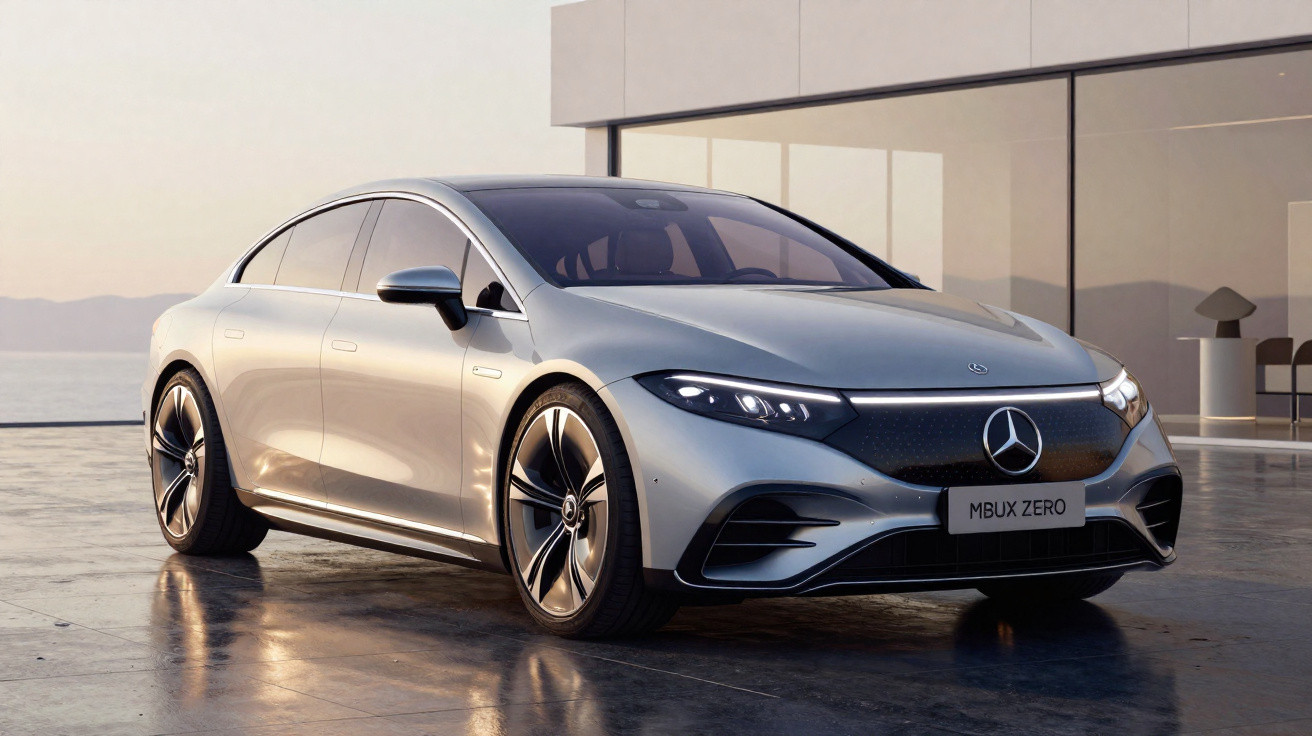
Mercedes-Benz has unveiled the MBUX Hyperscreen: the first fully glass digital dashboard. It is the sort of breakthrough many assumed would arrive sooner or later from a Silicon Valley company rather than from Stuttgart.
That reveal comes from a carmaker that has long been seen as one of the most conservative in the industry, yet has dramatically reshaped its image over the last decade-both through the design of its models and through the way the business itself is structured.
Sajjad Khan, Daimler’s Chief Technology Officer (CTO), explains what sits behind the new MBUX Hyperscreen, which will make its debut as an option on the Mercedes-Benz EQS.
As well as being, beyond any doubt, the largest display ever fitted to a car, Mercedes-Benz also says it is the smartest. What is that claim based on?
Sajjad Khan – The Hyperscreen presents only the information you need, at the moment you need it. Instead of forcing people to dig through submenus, the user doesn’t have to hunt for data; the data comes to them. In our view, this is a milestone for the industry because of how we’ve blended the analogue and digital worlds, with a very high standard of execution.
So it was never an ego contest-“mine is bigger than yours”?
SK: Absolutely not. Building the world’s biggest screen was never the goal in itself. What drove us was the ambition to deliver something valuable-innovative and intelligent-for our customers, with an uncompromising focus on the user and digital thinking.
“Zero layer”
What is the Hyperscreen made of, and how is information arranged?
SK: Under a slightly curved surface we have three separate displays that, to the user, appear as a single interface. The central screen looks especially vivid thanks to the latest OLED technology and, because we prioritise simplicity, we created a new interaction level we call the “zero layer”.
All necessary, personalised content is placed directly in the driver’s line of sight, without requiring them to rummage through submenus-something that can distract from their primary job in the car. We also apply different colours depending on the driving mode, and in the instrument area we introduced a new flying-saucer-shaped icon that helps indicate energy recuperation status, acceleration and g-forces.
Can you be more specific?
SK: Of course-especially because it really does need explaining, otherwise you wouldn’t appreciate that this is a reinvention of how humans interact with the car. We began developing the “zero layer” concept three years ago. It contains three very different modules, and everything is shown without the need to navigate submenus. And because it is powered by Artificial Intelligence (AI), the system quickly learns the user’s preferences and habits, then delivers what they need.
It looks striking on the outside and is extremely intelligent underneath, connecting with the outside world and with every occupant of the vehicle. Every function and feature-battery charging, entertainment, phone, navigation, social media, climate functions, connectivity, massage, and so on-is visible and available at all times, fully connected and personalised, combining very high computing power with AI.
In your tests with “human guinea pigs”, was the “zero layer” principle judged easy to use?
SK: Yes-because it places all apps and functions in a proactive, fluid user interface, right at the user’s fingertips. The crucial navigation map stays permanently visible in the centre, and underneath we position the communication and entertainment controls.
Since we launched the first generation of our new operating system (MBUX) in 2018, we’ve analysed customer feedback and found that four out of five actions (with the car moving) relate to navigation, media and phone calls, so we made access to those the priority. Through AI, the system learns which in-car actions are most common for a particular user and surfaces them on the display, while pushing less-used items into the background.
Can you give an example of the kind of learning the Hyperscreen can do?
SK: Certainly. The EQS chassis can raise to create extra ground clearance, which is useful for steep garage entrances or driving over speed bumps. The system remembers the GPS position where the driver used the vehicle-lift function, and the next time the car approaches that GPS location, MBUX suggests-by its own “decision”-raising the EQS. The driver can then accept or reject the recommendation.
We’re used to interface systems focusing almost entirely on the driver, but as the autonomous vehicle (AV) becomes more realistic, it’s natural that passengers will be “considered” more too. Do you agree?
SK: Completely-and that’s why we offer something for every passenger, especially for the front passenger who has their own screen within the Hyperscreen. That screen doesn’t interfere with driving-related functions, but the person in the front can help the driver by finding a destination in navigation, adjusting the volume or choosing music, and they can also view general vehicle information.
That passenger can share information with anyone else in the car and, in some countries (depending on local legislation), can even watch videos while travelling because we have a technology (based on an intelligent camera) that prevents the driver from seeing those images, so they are not distracted from the road and traffic.
But there’s no need to feel sorry for the driver: they get the same sensational MBUX interaction we recently introduced in the new S-Class, including a huge Augmented Reality (AR) projection.
Interaction
Some manufacturers seem to be working towards a solution pioneered by Panasonic, where large buttons float on the screen and allow quick, instinctive adjustments. Mercedes-Benz chose an approach where every function is controlled via the screen surface itself. Why?
SK: There are many technologies and different conceptual approaches to let users interact with their car in this new digital era-touch, gesture, voice control, vision and so on. Our solution, Hyperscreen, enables full control by combining different technologies and AI so effectively that the user doesn’t even notice when they are using the senses nature gave us (speech, hearing, sight, touch), all of which are fully integrated.
In 2012 your company showed the CUBE gesture-operation concept at CES in Las Vegas, where users lifted their arms to activate virtually displayed controls. What led to this technically and conceptually different direction?
SK: Using the windscreen as a projection surface has always been on our minds, but right now the head-up display in the new S-Class is as large as it can be. The main drawback is that only the driver can see it, and from an ergonomics standpoint it may not be a good idea for the driver to wave arms and hands up and down, and side to side, while driving.
Perhaps it becomes viable in the medium to long term, but at the moment the technology doesn’t allow it. In any case, we were able to bring many of those ideas and content elements into our large central screen.
How do you ensure the driver isn’t excessively distracted by such a huge touch surface?
SK: Preventing driver distraction has been an obsession for us from day one. That’s why information can appear or hide itself in the background automatically, based on what the system learns from the user’s behaviour over time; and voice and gesture controls add to that, creating an experience that is easy, intuitive and effortless.
One example: advanced pixel technology increases the brightness of the information that has just been requested and then, with help from the camera, can darken the front-passenger screen for the driver so that when the driver looks towards it they can’t see the image (while the front passenger can). To give you a sense of the work we’ve done to reduce distractions, more than 90% of information is accessible on the first level of the Hyperscreen and/or via voice command.
How do you stand out from the (future) competition?
A Samsung tablet and an iPad look far more alike than the dashboard of a Mercedes-Benz and a BMW. Put differently: how do you inject brand DNA into a dashboard that is “just” a huge glass surface, which will probably resemble the glass surfaces competitors will present in the future?
SK: It’s true that once the dashboard becomes entirely a screen, you lose some of the differentiation we’ve traditionally achieved through hardware-shapes, details and so on. In this case we kept the jet-turbine-style air vents at the outer edges of the dashboard, but because the display dominates so strongly we have to express that DNA more through how the system is used, and less through the form itself-while also using specific features, colours and functions.
Just a few months ago you introduced the new MBUX in the new S-Class. Now this even more revolutionary Hyperscreen arrives. Aren’t you concerned it will irritate early S-Class buyers, who may feel they only have the second-best system on the market…
SK: Hyperscreen is closely tied to the EQ brand: more progressive and fully electric. The S-Class dashboard is outstanding, but it suits a slightly more traditional user, with its balanced mix of analogue and digital technology.
Hyperscreen isn’t better than the S-Class MBUX-it’s simply different-because the two concepts actually share the same underlying technology platform (we have eye-tracking and 3D technology in both systems, for example). So I don’t see any reason for “jealousy” or disappointment from people who have already become customers of the new S-Class.
Is there more than one central computer behind this system? And what are the screen sizes?
SK: We managed to concentrate all computing power into a single unit for the three screens, even though we use LCD and OLED panels with different resolutions. The side displays for the driver and the front passenger are 12,3” each, and the central display is 17,5” diagonally.
What type of glass was used?
SK: It’s a very sophisticated, slightly curved glass surface, created by bonding the different types of display. In areas with a more pronounced curve we use dry bonding, and in less curved areas we apply wet bonding. We also had to deal with different PPI (pixels per inch), so you can imagine how complex it is to industrialise this dashboard...
Is the plan to use the Hyperscreen concept in smaller models within the EQ sub-brand after its debut in the EQS at the end of this year?
SK: We’re working to offer similar technological solutions for future EQ models and, as always, that takes time-especially in significantly lower market segments. But we believe touch control in different forms is the future, alongside AI and voice control.

Comments
No comments yet. Be the first to comment!
Leave a Comment