
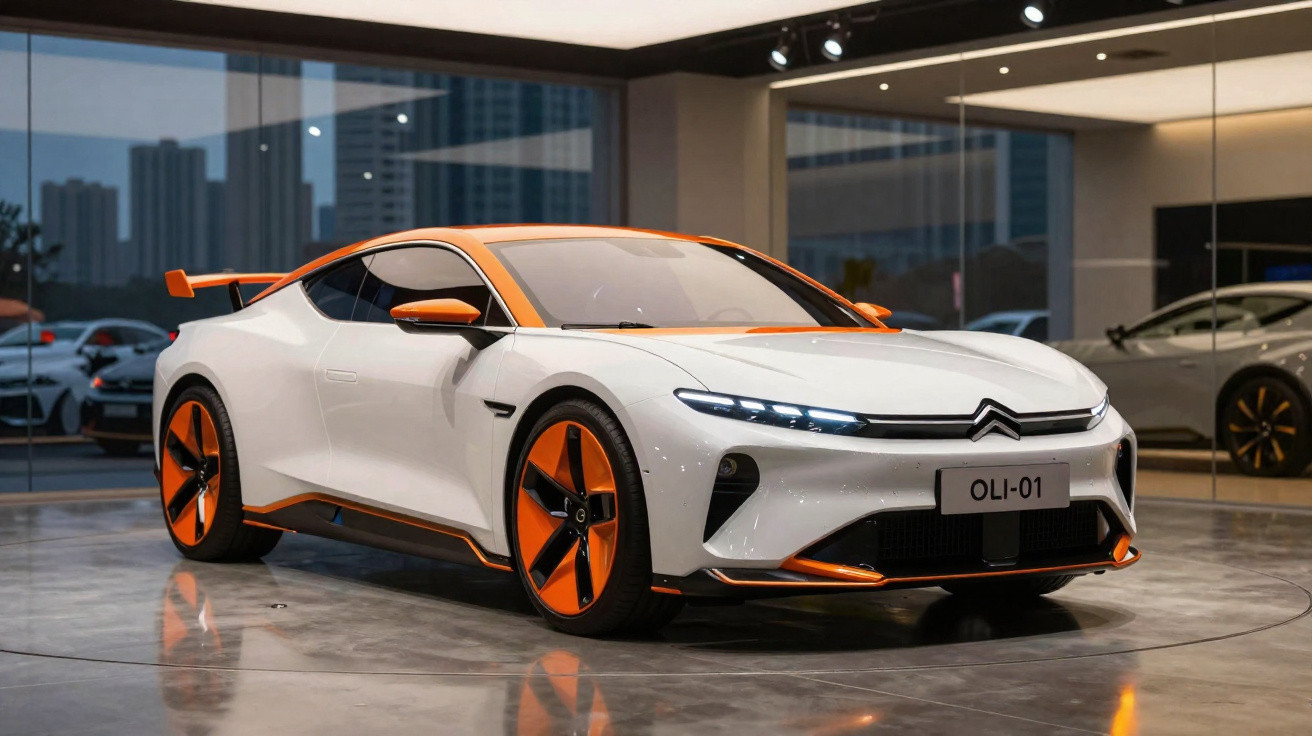
Straightforward, inexpensive and built to last: that is how the Citroën Oli positions itself. We previously had the chance to see it up close in Paris, and it was immediately clear what this concept car is trying to prove.
Moving from theory to reality, we were then able to drive the Oli in Portugal - specifically around Guincho. It may be a one-off prototype, but it is fully operational.
And throughout our time behind the wheel, we kept one (important) question in mind: how close is the Citroën Oli to becoming a production model?
No one is indifferent to it…
We have already discussed the Oli’s styling on several occasions. It is pared-back, playful and impossible to ignore. Much of that comes down to the matching front and rear bumpers, the pronounced wheel arches and the doors - but also the upright windscreen and the fact it can turn into a… pick-up.
Yet there is far more going on than first meets the eye. In this prototype, everything exists for a reason, and it quickly becomes obvious that function is prioritised over form - always with “eyes” on price, which remains the biggest “Achilles’ heel” for electric cars.
That is why the Citroën Oli uses fewer parts than a conventional vehicle and incorporates recycled materials. The result should be a lower purchase cost, reduced maintenance outlay and a longer service life.
It looks like a lunar buggy, but it works
Do not let the Oli’s lunar-buggy appearance fool you; it is fully functional. It is built on the E-CMP platform, the same one used by the Citroën ë-C4, and it claims 400 km of range from a 40 kWh battery.
The Oli also aims for strong efficiency, quoting an average consumption of just 10 kWh/100 km - and the fact it weighs only 1000 kg will certainly help. Charging from 20% to 80% is said to take only 23 minutes.
Enough for the road?
Citroën is not disclosing the output of the Oli’s electric motor, but it does confirm the top speed is capped at 110 km/h. That figure may not sound impressive, yet on the road we never felt it needed more.
Because this is a one-of-a-kind prototype, our drive was short and came with some constraints (in terms of speed, time and distance covered).
The Oli was conceived for urban environments, and in that context 110 km/h is plenty. Especially as it feels brisk, much like the majority of today’s electric cars.
It is nimble, easy to drive and genuinely pleasant to use - particularly at the lower speeds typical of busy city centres.
But what surprised me most from the driver’s seat was just how much closer it is to a production-ready vehicle than I expected.
Rudimentary? Not at all
I assumed it might be a rudimentary, far simpler proposition, created purely to test ideas and concepts. Instead, I found a vehicle that can be used and… enjoyed.
Of course, sound insulation is virtually non-existent, the build standards are very different from what you get in a model on sale, and the software controlling the entire electrical system is still a long way from its final form. Even so, the Oli impressed me.
Not only in how it operates, but also in ride quality: it is noticeably more comfortable than you might imagine - despite this prototype running on revolutionary tyres claimed to last up to half a million kilometres, and seats produced using 3D printing.
Does the Oli have a future?
Citroën was unequivocal in saying the Oli will not go into production and should be seen as a laboratory on wheels. Even so, it is safe to say many of these ideas and solutions will be reflected in upcoming launches from the French brand.
Comments
No comments yet. Be the first to comment!
Leave a Comment