
Volkswagen has been taking a few “zig-zags” when it comes to defining the design language of its latest models. It initially pushed for a distinct look for the all-electric ID family, but later brought the styling of its EVs and combustion-engined cars closer together.
That shift was also shaped by a change at the very top of the design department, with Andreas Mindt now tasked with re-establishing the visual identity that defined the Wolfsburg brand for decades.
The first clear signs of that direction are already visible in the latest ID concepts, and also in the incoming Passat and Tiguan models due to arrive in 2024.
Greater convergence
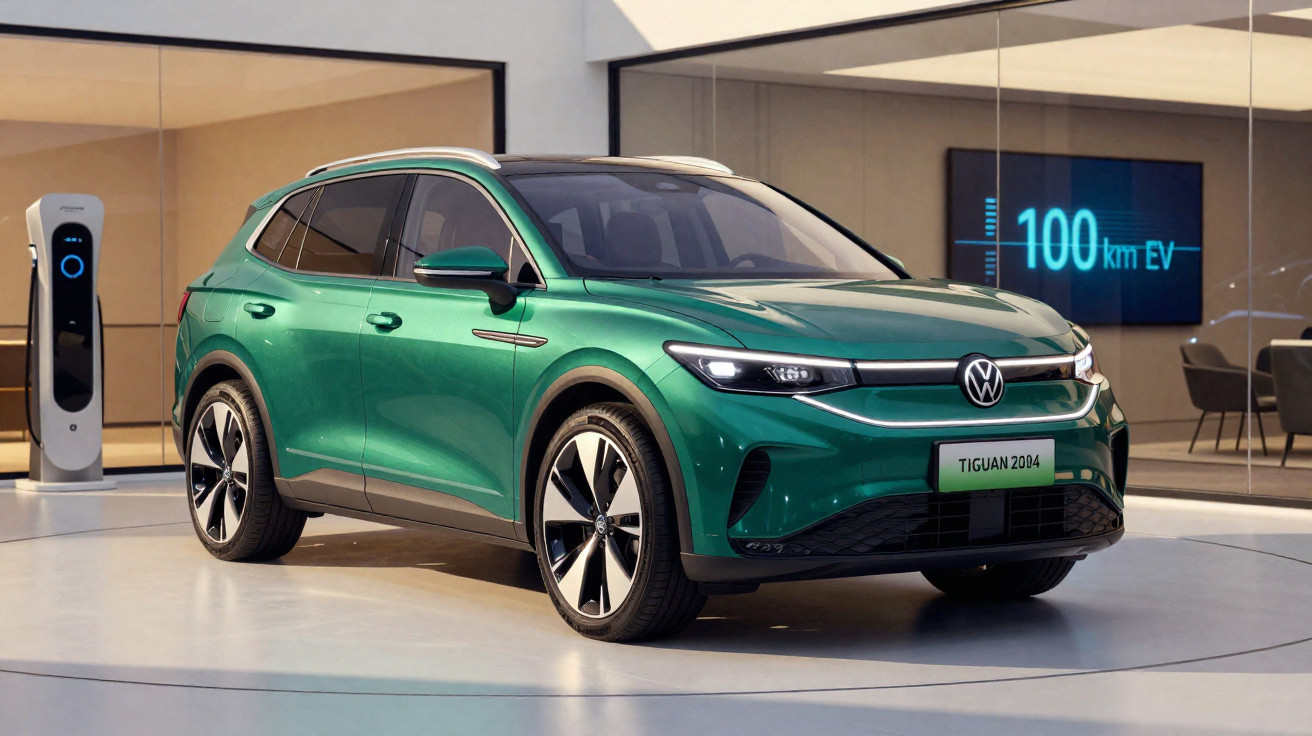
From the outside, the new Volkswagen Tiguan adopts softer, more rounded surfacing, with slimmer and more horizontal lights-an obvious move towards the lines seen on Volkswagen ID models. Those EVs are, over time, set to become the dominant force across the brand’s line-up.
Inside, the gap between combustion models and electric vehicles narrows further as well. The latest generation of Volkswagen’s modular infotainment system, MIB4, introduces a new graphical interface. It also brings a revised storage and navigation structure designed to make the system simpler to use, more intuitive and easier to personalise.
To achieve that, the screen layout is split into two bars-one at the top and one at the bottom-both permanently visible. The upper bar lets you pin favourite functions for direct access, and the same applies to the home screen. Meanwhile, the lower bar is fixed and houses controls for the most frequently used functions.
Another key step addresses criticism aimed at the first generations of MIB: the touch-sensitive sliders (used to adjust cabin temperature and audio volume) are now backlit. The central display itself has also been angled much more towards the driver. Compared with the current Tiguan, this helps create a sportier feel in the cabin.
The instrument cluster in the new Volkswagen Tiguan is fully digital and features a 10.24” display, larger than in the previous generation. It comes with new colours and a more refined, more intuitive user experience. The steering-wheel buttons offer four default graphic configurations (while still allowing specific functions to be assigned): Classic, Progressive, Navigation and R-Line.
Platform evolution
The new Volkswagen Tiguan (now in its 3rd generation), along with the Passat Variant (9th generation) and the future Golf (an update of the 8th generation), will benefit from major economies of scale made possible by the latest evolution of this platform.
In practical terms, that means these new models can be fitted with technologies more typically associated with higher segments. Because development costs are spread across more than one high-volume model, Volkswagen can justify different types of investment.
The updated MQB-Evo architecture (with independent suspension on all four wheels-McPherson struts at the front and a multi-link set-up at the rear) features a rear axle with stiffer camber characteristics and suspension mounting points positioned further apart, packaged within larger-diameter wheels. The result is greater steering precision, while the steering is also less geared down (just 2.1 turns lock-to-lock).
In addition, there is a new control “brain” managing damping, steering and torque vectoring systems: the Vehicle Dynamics Manager.
One of the biggest chassis headlines is the optional availability of DCC Pro. This is a new variable damping solution that uses two valves per damper-one for compression and another for rebound. The new Volkswagen Tiguan will be the first model from a mainstream brand to offer this technology (which already exists at Porsche, for example).
With this set-up, the wheels can absorb impacts more effectively, while the body remains more stable than with a conventional system. The end goal is to improve body control, ride comfort and the Tiguan’s cornering precision.
Engine range for the Tiguan
It is an unavoidable trend in today’s automotive industry: diesel engines continue with a reduced presence, while petrol units become electrified (through different forms of hybridisation).
For the new Volkswagen Tiguan, one fresh addition is the second generation of the 1.5 TSI engine producing 150 PS, now paired with a 48V mild-hybrid system. It includes a dedicated battery and a starter-generator unit capable of supplying 20 PS and 25 Nm of torque. It is also the engine that already features technology to deactivate half the cylinders when the accelerator load is low or absent.
Up to 100 km of electric range
The biggest step forward, however, comes with the plug-in hybrids, which now deliver an electric-only range of up to 100 km. This increase is enabled by a new battery with 19.7 kWh usable capacity, well up on the previous version’s 10.6 kWh.
At the same time, the system also gains a new charger, allowing AC charging up to 11 kW as well as DC charging up to a maximum of 50 kW. In that case, charging from 10 to 80% could take around 25 minutes.
The plug-in hybrid systems will be offered in two power levels, both using the 1.5-litre petrol engine and an electric motor delivering 115 PS. In the first option, the combustion engine produces 150 PS, resulting in a combined output of 204 PS. In the second, the combustion engine delivers 177 PS, producing a combined figure of 272 PS. While the first prioritises efficiency, the second is more focused on performance.
The remaining versions include 2.0-litre petrol and diesel engines, with outputs of 204 PS/320 Nm and 265 PS/400 Nm for petrol, and 150 PS/360 Nm and 193 PS/400 Nm for diesel. Every version of the new Volkswagen Tiguan will come with a dual-clutch automatic gearbox (DSG), with six speeds for the hybrids or seven for the combustion-engined models.
Comments
No comments yet. Be the first to comment!
Leave a Comment