
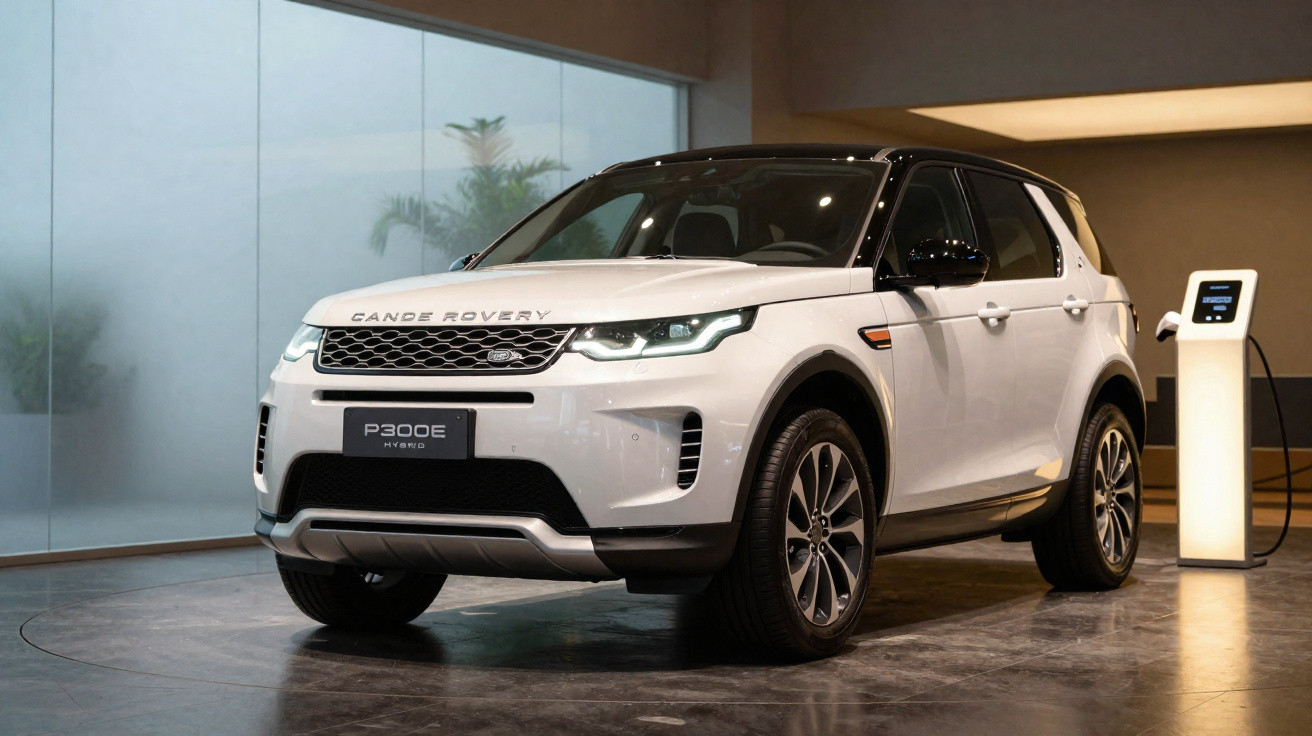
Land Rover has been working to bring down the average emissions across its line-up, and around a year ago it added an all-new plug-in hybrid version to the Discovery Sport range: the P300e, which claims up to 62 km of fully electric driving.
In theory, fuel use should drop dramatically-at least while there’s charge in the battery-and the emissions benefits are clear. But while those are strong arguments for electrification, there are equally obvious drawbacks, starting with the higher price.
The extra mass of the electric motor and battery is noticeable too, and the move to hybrid power has forced compromises. The seven-seat layout-one of this model’s biggest selling points-has been dropped, leaving the P300e available only as a five-seater.
So, once you add it all up, is the Discovery Sport still a compelling choice for more adventurous families now that it has “given in” to electrification?
We spent a weekend with this British SUV as our travel companion, giving it the chance to show what it can do. But was it enough to win us over? The answer is in the lines below…
The look hasn’t changed
From a styling perspective, if it weren’t for the charging flap on the left-hand side (the fuel filler is on the right) and the “e” in the official model name-P300e-it would be almost impossible to tell this Land Rover Discovery Sport apart from a non-electrified sibling.
That’s hardly a criticism, particularly because the most recent update the model received two years ago already brought revised bumpers and a new LED lighting signature.
Cabin treated in much the same way
Just like the exterior, the interior has largely been left untouched. The main differences are the changes required to operate the hybrid system-such as selecting the driving mode-and the newer Pivi and Pivi Pro infotainment systems, which also feature some graphics specific to this version.
The biggest change is at the back: electrification has taken away one of the Discovery Sport’s headline features, the option of seven seats. The reason is the placement of the electric motor, which is integrated into the rear axle.
It’s a small price to pay-provided, of course, that the third row of seats is something you can live without-but in terms of cabin room, another of this SUV’s key strengths, there’s still plenty on offer.
Space in the second row-whose bench can slide fore and aft-remains very strong, and fitting two child seats back there is straightforward. The same goes for the “exercise” of accommodating three children, or two average-sized adults.
Does the hybrid drivetrain convince?
With a combined output of 309 hp, the Land Rover Discovery Sport P300e is the most powerful Discovery Sport currently available, and that’s a very persuasive headline figure.
Interestingly, Land Rover reaches those numbers by using the smallest engine in the Ingenium family: a 1.5-litre turbocharged petrol unit with three cylinders, producing 200 hp and driving the front wheels.
The rear wheels are powered by an 80 kW (109 hp) electric motor, fed by a battery with 15 kWh of capacity.
Together, that adds up to 309 hp and 540 Nm of maximum torque, channelled through a new eight-speed automatic gearbox.
It may not be the main reason anyone chooses a Discovery Sport, but this plug-in hybrid P300e completes 0–100 km/h in just 6.6s and tops out at 209 km/h. In electric-only running, maximum speed is limited to 135 km/h.
What about range?
Overall, the driver can choose between three driving modes: “HYBRID” (the default setting, blending the electric motor with the petrol engine); “EV” (100% electric mode); and “SAVE” (which holds battery charge back for later use).
In 100% electric mode, Land Rover quotes 62 km of range-an appealing figure for a car with the space and flexibility of this Discovery Sport. But in real-world use-unless you’re always (always!) in town-it’s virtually impossible to match that claim, even with careful driving.
As for charging times, using a 32 kW DC public charger it takes 30 minutes to reach 80%.
With a 7 kW Wallbox, the same 80% charge takes 1h24min. From a domestic socket, a full charge takes 6h42min.
Behind the wheel, is it better than a “normal” Discovery Sport?
If you’re worried about the capability of a three-cylinder engine, it’s worth saying straight away that it suits this electrified Discovery Sport very well. The instant torque from the electric motor means this SUV barely breaks a sweat at low revs.
That is, however, only true while there’s energy in the battery. Once it’s depleted-and even though outright shove never really becomes an issue-you hear the petrol engine much more clearly, sometimes too clearly, in a cabin that doesn’t match the sound insulation of its bigger-and pricier-“Range” relatives.
On open roads, though, and compared with a conventional Discovery Sport, this plug-in hybrid feels impressively polished, with a hybrid system that operates with a notably smooth character. But it bears repeating: much of that refinement depends on there still being battery charge in the “tank”.
It’s fairly easy to manage your inputs to limit how often the petrol engine is called upon, especially in urban driving, and that can pay off at the pumps. Outside the city, however, and with no battery charge left, it’s hard to get below 9.5 l/100 km-and on motorway runs that figure rises beyond 10.5 l/100 km.
In terms of driving feel, and putting aside the extra “firepower” delivered by the electric motor, the Discovery Sport P300e behaves much like the internal-combustion versions.
In other words, in corners-despite this plug-in hybrid having a centre of gravity that’s 6% lower-it displays the same basic traits.
This is a fairly large SUV and you can sense its size. Even so, body movements are well contained overall, and grip levels remain high, which encourages a quicker pace.
The steering is on the slow side, but it’s accurate, making it easy to place the car neatly on turn-in. The eight-speed automatic gearbox is just as convincing (it’s 8 kg lighter than the automatic fitted to other versions in the range), and it consistently worked in a very smooth manner.
And off-road?
Because it’s a Land Rover, you naturally expect strong abilities once the tarmac ends-or at least something above the class average. Here, the Discovery Sport PHEV P300e performs well, even if it does carry slight disadvantages versus conventional Discovery Sport versions.
Ground clearance, for instance, drops from 212 mm to 172 mm, and the breakover angle decreases from 20.6º to 19.5º. Even so, the Terrain Response 2 system-with several specific modes depending on the surface-does an exemplary job, allowing you to get past obstacles that initially seem out of reach.
Don’t expect a hard-core off-roader, because that isn’t what it is. But it manages far more than you might assume. Ultimately, the biggest limitation is ground clearance, which can become an issue if you’re faced with a more demanding obstacle.
Is it the right car for you?
The Discovery Sport has long been a strong entry point into the Land Rover world, and a model worth considering for anyone wanting a flexible solution with room for seven.
This plug-in hybrid version of the British SUV makes it a little “greener” and brings different strengths in town, where it’s surprisingly easy to drive in 100% electric mode, always with a calm, effortless feel.
However, it also takes away some of the versatility that defines it, starting with the reduction from seven seats to five. Packaging the electric motor has removed the space needed for the third row, which may be a deal-breaker for larger families who otherwise see the Discovery Sport as a very appealing option.
With few direct rivals on the market-largely because of its more premium positioning-the Discovery Sport PHEV P300e will suit buyers who want a roomy vehicle (the boot seems to go on forever…), one that remains capable off-road, and one that can cover several dozen kilometres with zero tailpipe emissions.
The price is on the high side, but it remains very competitive against likely plug-in hybrid alternatives, and it’s even notably cheaper (by around €15,000) than the most powerful Diesel in the line-up-the 2.0 TD4 AWD Auto MHEV with 204 hp-when specified with the same equipment.
There is, however, a more affordable 163 hp Diesel variant, which narrows that price gap-while widening the performance gap-but offers more appealing fuel consumption and seven seats. It’s a very balanced choice for those who want the maximum versatility this British model can provide and who cover a lot of kilometres each month.
Comments
No comments yet. Be the first to comment!
Leave a Comment