
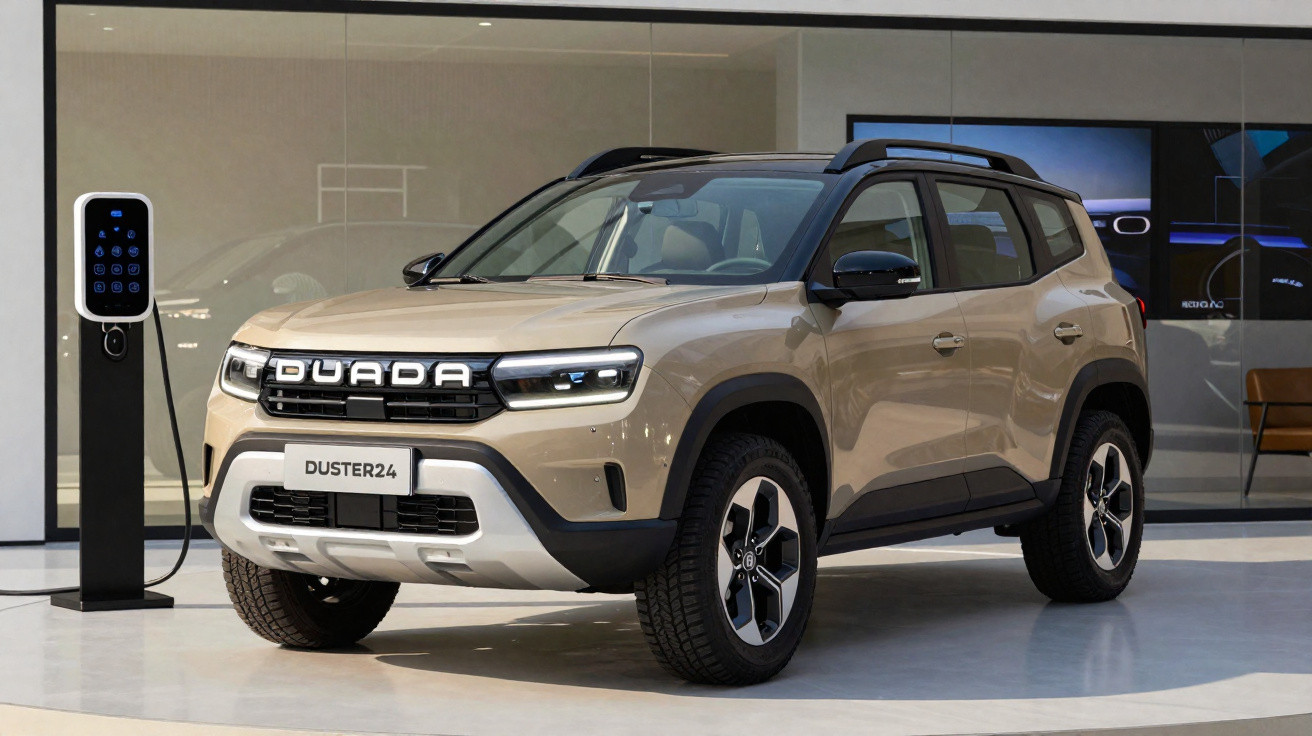
Two generations and more than 2.2 million units on, Dacia has pulled the covers off the third generation of the Duster, its most recognisable model.
That means the new Dacia Duster carries a hefty burden: it must extend a success story that began back in 2010. On paper, the latest version seems well armed. Here are the seven biggest talking points from the Duster 2024.
1. Brand-new underpinnings
The new Dacia Duster really is new. It now sits on the CMF-B platform-the same architecture used by the Sandero and Jogger, as well as other Renault Group models. Crucially, this paves the way for powertrains that weren’t previously available, including a hybrid (more on that shortly).
For now, what stands out is that the Duster 2024 keeps (almost) the same footprint as its predecessor-refreshing in a market where cars rarely stop growing.
Width is up by just 1 cm, to 1.81 m, while overall length remains exactly the same at 4.34 m. It’s also 3 cm lower, at 1.66 m.
Dacia has yet to confirm the wheelbase, but despite near-identical exterior measurements, it promises a roomier cabin. The brand highlights greater shoulder room for front occupants and an extra 30 mm of rear legroom. Boot capacity has also edged up, reaching as much as 472 litres (depending on version).
2. Bigster influence
Looks matter, and the Duster 2024 adopts a smarter design with a stronger impression of ruggedness. While it’s clearly an all-new model-yet with cues that nod to earlier Dusters-the styling didn’t come entirely out of the blue, having been previewed in 2021 by the Bigster concept.
In fact, the Duster 2024 ends up resembling a Bigster… just one size smaller. That’s not a complaint, because at first glance the end result appears very well judged.
Up front, the slimmer headlamp-and-grille arrangement introduces Dacia’s new "Y"-shaped lighting signature. The tougher look isn’t only down to the pronounced wheelarches: it’s also reinforced by the protective "armour" around the lower body and arches, plus the chunky front and rear bumpers.
Also notable is the lack of chrome (a more environmentally friendly approach) and the material used for much of that "armour". Developed by Dacia and called Starkle, it contains up to 20% reused polypropylene and, further supporting its green credentials, it isn’t painted.
3. Digital tech takes over the cabin
Inside, the design mirrors exterior themes, particularly the repeated "Y" motif. You can see it in elements such as the air vents and the door panels.
Digital displays also play a bigger role in the Duster 2024. Higher-spec versions feature two screens: a 7-inch display for the instrument cluster and a 10.1-inch screen for the infotainment system. On the entry-level Essential trim, the instruments are analogue with a small 3.5-inch display between the dials, and the central screen only appears one step up, on Expression.
It’s clear Dacia has retained physical controls for several functions, including the climate system. What remains to be seen is whether the new toggle-style buttons prove as intuitive as the previous rotary controls.
Connectivity is another focus. Android Auto and Apple CarPlay compatibility are included, and there are four USB-C ports-two in the front and two for rear passengers.
4. Goodbye diesel, hello hybrid
Under the bonnet of the Duster 2024, the headline is what’s missing: a diesel engine. That outcome had been widely expected, and it’s now confirmed. In its place is a 140 hp hybrid setup-the same one used in the Jogger.
That isn’t the only electrified option: the new Dacia Duster also introduces a 48 V mild-hybrid powertrain.
At the bottom of the range sits the familiar ECO-G bi-fuel version. It comes with two 50-litre tanks-one for petrol and one for LPG-delivering a range of up to 1300 km. Battery-electric cars may well be jealous.
- Duster HYBRID 140 - 140 hp (1.6-litre petrol engine plus two electric motors), automatic gearbox, 1.2 kWh battery;
- Duster TCe 130 - 130 hp, petrol Miller-cycle engine, three-cylinder, 1.2-litre, turbocharged; six-speed manual gearbox; 48 V mild-hybrid system (electric motor + 0.8 kWh battery);
- Duster ECO-G 100 - 100 hp, petrol/LPG engine, three-cylinder, 1.0-litre, turbocharged; five-speed manual gearbox.
5. The 4×4 option remains
From day one, the Dacia Duster built a following among off-road enthusiasts by offering four-wheel drive for those who needed it-even if it isn’t a hardcore 4x4. That won’t change with the new generation.
However, with diesel gone, the Duster 4×4 will have just one engine choice: the new 1.2-litre turbocharged petrol unit with 130 hp, paired with a manual gearbox.
Dacia also draws attention to five 4×4 driving modes, which adjust various settings to suit the surface: Auto, Snow, Mud/Sand, Off-Road (the most extreme setting, similar to the current Duster 4×4’s Lock mode), and Eco.
Alongside these modes there is also downhill speed control, which uses the brakes to hold a pre-selected descent speed (up to 30 km/h).
6. Much improved safety
Last, but absolutely not least, the Dacia Duster 2024 makes a major step forward on safety-particularly in active safety and driver assistance systems.
In truth, many of these features arrive largely because the latest European vehicle-safety requirements have made them mandatory.
As a result, the new Duster includes systems such as automatic emergency braking, traffic sign recognition, speed alerts, lane-departure warning, driver attention alert, lane-keeping assist, and even cruise control.
7. Under €20,000
The Dacia Duster 2024 will be built at the Pitești plant in Romania, just like the outgoing model. It is set to make its public debut at next year’s Geneva Motor Show in March, broadly aligning with the start of sales.
Prices haven’t been announced yet, but speaking to Autocar, Denis Le Vot, Dacia’s Chief Executive Officer, said the new model will have a starting price below €20,000.
Comments
No comments yet. Be the first to comment!
Leave a Comment