
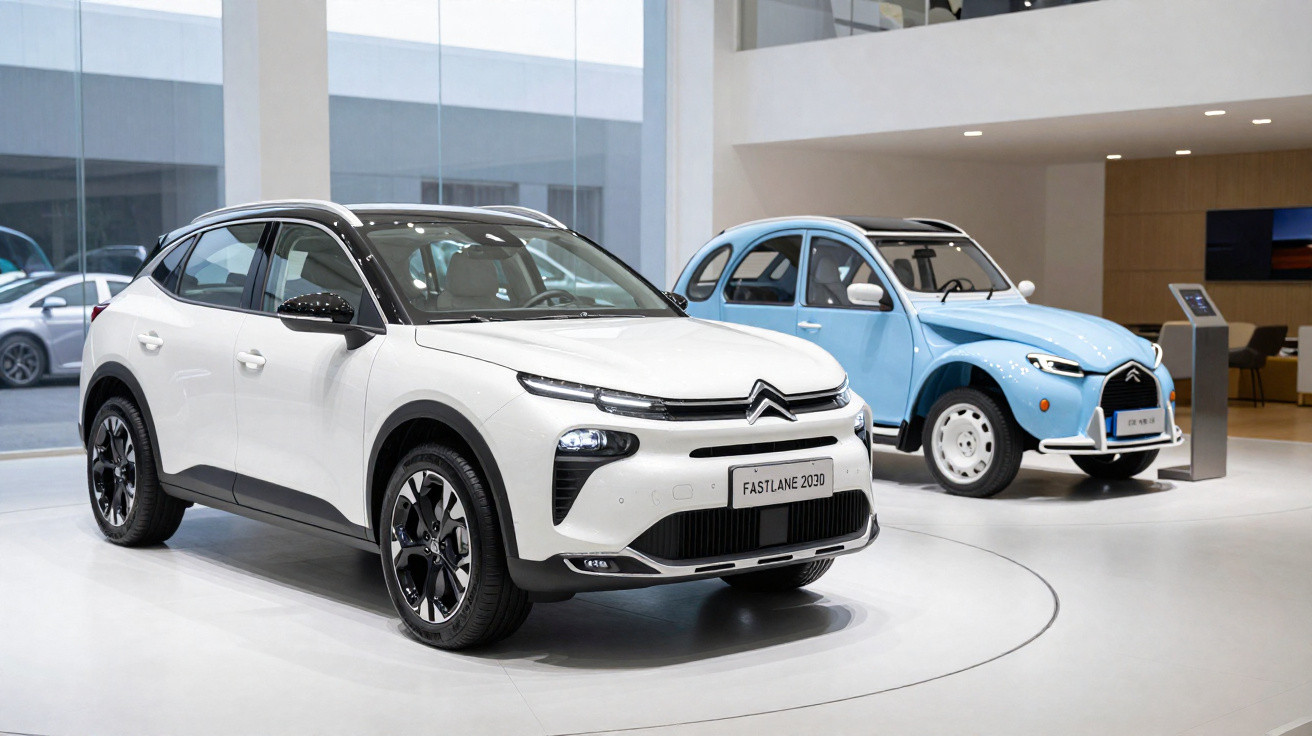
With a new role inside Stellantis under the FaSTLAne 2030 plan, Citroën effectively treats 2026 as a kind of year zero. That, combined with a relatively fresh line-up, helps explain why the French brand has fewer new launches: this year, the C5 Aircross is its single headline arrival.
Citroën C5 Aircross as the new flagship
Citroën has not played it safe with its new range-topper. The latest C5 Aircross is closer to a clean-sheet change than a gentle update compared with the outgoing model. It adopts the brand’s latest design language, moves to a new platform (STLA Medium) and, for the first time, adds 100% electric versions alongside the mild-hybrid and plug-in hybrid variants already offered.
With comfort and technology placed front and centre, the Citroën C5 Aircross is positioned as a showcase for what Citroën believes it does best. Yet in the wake of the plan set out by Stellantis, it also reads as another step towards a broader, deeper transformation of the marque.
A step back to move forward
What’s missing in terms of product news in 2026 is offset by announcements about Citroën’s repositioning within Stellantis.
On one hand, Citroën is set to join the industrial giant’s group of regional brands - while Jeep, Ram, Peugeot and FIAT take on the status of global brands. As a result, Citroën will increasingly rely on the assets of those four Stellantis “super-brands” to help it stand out.
Even so, compared with other regional names in the group - such as Alfa Romeo or Opel - Citroën’s role is strengthened for one simple reason: DS Automobiles is being brought back under its wing. DS loses its independence and returns to its roots.
The stated aim of this structural reshuffle is to maximise synergies by sharing teams and cutting duplicated effort. In DS’s case, however, it also amounts to an acknowledgement that the brand did not reach the scale needed to justify fully independent teams and budgets.
DS Automobiles and the return of the 2CV
That leads to another trait long associated with Citroën, beyond the innovation of earlier decades. Historically, it has been a brand with a split personality: capable of covering both premium and entry-level segments effectively, helping to democratise the car. With DS’s absorption reopening access to the premium end, the opposite extreme is set to deliver a Citroën “minimum” car once again: the 2CV is coming back.
The 2CV is not due to reappear until 2028 and sits within Stellantis’s E-Car project. This programme will produce at least one additional model (for FIAT), and both will belong to the European Union’s new category for small, affordable electric cars, known as M1E.
For now, what’s known is that it will be 100% electric and will feature styling cues inspired by the original, as suggested by the teaser already released. As for price, it is expected to come in at around 15 thousand euros, which would make it one of the most accessible electric cars on the market and a clear nod back to the brand’s popular beginnings.
Comments
No comments yet. Be the first to comment!
Leave a Comment