
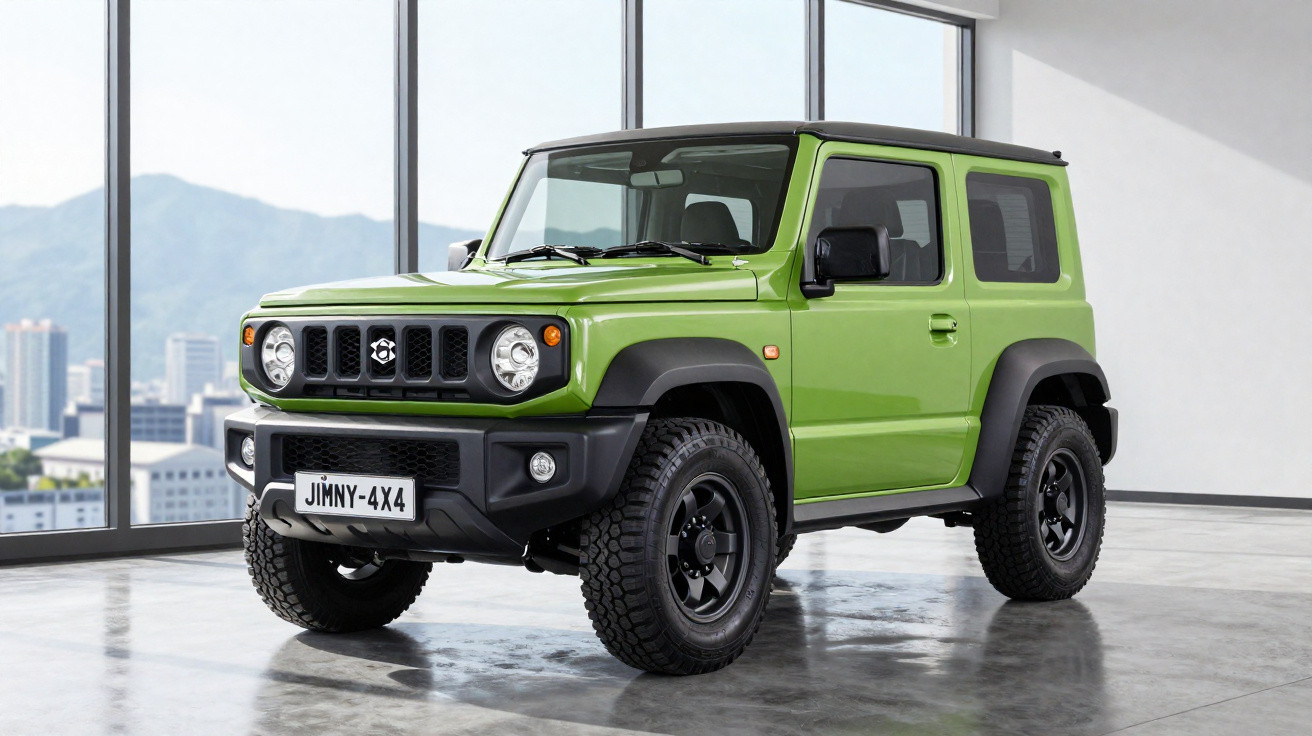
The big “existential” question hanging over the new Suzuki Jimny is simple: what, exactly, is it? We couldn’t resist putting it to you on our Instagram, and more than 1,500 of you weighed in. While 43% said it was a small SUV built for city life, 57% insisted the Jimny is a proper, no-compromises off-roader.
I can confirm first-hand that the 57% are absolutely right - I’d bet a fair number of that 57% already own a Jimny or a Samurai. Talking about the Suzuki Jimny’s off-road credentials in the same breath as a G-Class, a Wrangler, or even the now-discontinued Defender isn’t as far-fetched as it sounds.
Even so, and against my initial expectations, the new Jimny can also work surprisingly well as an everyday urban runabout. Confused? Let me explain.
Everything about the Jimny has been designed with off-road use in mind, which on paper ought to severely undermine its “road manners” on tarmac. Yet, as I found out, the trade-off for that narrow focus may not be anywhere near as harsh as I first imagined.
Jimny, the tough, no-nonsense off-roader
Its tiny footprint - similar to a typical city car like a Fiat Panda or Toyota Aygo - disguises a skeleton that feels like a scaled-down G-Class or Wrangler.
Unlike city cars (and most passenger cars in general), the Jimny doesn’t use a monocoque body. Instead, it follows the traditional body-on-frame approach you’ll find in pick-ups and true “hardcore” 4x4s, with separate chassis and body.
The body sits on the chassis at eight mounting points - clearly visible in the image above - each one using silentbloc bushes to cut vibrations and improve comfort. In practice, they work well: the Jimny delivers perfectly acceptable comfort and refinement levels, even on tarmac, though we’ll come back to that later…
The new Suzuki Jimny’s 4WD system (called ALLGRIP PRO) isn’t like the “front-led” AWD setups where the rear axle only gets power once the front loses grip. This is a genuine four-wheel-drive system, where the driver chooses the drivetrain mode. A second lever, positioned behind the five-speed manual gearbox (or four-speed automatic), lets you select what you need: 2H for two-wheel drive, 4H for high-range four-wheel drive, and 4L for low-range four-wheel drive with reduction gears - allowing you, slowly and steadily, to tackle whatever obstacles are in your way.
The angles are straight out of off-road legend: 37º approach, 28º breakover, and 49º departure, plus 210 mm of ground clearance. With numbers like that, I couldn’t wait to get on the road - or rather, off it…
"I can only see sky…"
The launch location, just over 20 km north of central Madrid, Spain, felt as though it had been chosen specifically for the Jimny. The woodland tracks were unexpectedly tight, twisted and narrow and, if I’d been driving a G-Class or Wrangler, I’d have questioned whether they’d fit through certain sections - not because they lack ability, but because they’re simply much larger…
The route had a bit of everything: a very steep dirt descent to test Hill Descent Control - impressively effective -; ruts deep enough to “swallow” most vehicles that call themselves SUVs; several corners with side slopes; and highly uneven, pronounced climbs and drops. On one of them, we were left staring at nothing but sky, with no real sense of where we were heading… There were even tree-to-tree “chicanes”, designed to challenge the Jimny’s manoeuvrability to the fullest.
We were able to run the route more than once. The first time, we used low range, as instructed by the Jimny convoy leader. The second time around, we skipped the low gears and stayed in four-wheel drive.
That made it clear just how far the naturally aspirated 1.5 (102 cv and only 130 Nm at a relatively high 4000 rpm) could go without the torque multiplication that low range provides. And it didn’t do badly at all… only on the steepest climb, over a very corrugated surface, did it finally “give up” and stall.
Robust and capable? Without question!
A few conclusions were unavoidable. First: the Jimny’s ability itself - it is a genuine off-roader, with no room for doubt. Second: the toughness of its build. The cabin may look utilitarian (almost like a work vehicle) and it’s covered in hard plastics that aren’t always pleasant to the touch, but everything feels tightly assembled. No rattles, no unwanted creaks - with one note: in low range, there is a more noticeable differential whine.
Visibility also proved to be strong, thanks not only to the boxy shape but also to well-positioned pillars that aren’t excessively thick. Even though the driver’s seat doesn’t have height adjustment, the driving position is perfectly acceptable; it’s upright, but in these conditions I didn’t feel the need to change anything.
Motorways? Probably best avoided…
A clarification. Because the event schedule ran late, I didn’t get the chance to drive the new Suzuki Jimny on tarmac - we’ll do that soon, don’t worry - and only experienced it on the road as a passenger. Still, that was enough to show my initial fear of a crude, uncomfortable car on asphalt was unfounded.
Up front there’s plenty of space, and the ride is comfortable enough - the 80-profile tyres may have something to do with that - and it’s more refined than expected, with wind noise kept reasonably under control (especially given the square-edged body).
However, it does have limits, particularly on a route that was almost entirely motorway. Holding a 120 km/h cruising speed isn’t always easy - top speed sits at 145 km/h - and acceleration is unhurried. We don’t even know how long it takes to reach 100 km/h, but does that really matter in a car like this?
You’re better off sticking to A-roads and B-roads at more modest speeds. I saw consumption hovering around 7,0 l/100 km. Off-road, when negotiating obstacles, it rises to roughly 9,0 l/100 km.
Jimny, the city car
With its unexpected comfort and refinement - considering how single-mindedly it was designed for off-road driving - can the Suzuki Jimny genuinely serve as an everyday city car? Yes, but… you need to know what you’re signing up for.
Its compact size makes it brilliantly easy to manoeuvre, and finding a parking space is as straightforward as with any other city car. What’s more, its design arguably makes it the ideal urban tool for dealing with aggressive speed humps, cobbled streets, and the crater-like potholes scattered around our towns and cities.
There are compromises, though. Rear space is decent, but if you carry passengers you effectively lose the boot - it’s only 85 l, which is basically useless. Fold the rear seats (50:50) and it rises to a much more workable 377 l. On higher-spec versions (JLX and Mode 3), the backrests of the rear seats and the boot area are even lined with plastic material to make cleaning easier.
And, of course, access to the rear seats is “via the front”. The Jimny keeps its three-door body, but entry is reasonably straightforward - and it certainly hasn’t stopped the Fiat 500, the other three-door success story, from thriving.
In Portugal
The Suzuki Jimny can already be viewed and ordered at national dealerships. However, the model’s outsized success, especially in Japan, may translate into long waiting times. Suzuki Ibérica had planned 2000–2500 units for Portugal and Spain up to March next year (the end of the Japanese fiscal year), but overwhelming demand means only 400 units for the entire peninsula by March.
In Japan, the waiting list is already a year - impressive… - so Suzuki has prioritised meeting demand in its home market. The brand has already promised production increases, but the effects should only be felt during the 2019–2020 fiscal year (which starts next April).
As for pricing, it starts at 21 483 euros and tops out at 25 219 euros. Expensive? Perhaps, particularly when you look at Spanish pricing, which starts at 17 thousand euros and ends at 20 820 euros - meaning the best-equipped version costs less in Spain than the base version does in Portugal.
What explains such a large gap? It isn’t the Suzuki Jimny’s base price, which is identical in both countries, but Portugal’s car taxation - in other words, more than 50% of what you pay for a new Jimny is tax - and we still need to see what impact the move to real-world WLTP emissions figures (rather than the current values converted to NEDC) will have on the sums in January next year…
| Version | JX | JLX | JLX AUT. | MODE 3 |
|---|---|---|---|---|
| Price | 21 483 € | 23 238 € | 25 297 € | 25 219 € |
In conclusion
I stand by what I said: it’s one of the launches of the year. By swimming against the tide and staying true to its principles, the Jimny is outstanding off-road without becoming excessively compromised on it. It’s a unique proposition in today’s market - it effectively has no direct rivals. The closest alternative is probably the Fiat Panda 4×4, but for anyone looking for stronger off-road ability, the Suzuki Jimny is unquestionably the one to consider.

Comments
No comments yet. Be the first to comment!
Leave a Comment