
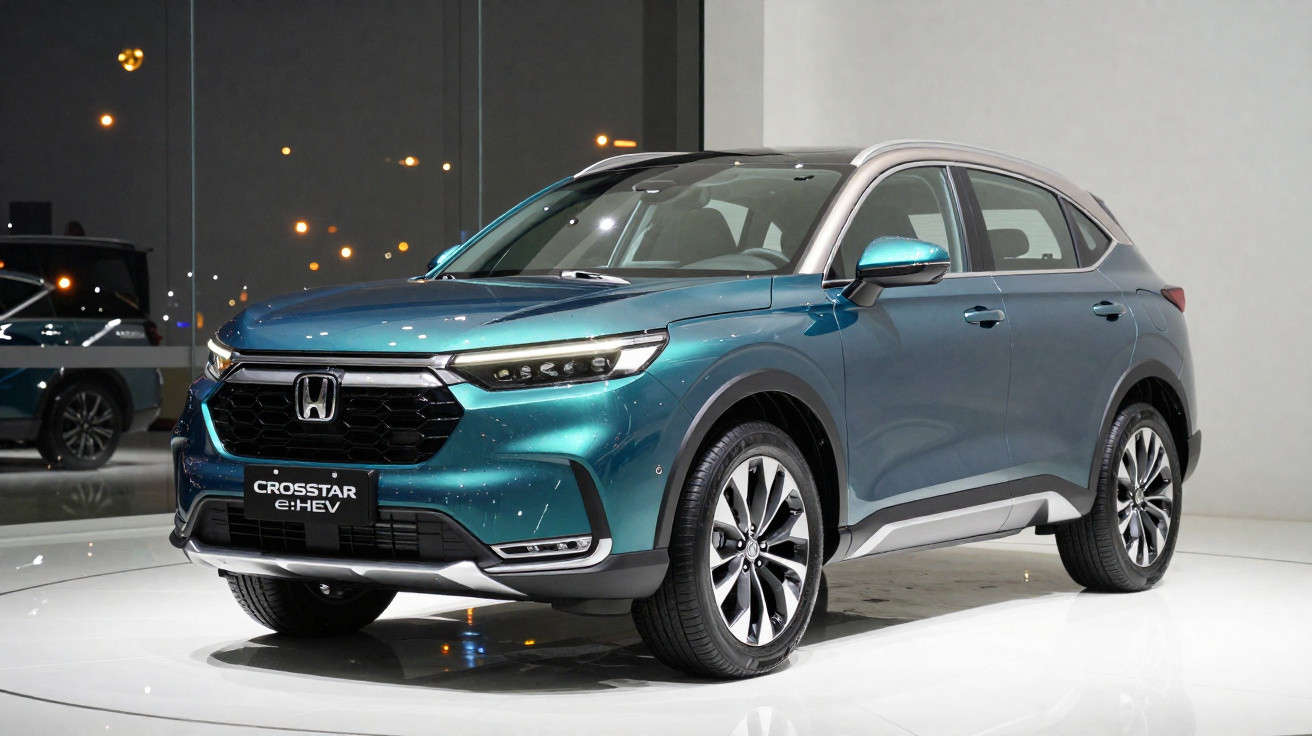
The Crosstar? It looks like a Honda Jazz… and, in practice, it is. The new Honda Crosstar is the Jazz’s promotion - literally and figuratively - into crossover territory. The badge may be fresh, but the method used to turn the compact Jazz MPV into the compact Crosstar crossover is the same one we’ve already seen on other models with a more rugged look.
The updated styling brings the usual black plastic cladding around the lower edge of the bodywork and the obligatory increase in ground clearance - only 16 mm more - achieved thanks to higher-profile tyres (which genuinely increase overall wheel diameter) and longer-travel springs.
The exterior changes don’t stop there - you can see them in more detail in the gallery below - and they carry through to the cabin too, which gains different tones and a few new fabric trims.
Hybrid only - Honda Crosstar, and nothing else
Beyond that, the Honda Crosstar is technically identical to its Jazz sibling, a model that has already been through our garage and was tested by Guilherme Costa and João Tomé. And just like the Jazz, the Crosstar is only offered with a hybrid powertrain - Honda wants its entire line-up electrified by 2022, with the exception being the Civic Type R, which even in the next generation will remain… pure… combustion.
It’s worth remembering that the Honda Crosstar is not a plug-in hybrid (you can’t connect it to a socket), but it also sets itself apart from other conventional hybrids on the market, such as the Toyota Yaris 1.5 Hybrid or the Renault Clio E-Tech.
Both the Jazz and Crosstar use the same i-MMD system first introduced in the CR-V - including the Electric (EV), Hybrid Drive and Engine Drive operating modes - although here it’s a more modest version of the same idea, meaning it isn’t as powerful as its SUV relative.
We’ve already explained how Honda’s i-MMD system works when we first drove the Honda CR-V, for instance. In the link below, we clarify everything:
Driving: it couldn’t be simpler
The i-MMD system may sound complicated on paper, but behind the wheel you barely notice it. Driving the Honda Crosstar feels no different from driving a car with an automatic gearbox. You put the selector in “D”, accelerate and brake - simple….
The small battery is replenished through energy recovery when you lift off and brake - you can move the selector to “B” for maximum regeneration - or with help from the combustion engine.
That means that whenever you can hear the combustion engine running, it is (almost always) acting as a generator to recharge the battery. The only driving scenario where the combustion engine is mechanically connected to the driven axle (Engine Drive mode) is at higher speeds, such as on the motorway, where Honda says it’s more efficient than relying on the electric motor.
In other words, you don’t need to worry about the operating modes mentioned earlier; they are selected automatically. The system’s “brain” manages everything and chooses the most suitable mode depending on what you demand and how much charge is in the battery. To see which mode you’re in, you can check the digital instrument display - the letters “EV” appear in electric mode - or look at the energy-flow graphic to understand where power is coming from and where it’s going.
That easy-going nature also shows up in the Crosstar’s very good visibility (although the driver’s double A-pillar can create issues in some situations) and its light controls, with gentle steering and pedals. In the case of the steering, it may even be too light: it’s helpful in town and when parking, but it doesn’t make for the best communication channel about what’s happening at the front axle.
The crossover effect
In terms of personality, there isn’t a major gap between the Jazz and the Crosstar. The crossover-styled MPV turns out to be a touch more comfortable, a few tenths of a second slower in acceleration, and a few tenths of a litre thirstier than its closest relative - nothing alarming.
All of that comes down to the differences highlighted earlier, especially those tied to the tyres, springs, and the increased ride height (and overall height).
Thanks to the taller tyre sidewalls and the longer-travel springs, the Crosstar rides even more softly than the Jazz, and road noise remains well contained - as does wind noise. In fact, the Crosstar feels impressively refined even at motorway speeds, except when you press the accelerator with more intent. At that point, the combustion engine makes itself heard - and loudly - and it doesn’t sound particularly pleasant.
It was during one of those “let’s see what it can do” moments that I discovered an interesting quirk of the Crosstar (and Jazz) hybrid system. Floor it and, despite having only one gear, you’ll clearly hear what you’d normally associate with a combustion engine paired to a multi-speed gearbox: the revs climb and then drop as if a gear change had taken place - it made me laugh, I have to admit…
That illusion improves the link between acceleration and engine noise, unlike traditional CVTs where the engine simply sits “stuck” at the highest possible rpm. But it’s still only an illusion…
Even so, the electric motor’s 109 cv and 253 Nm consistently deliver convincing acceleration and in-gear response, and you don’t need to press very hard to make brisk progress.
Comfort takes centre stage
No matter the pace, the Crosstar’s standout trait is comfort. Not only because of the soft damping, but also thanks to the seats, which additionally provide decent support.
That strong emphasis on comfort, however, combined with the steering’s limited feedback, means the Honda Crosstar isn’t especially sharp or engaging dynamically.
With that said, its handling is tidy and predictable, and body movements are fairly well controlled despite some roll. It feels most at home at more moderate speeds and with lighter throttle inputs (again, the engine noise can become quite intrusive if you drive more aggressively).
Does it use little fuel?
Absolutely. Although it can’t match the Jazz for frugality, the Honda Crosstar still impresses, particularly in urban driving where there are more chances to lift off and brake, regenerate energy and make greater use of fully electric propulsion. In mixed use, combining town driving and faster roads, fuel consumption always stayed below five litres.
If you travel at moderate, steady speeds over longer distances, without opportunities to slow down or brake to recover energy and recharge the battery, you’ll notice a repetitive alternation between EV (electric) and Hybrid Drive.
As long as there’s enough “juice” in the battery, it will run in EV (electric) mode - even at 90 km/h - but as soon as charge drops (it may last 2 km, depending on speed), the combustion engine comes into play (Hybrid mode) and charges it until there’s sufficient energy stored. A few minutes later, with enough “juice” back in the battery, it returns to EV automatically - and the cycle repeats again and again and again…
Even so, despite the trip computer showing high figures while the combustion engine is charging the battery, at a steady 90 km/h fuel consumption sat at 4,2-4,3 l/100 km. On the motorway, only the combustion engine drives the wheels (Engine Drive mode), so 6,5-6,6 l/100 doesn’t come as a surprise. Although the 1.5 l thermal engine uses the more efficient Atkinson cycle, it doesn’t help aerodynamically that the Crosstar is short and tall.
Is it the right car for me?
If the test ended here, I’d have no trouble recommending the Honda Crosstar to anyone. As João and Guilherme also found in their tests of the new Jazz, this could easily be the right formula for any small car: roomy, flexible, practical, and here even more comfortable - the first Jazz’s recipe is just as relevant today as it was when it launched. It may not have the most sex appeal, but it delivers everything it promises with brisk, economical calm.
But there’s an “elephant in the room”, and it’s called price - déjà vu, it was one of the same “elephants” in the Honda e test. The Honda Crosstar is only sold in a single version with a single equipment level, the top-spec Executive. It’s true the kit list is long and very comprehensive - covering safety and comfort equipment as well as driver-assistance systems - but even so, asking for more than 33 thousand euros is hard to justify.
You could argue that, as with 100% electric cars, what you’re paying for is the technology itself, but that argument carries less weight when there are now 100% electric superminis at the same price (almost certainly not as well equipped or as versatile). And, on top of that, they don’t pay ISV, unlike the Crosstar.
The maths looks even shakier when you set the Honda Crosstar’s price against other hybrids in the segment, such as the aforementioned Yaris 1.5 Hybrid, Clio E-Tech, or the B-SUV Hyundai Kauai Hybrid (with a facelifted version arriving in the market soon). They can’t match the Crosstar on space/versatility, but they cost several thousand euros less than it does (even looking only at their better-equipped versions).
For anyone who doesn’t want to give up the Crosstar’s space/versatility trump cards, the remaining answer is… the Jazz. It offers everything the Crosstar does, but comes in slightly under 30 thousand euros (still expensive, just not as much as its sibling). What’s more, it manages to be a little quicker and more economical, albeit (very slightly) less comfortable.
Comments
No comments yet. Be the first to comment!
Leave a Comment