
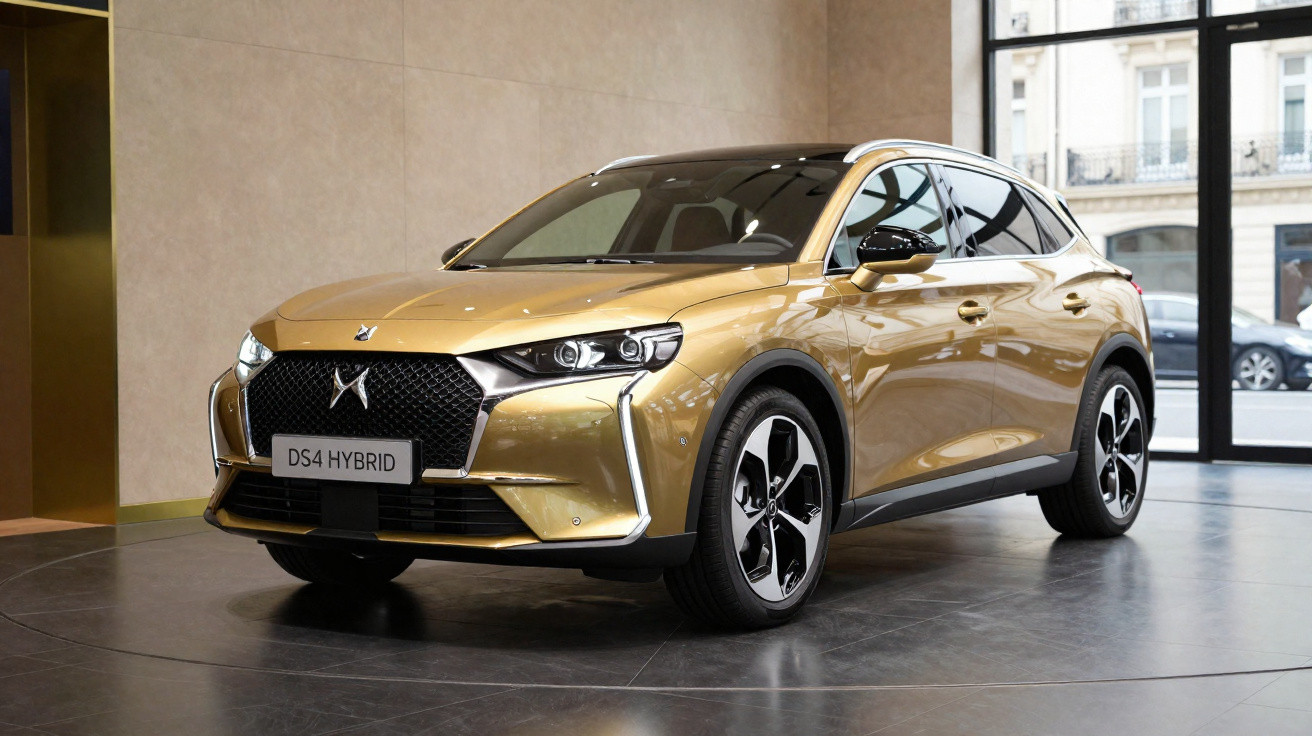
Now part of the Stellantis constellation, DS Automobiles is keen to live up to the premium status it enjoyed within Groupe PSA - and says it intends to preserve within the new organisation - starting with the new DS 4. It is a hybrid (in more ways than one) of bold styling cues, sitting somewhere between a traditional hatchback (two-box, five-door) and the more popular, taller SUV.
Underneath, the new DS 4 is built on a heavily evolved version of the EMP2 platform (the same base used by cars such as the Peugeot 308/3008). It comes in three variants and, in every case, measures 4.40 m in length, 1.83 m in width and 1.47 m in height. Whatever the version, the boot offers a generous 430 l of luggage capacity, which DS says tops that of its likely rivals.
Alongside the standard version, there is the Cross, which adopts an SUV-inspired look and brings roof bars, traction optimisation for sand, snow and mud, plus assistance on steeper descents. The Performance Line is the most visually dynamic of the range.
Reworking EMP2 has also given the new model a different set of proportions. DS has been able to lower the bonnet, push the A-pillars further back and increase wheel size to a 720 mm diameter. In practice, that means wheels up to 20″, with most versions fitted as standard with 19″ alloy wheels.
DS Automobiles argues that the larger diameter does not have to mean poorer aerodynamics or higher fuel use (and therefore emissions), because it uses narrower tyres and aerodynamic inserts within the wheel design. It also promises strong handling, noting that the new wheels are 10% lighter (1.5 kg per wheel).
French-style luxury
Over time, luxury in a car has stopped being the sole preserve of the top market segments. Even models in the so-called “Golf segment” now offer comforts that, not long ago, were largely reserved for a Mercedes-Benz S-Class or similar.
With the new DS 4, the brand aims to prove that point again as it lines itself up against established German contenders in this class, including the BMW 1 Series, Audi A3 and Mercedes-Benz A-Class.
Its “French-style luxury” begins with a palette of particularly distinctive paint finishes - there are seven body colours in total - including gold or bronze tones that took several years to perfect, so the shade remains exactly consistent from the front grille area all the way to the rear bumper.
That theme continues inside. The air-conditioning system uses very compact vents and “invisible” blades, which create a cleaner design while allowing the airflow to be directed up and down more precisely. And, because the unit is so compact, DS says it can be positioned “very discreetly” within the dashboard.
Attention then shifts to the material choices: various leathers, Alcantara, and decorative touches ranging from wood to forged carbon fibre, depending on the version or interior ambience selected. The cabin can also be finished in a two-tone scheme. According to the manufacturer, the DS 4 is made from 94% recyclable materials and uses 85% recyclable parts. By way of example, much of the dashboard is produced from hemp, particularly in areas that are out of sight.
Technological sophistication in the service of comfort and safety is not far behind.
One example is the camera-controlled, pilot-operated damping system making its debut in this market segment. A camera behind the windscreen, along with four tilt sensors and accelerometers, feeds data about the road ahead and about the car’s movements (steering angle, braking, speed, and so on). A computer then processes this information in real time and controls each wheel individually so the damping can be continuously adjusted in the best possible way, bringing clear benefits for comfort and dynamic effectiveness.
The first car to offer a similar set-up was the Mercedes S-Class (the “Magic Body Control”), initially sold as an option costing around 5250 euros. DS has not yet disclosed what it will charge for this “touch of wicked refinement”, but it is expected to come in below that figure.
The new DS 4’s headlights have also been extensively developed. They are exceptionally slim and use three LED modules on each side.
The inner module houses the sidelights, while the centre module can rotate by up to 33.5º to act as a cornering beam, adapting to the driver’s field of view and illuminating the edges of the lane. The outer module is split into 15 segments that can be switched on or off independently according to driving conditions.
All the headlights adapt via five preset modes: town, country, motorway, bad weather and fog. The new DS 4 can also be driven with main beam on (with a 300 m range) without dazzling other drivers. In addition, the daytime running light is made up of 98 LEDs - the vertical light signature is inspired by the DS Aero Sport Lounge concept and incorporates the indicators - and the rear lights are laser-etched.
Augmented technology
The DS 4’s driver-assistance suite enables level 2 semi-autonomous driving (DS Drive Assist 2.0). Using sensors, cameras and radar, the car can be positioned more precisely within its lane and, according to DS, can also carry out semi-autonomous overtakes and adjust speed through bends.
An infrared camera in the radiator grille detects pedestrians and animals nearby (up to 200 m in front of the car, even at night and in poor weather) and warns the driver via the head-up display.
This system, called the DS Extended Head-up Display - which DS engineers are particularly proud of - projects information not onto the windscreen, but instead “on the road itself”. The result is a completely new navigation experience (once again, the latest S-Class was the first to do something similar, which is notable given the Mercedes is only just reaching the market).
With a 21″ diagonal, the projection can show speed, warning messages, driver-assistance systems, navigation and even the music track currently playing. Thanks to an optical illusion, the data appears around four metres ahead of the windscreen, within the driver’s direct line of sight, helping keep attention more firmly on the road.
Interaction with the infotainment system, the DS Iris System, is possible via a 10″ touchscreen, voice commands and gestures. In the latter case, DS Smart Touch uses an extra display in the centre console that you operate with your fingertips. Not only can it be pre-set with favourite functions, it also recognises pinch-to-zoom-style gestures and can even read handwriting, much like a smartphone screen.
Now increasingly common, the DS Iris System can also be updated “over the air” via the cloud.
Plug-in hybrid yes, electric no
As for engines, the line-up will include four petrol and Diesel units plus a plug-in hybrid. Known as E-Tense, it combines a turbocharged 1.6 l four-cylinder petrol engine producing 180 cv and 300 Nm with an electric motor delivering 110 cv (80 kW) and 320 Nm of torque. Power is sent through the familiar eight-speed e-EAT8 automatic gearbox (the only transmission offered). Total system output is 225 cv and 360 Nm, and with a 12.4 kWh battery it will be possible to achieve a fully electric range of more than 50 kilometres.
The lack of a fully electric variant is explained by the use of EMP2 which, unlike the CMP platform used in models such as the Peugeot 2008 or the Citroën C4, does not allow for it. A new generation of models based on the forthcoming eVMP will be required.
The other announced powertrains are the petrol PureTech units with 130 cv, 180 cv and 225 cv; and a single Diesel engine, the Blue HDI with 130 cv. An eight-speed automatic gearbox will be the only transmission available.
When does it arrive?
The new DS 4 is expected to reach the market in the fourth quarter of 2021, though DS has not provided a specific date or pricing.
Comments
No comments yet. Be the first to comment!
Leave a Comment