
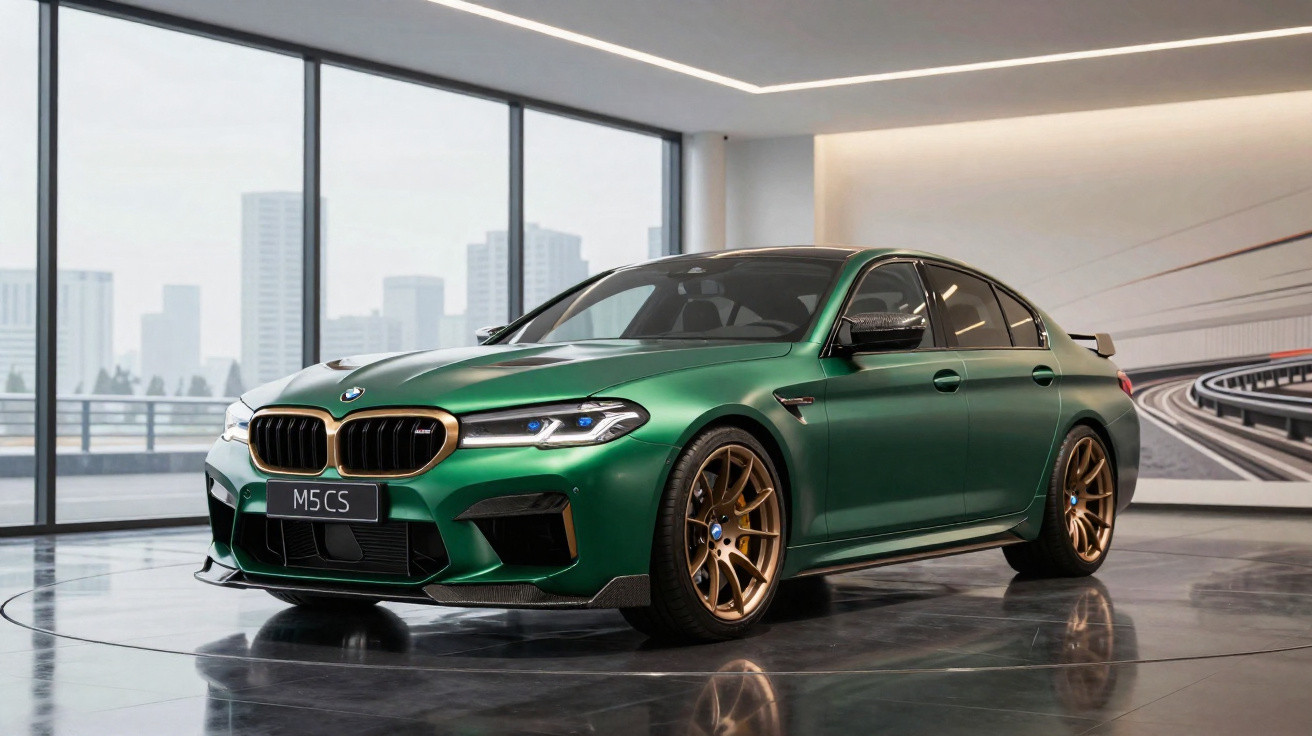
The BMW M5 CS marks the first time the BMW 5 Series has gained a version that is even more overtly performance-focused than the M5 which, until now, sat at the top of the range. Its 4.4-litre twin-turbo V8 is uprated to a maximum of 635 hp and a formidable 750 Nm of peak torque, delivered across a broader rev band under the driver’s right foot (between 1850 rpm and 5950 rpm).
Beneath the bespoke M Power engine cover, made from carbon fibre, sit two optimised turbochargers along with revisions to the lubrication and cooling systems. Maximum injection pressure rises to 350 bar, enabling shorter injection durations and finer fuel atomisation, which in turn sharpens throttle response and improves mixture preparation efficiency.
Oil supply is handled by a fully variable pump, engineered specifically for extreme track use, where it must cope with particularly high levels of longitudinal and lateral acceleration.
3.0s from 0 to 100 km/h and 305 km/h
Engine response changes with the selected driving mode, ranging from the more relaxed Efficient setting to the more assertive Sport and Sport+. In these sportier modes, it becomes easier to access the headline figures quoted by the Bavarian manufacturer: 3.0 seconds from 0 to 100 km/h (three tenths quicker than the M5 Competition), 10.4s to 200 km/h (0.4s less), and a top speed of 305 km/h (still electronically limited).
The BMW M5 CS uses the same engine mounts as the M5 Competition, which are stiffer than those fitted to the “regular” M5 - 900 N/mm versus 580 N/mm - to make the powertrain’s reactions more immediate and to speed up the transfer of power into the drivetrain.
To match the theatre of these numbers, the car features a sound enhancement system with a dual-branch valve. Outside, the exhaust note is significantly louder, spans a wider range, and feels more evocative, while also changing character depending on the chosen driving mode. If the driver simply wants to trim the decibel level, they can press the M Sound Control button, which can be useful when the M5 CS is passing through residential areas, for instance.
A stiffer chassis and (almost) race tyres
Although the M5 Competition’s chassis is already firmer than the “standard” M5 - thanks to changes to the springs, suspension and anti-roll bars - the CS goes further to accommodate the performance increase (also helped by a 70 kg weight reduction). Ride height is lowered by seven millimetres, and the car adopts dampers developed for the M8 Gran Coupe. As well as improving comfort at motorway cruising speeds, these dampers also cut wheel load fluctuation, which is beneficial when driving close to the limit.
As standard, the car wears the more track-leaning Pirelli P Zero Corsa tyres, sized 275/35 R20 at the front and 285/35 R20 at the rear, fitted to forged M wheels with Y-spokes and a golden bronze finish. Standard brakes are ceramic, cutting mass - including unsprung weight - by no less than 23 kg compared with the set-up used on the M5 Competition.
From driver to racer
Because this is a dual-purpose performance saloon that can be used both on the road and on circuit, the person behind the wheel can choose to be more of a driver or more of a racer. To that end, Road, Sport or Track calibrations can be selected using the M button.
When Sport is chosen, both the 12.3” central display and the head-up display switch to a more performance-orientated view, showing items such as the M rev counter, shift lights, a digital speed read-out, boost pressure, coolant temperature, tyre status, longitudinal and lateral acceleration, and more.
Drivers can also set their preferred configurations for the 4×4 system (which favours rear-wheel drive), engine, steering and suspension, save them, and then recall them quickly via the M1 and M2 buttons positioned by the steering wheel spokes. Power distribution between the front and rear axles can be varied as well, and it is even possible to run in rear-wheel drive only for more “freedom of movement” on track (particularly if stability control is also set to its most “permissive” mode).
The M5 CS’s more hard-edged attitude is also reflected in the design, inside and out. Externally, several body elements use carbon-fibre-reinforced plastic (CFRP), while others feature exposed carbon fibre. The twin-kidney grille is finished in golden bronze, matching the “M5 CS” badges. The bonnet is made entirely from CFRP, as are the front splitter in the lower bumper, the exterior mirror caps (borrowed from the M8), the additional rear spoiler on the boot lid, and the rear diffuser.
Inside, the cabin is defined by four individual bucket seats. The front pair are carbon items and feature illuminated M5 logos, along with Merino leather upholstery and red stitching. They are heated and electrically adjustable for height, seat cushion extension and backrest angle, while the side bolsters can be altered pneumatically. The M steering wheel rim is trimmed in Alcantara, and the gearshift paddles are made from carbon fibre.
Comments
No comments yet. Be the first to comment!
Leave a Comment