
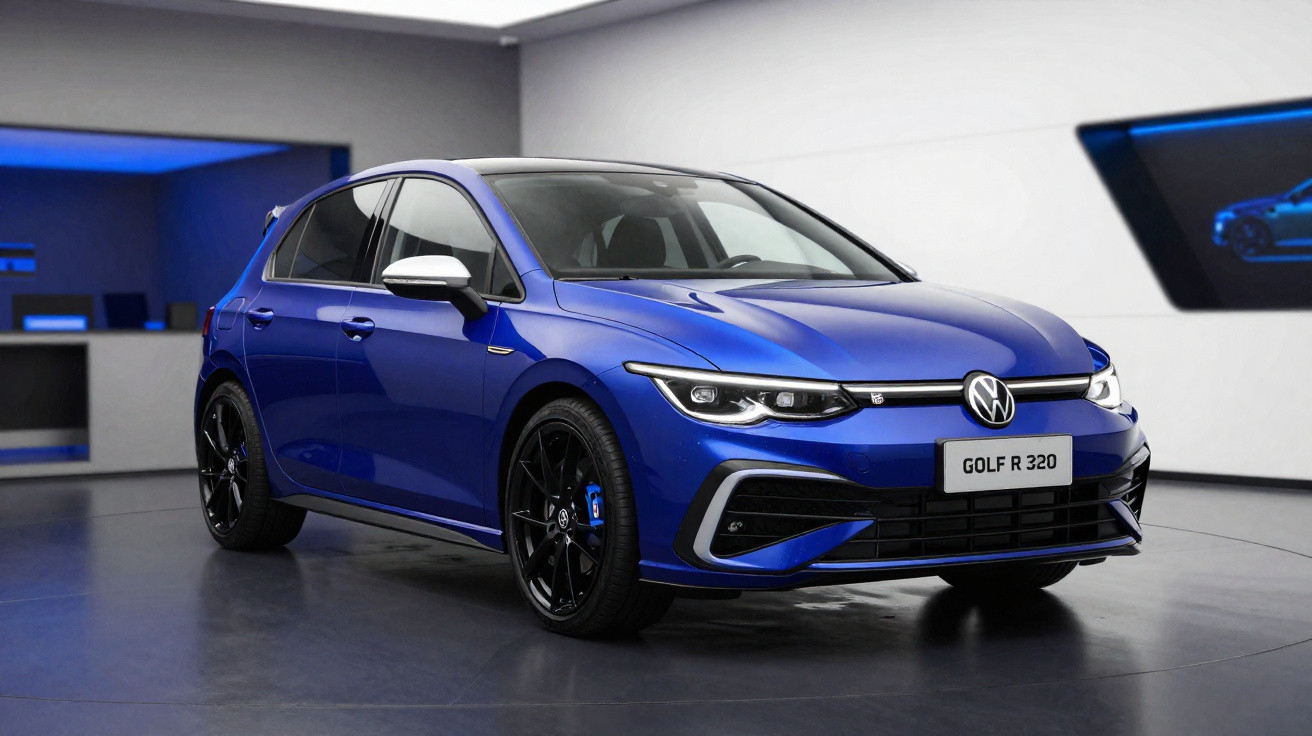
At the start of the century, Volkswagen wanted a genuinely special model to outgun the Golf GTI, but doing so with only a lightly uprated turbocharged four-cylinder would not have been straightforward. That is why the first Golf R, the R32-launched in 2002 and built on the Golf Mk4-arrived with a naturally aspirated 3.2-litre V6 producing 240 cv and 320 Nm. It also brought 4×4 drive, a six-speed manual gearbox and, later on, a dual-clutch transmission (DSG); it was the first production car to receive it.
In 2005, it made way for the Golf Mk5 R32, whose engine received small revisions that lifted output by 10 cv (to 250), while peak torque stayed the same. The DSG increasingly became the popular choice, and it cut three tenths from the 0 to 100 km/h time versus the manual (6.2s vs 6.5s).
This would be the last Golf R to use a six-cylinder engine. In 2009, based on the Golf Mk6, the model would be introduced simply as Golf R-R for Racing (with no number attached). The V6 was replaced by a 2.0-litre four-cylinder, now with a turbocharger and direct injection, enabling maximum output to climb to 271 cv.
By 2013, the Golf R (based on the Golf Mk7) became the first Golf to reach 300 cv (and 380 Nm of torque). In its final two years, it pushed beyond that threshold, rising to 310 cv.
The fifth Golf R
This fifth member of the Golf R family, built on the Golf Mk8, retains the same engine (and the same seven-speed DSG automatic), but with a little more boost to reach 320 cv and 420 Nm. The downside is a much higher price (57 000 euros) than the 245 cv GTI (sold for 11 300 euros less), even if it sits only slightly above the 300 cv GTI Clubsport (which costs just 2700 euros less).
From the outside, the R is set apart by bespoke bumpers, larger air intakes and a lower lip inspired by motorsport. There is also an illuminated strip across the middle of the front grille, serving as a daytime running light. The mirror caps are finished in matt chrome, and the standard 18-inch alloys have a unique design (the GTI uses 17-inch wheels), as do the optional 19-inch items.
At the rear, the gloss-black aerodynamic diffuser and the four exhaust outlets provide the headline. The drama can be turned up further with the R-Dynamic pack, which adds an XL-sized rear spoiler alongside those larger wheels. For looks-but above all for the Golf R’s sound-buyers can choose an Akrapovič titanium exhaust system (7 kg lighter), with a note that the driver can adjust from their "command post".
Inside, there are further R-specific touches: seats trimmed in black and blue fabric with integrated head restraints (optionally, alternative leather seats are available with side sections that mimic carbon fibre, matching the dashboard surrounds), a steering wheel with blue accents and decorative stitching, a black headlining, and stainless-steel pedals and footrest. Even though the front seats are more supportive, Volkswagen ought to offer-at least as an option-adjustable side bolsters and an extendable thigh support.
320 cv and 4.7s from 0 to 100 km/h
The 2.0-litre engine delivers the stated 320 cv and 420 Nm-just 20 cv and 20 Nm more than the GTI Clubsport, the next step down in power. Because it is 90 kg lighter (the 4×4 hardware adds mass…), the Clubsport ends up with broadly similar performance. Even so, it is still a second slower in the 0 to 100 km/h sprint (4.6s versus 5.6s), which mainly reflects the R’s ability to put its output on the road with far fewer traction losses than a front-wheel-drive GTI.
Volkswagen’s engineers had managed to extract a peak of 333 cv from this generation of the EA888 engine, but anti-pollution rules forced the adoption of a particulate filter and output dropped by 13 cv. Top speed can be raised from 250 to 270 km/h by selecting the optional Performance pack (in Germany, that can make sense for drivers with a racer’s streak who can legally exploit the difference on many motorways).
Ahead of serious rivals
In in-gear acceleration-arguably more relevant than outright standing-start times away from a track-the Golf R does not hold a major advantage over the already excellent GTI Clubsport. The Clubsport is lighter and reaches peak torque at a marginally lower engine speed (2000 rather than 2100 rpm). However, at higher revs it becomes clear that the R’s cylinders are "more full of breath", and maximum torque remains available until 150 rpm later (5350 rpm).
It is worth underlining that all of this plays out at a very high level of ability, with credit shared between the engine’s sharp response and its strong pairing with the fast seven-speed DSG. As evidence beyond the Volkswagen universe, the Golf R is quicker (even if only by one to three tenths) than key rivals such as the Mercedes-AMG A 35, MINI JCW GP, BMW M135i (all with 306 cv) and the Audi S3 Sportback (310 cv)-all of them also featuring four-wheel drive.
Improvements to the 4×4 system
On that note, the Golf R keeps all-wheel drive, still capable of varying torque delivery between the front and rear axles. Now, though, it also features a rear limited-slip differential enabling torque vectoring, allowing all the drive it receives to be sent to either rear wheel (achieved via two clutches, one at each differential output).
That makes it possible, for instance, to generate a yaw moment that tightens the line (boosting grip in a corner taken under hard acceleration). It also enables controlled slides if the car is equipped with Drift driving mode. That mode-together with Special (set up for Germany’s Nürburgring circuit, where it is best not to have adaptive dampers that are too "stiff" because of the constant surface imperfections)-is among the extra programmes included in the R-Performance pack.
As standard, there are always four modes: Comfort, Sport, Race and Individual. In Race, intended for circuit use, the stability control becomes more permissive, and the rear limited-slip differential sends more drive to the outside wheel in a bend (to make oversteer and rear-end slip easier to provoke).
Up front, the XDS electronic differential applies a similar approach, helping pull the car into the corner and preventing the line from running wide when driving turns more like proper piloting. The suspension itself, with independent set-ups on all four wheels, has been retuned with springs that bring the car 5 mm closer to the road than the GTI-where the ride height was already 20 mm lower than on less powerful Golfs.
A multi-faceted personality
The outcome of this very complete technological "cocktail" is clearly positive. Ride comfort ranges from reasonably compliant (for a car with these tyres, this power and these intentions) in Comfort mode to genuinely firm at the other extreme-where the Golf R’s eager responses and steering accuracy (progressive and direct, needing only 2.1 turns lock-to-lock) are most appreciated, working well with the upgraded brakes (the same as the GTI Clubsport’s).
With the various modes on offer, the Golf R genuinely delivers a versatile dynamic character, suiting different road types, changing traffic conditions and even shifts in the driver’s mood.
Technical specifications
| Item | Specification |
|---|---|
| Model | Volkswagen Golf R |
| Engine | |
| Position | Front, transverse |
| Architecture | Inline 4-cylinder |
| Capacity | 1984 cm³ |
| Valvetrain | 2 overhead camshafts; 4 valves per cylinder (16 valves) |
| Induction | Direct injection, Turbo, Intercooler |
| Power | 320 cv (rpm not available) |
| Torque | 420 Nm between 2100-5350 rpm |
| Transmission | |
| Drive | Four-wheel drive |
| Gearbox | Seven-speed automatic (dual-clutch) |
| Chassis | |
| Suspension | Front: Independent, MacPherson; Rear: Independent, multi-link |
| Brakes | Front: Ventilated discs; Rear: Discs |
| Steering / turns lock-to-lock | Electric assistance / 2.1 |
| Dimensions and capacities | |
| Length × width × height | 4290 mm × 1789 mm × 1458 mm |
| Wheelbase | 2628 mm |
| Boot capacity | 374-1230 l |
| Fuel tank | 50 l |
| Tyres | 225/40 R18 |
| Weight | 1551 kg (EU) |
| Performance and consumption | |
| Top speed | 250 km/h; 270 km/h with R Performance pack |
| 0-100 km/h | 4.7s |
| Combined consumption | 7.8 l/100 km |
| CO₂ emissions | 177 g/km |
Authors: Joaquim Oliveira/Press-Inform
Comments
No comments yet. Be the first to comment!
Leave a Comment