
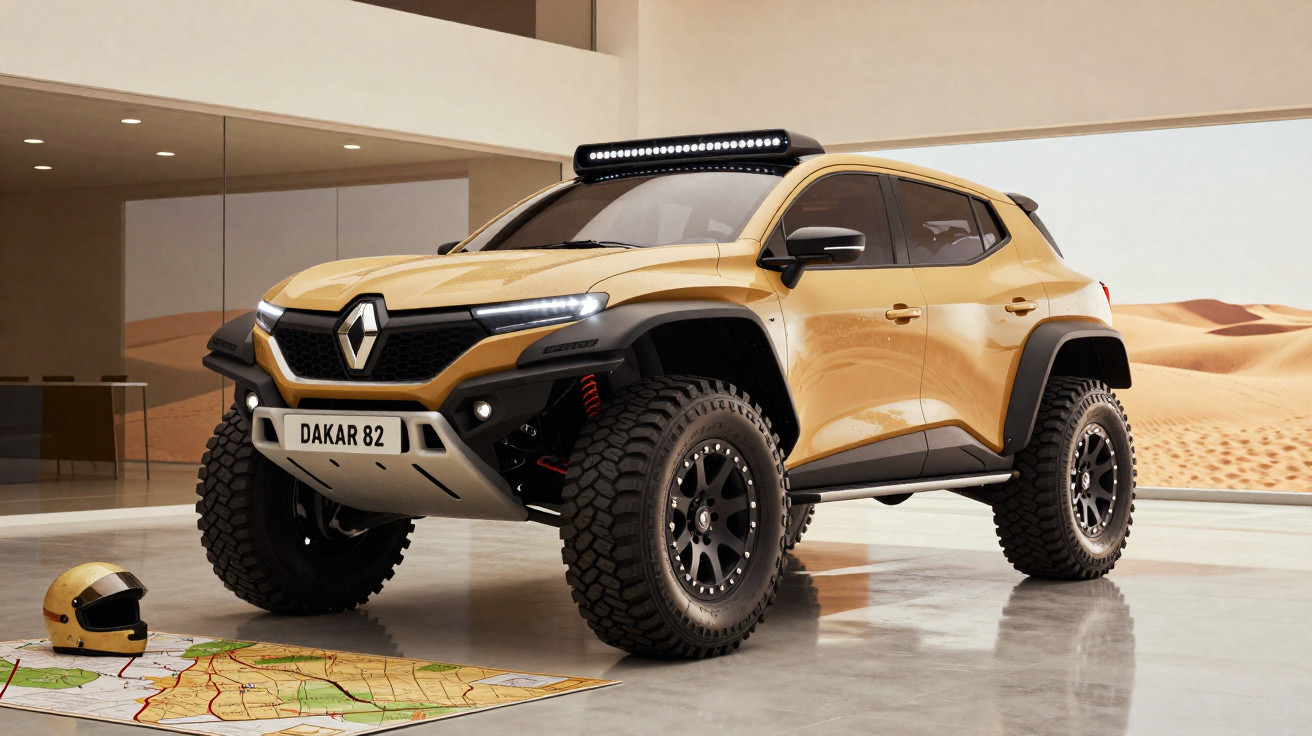
When you look at the Renault 20-the latest in a long line of diamond-badged range-toppers that, in truth, remained fairly under the radar-it hardly seems like the obvious recipe for a Dakar Rally winner.
Yet that is exactly what unfolded at the 1982 Dakar Rally, where a Renault 20 Turbo 4×4 took victory in what is widely regarded as the toughest rally in the world. It became the model’s ultimate “moment of glory”, especially for a car that ultimately enjoyed a rather low-key commercial life.
How did a comfortable saloon like the Renault 20 end up tackling Dakar? Somewhat unexpectedly, Renault itself was the driving force behind the idea.
To understand why, it helps to wind the clock back a few years in Dakar history-and it may not be so surprising to find another Renault at the centre of the story.
In the 1979 and 1980 editions of the Dakar Rally, one of the standout entries was the Renault 4L Sinpar. It secured 5th place in 1979 and an outstanding 3rd place in 1980-by which point the 4L already had four-wheel drive.
The 4L Sinpar was built by brothers Claude and Bernard Marreau, and the results they achieved very much caught Renault’s attention. That success encouraged the French marque to take the rally more seriously, and it set up a challenge from Renault to the Marreau brothers:
“Can you do the same with our range-topper, the Renault 20?”
Renault’s decision to use the larger Renault 20 reflected its desire to compete with one of its newer models-the 4L had arrived back in the 1960s, while the R20 launched in 1976-and it ultimately chose its flagship of the time, leaving aside the even newer Renault 18 (1978).
To “sweeten” the proposal for the Marreau brothers, Renault supplied them with a Renault 20 bodyshell and gave them “carte blanche” to transform it in whatever way they felt necessary to survive the most demanding rally in the world.
A “cut-and-shut” engineering job
Unsurprisingly, the Renault 20 Turbo the Marreau brothers eventually ran at Dakar bore little resemblance to what you could buy from a dealer.
Ride height was increased, protective elements and body reinforcements multiplied, and-just as you would expect-front-wheel drive was replaced by a four-wheel-drive system. But that was only the start.
The independent rear axle made way for the tougher rigid axle from the Renault Trafic. It also adopted the van’s 14-inch wheels and wider tyres. And to ensure it had the power it needed, the project “borrowed” an engine from the Renault 18 Turbo, its “younger brother”-as the Renault 20 did not offer turbocharged petrol engines.
In the Renault 18 Turbo, originally launched in 1980, the 1.6-litre four-cylinder produced 110 hp; in this “Dakar-proof” Renault 20, output was raised to 135 hp.
To better cope with Dakar’s punishment, even the exhaust system did not escape modification. Rather than running underneath the 20 Turbo-as is typical-the exhaust exited through the bonnet and then rose up the A-pillar to the roofline, resembling a snorkel-which, interestingly, the Renault 20 Turbo did not actually have.
The reasons for this change are unknown, but it is likely the Marreau brothers routed the exhaust to the roof either to protect it from potential impacts or to “make room” for the four-wheel-drive hardware.
In place of the rear seats, the cabin now housed two spare tyres and a fuel tank… with a capacity of 200 litres (!).
To keep weight at sensible levels-helping both performance and fuel consumption-the Marreau brothers replaced several body panels on the Renault 20 Turbo 4×4 with aluminium parts (bonnet, front wings and the outer door skins). The side windows were also swapped for plexiglass.
A quiet debut… followed by a winning exit
The first Dakar entry came in 1981 and… it went very badly. The Marreau brothers were forced to retire after multiple impacts, with the mechanics of their Renault 20-equipped with a turbo engine and four-wheel drive-unable to withstand the punishment.
That outcome was also linked to the limited time available to test the new machine-after all, they only finished it a month before the event.
Even so, the winning potential of their Renault 20 Turbo 4×4 was clear-they even led the rally for a period.
They returned for the 1982 Dakar Rally and, to the surprise of many, claimed their first Dakar Rally victory, beating the Renault 20 Turbo 4×4 against rivals such as the works Mercedes-Benz entries of Jacky Ickx and Jaussaud, as well as the Lada Niva driven by Briavoine and Deliaire.
In 1983 the Renault 20 Turbo did not return to Dakar to “defend the title”, but the relationship between the Marreau brothers and Renault continued-this time with the brothers competing in a Renault 18 Break 4×4, the model they used in the 1983, 1984 and 1985 editions.
Unfortunately, they were never able to repeat the Renault 20’s victory-1982 would remain the Marreau brothers’ only Dakar win-but the results were still strong: 9th place in 1983 and 5th place in both 1984 and 1985.

Comments
No comments yet. Be the first to comment!
Leave a Comment