
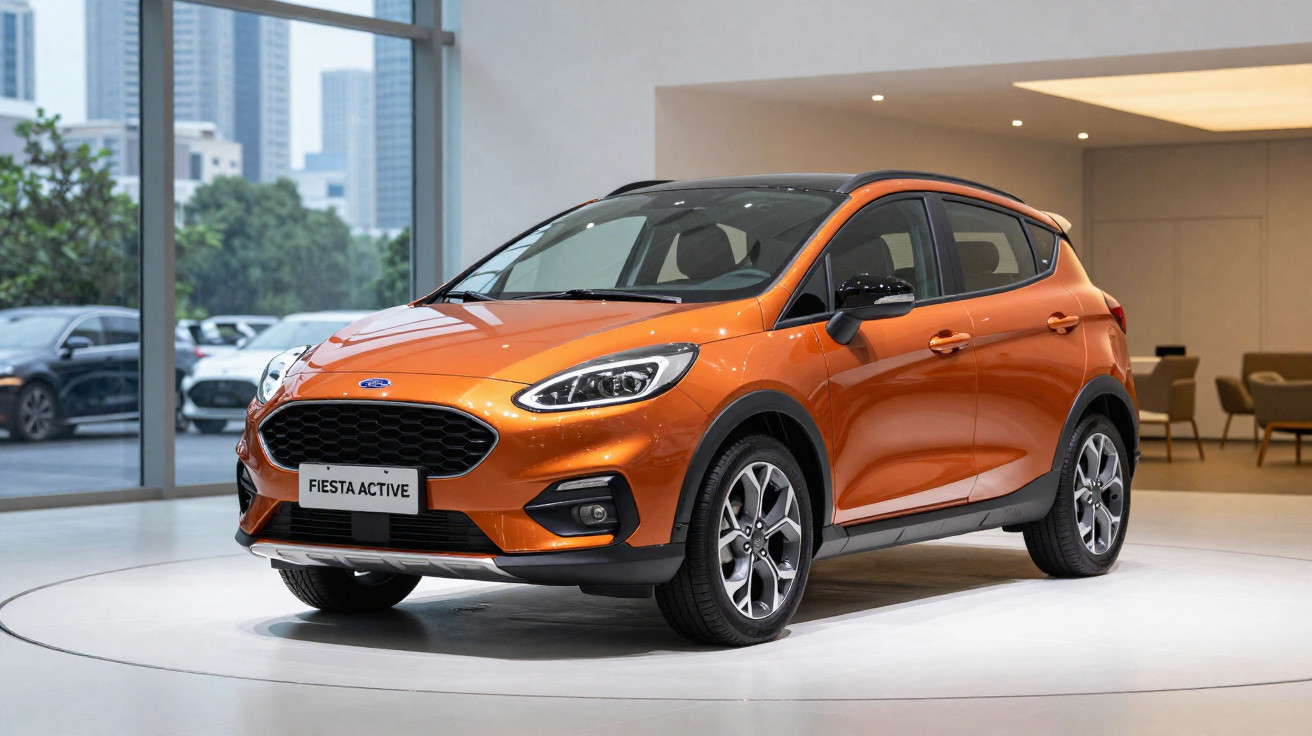
Despite styling cues borrowed from today’s SUV/crossover-obsessed car market, the Ford Fiesta Active is (oddly) a fairly rare proposition in the B-segment.
In fact, these days only the Hyundai i20 Active and the Dacia Sandero Stepway offer similarly more… adventure-themed versions in this class.
So, to understand whether Ford’s approach has what it takes to tempt us away from the ever more common and numerous SUVs and crossovers on sale - and even though Ford itself fields two different options in this space, the EcoSport and the Puma - we put the Fiesta Active to the test.
The looks deliver on the outside…
Whether it’s the protective plastic cladding, the larger-diameter alloy wheels or the extra ride height, the Fiesta Active genuinely manages to stand out visually.
Yes, it’s more understated than a conventional B-SUV. Even so, it also comes across as more youthful and less family-orientated in its appearance - perhaps helped by its more compact footprint - than many small SUVs.
But the Fiesta Active isn’t just about looks. Thanks to the increased ground clearance and the plastic protection, Ford’s supermini feels more at ease both in town and on the sort of weekend getaways where a little extra reassurance can be welcome.
…but the cabin doesn’t stand out as much
Predictably, it’s inside where the Fiesta Active diverges most from B-SUVs, particularly when it comes to passenger space.
Those tighter exterior dimensions translate directly into a more compact cabin once you compare it with the longer, wider and taller B-SUVs - after all, this is still a supermini.
It’s also worth remembering that many B-SUVs are designed with families in mind from the outset, whereas the Ford Fiesta Active isn’t. Even so, rear-seat space is more than acceptable for two occupants, matching other offerings in the class such as the French Renault Clio and Peugeot 208.
The 311-litre boot is also in line with most rivals in the segment. For anyone who needs to carry their “entire home on their back”, larger B-SUVs are simply better equipped. As a case in point, its “sibling” the Puma adds 145 l of capacity and also features a MegaBox beneath the boot floor.
If the exterior tweaks that separate the Fiesta Active from the rest of the Fiesta line-up are effective and well judged, the cabin, by contrast, lacks that same sense of distinctiveness.
That said, even though it uses a design similar to other Ford models (the Focus, for instance) and mirrors the same general style and control layout, the Fiesta Active’s interior feels sturdy and is ergonomically sound - everything falls to hand exactly where you expect it to be.
Dynamically… it’s a Fiesta
Where the Ford Fiesta Active most clearly sets itself apart from B-SUVs - and even from plenty of superminis - is in the way it drives, and not even the extra 18 mm of ground clearance seems to have dented its dynamic abilities.
The steering is accurate and direct with an appropriate weight, the chassis delivers a very good balance, and the added ride height can even help you avoid trouble if the road surface springs a nasty surprise.
Everything about the Fiesta Active encourages you to seek out a twisty road, and once you do, it doesn’t disappoint: Ford’s small hatch is more entertaining than most of its competitors. Against B-SUVs, the difference is, unsurprisingly, even clearer.
Once you leave the “playground” behind and tackle urban driving, the Fiesta Active again feels distinct from B-SUVs in character, despite the influence those models had on its creation.
Smaller and more nimble, it seems to fit into every gap you can find. On the motorway it also impresses with the stability it offers, with the little Fiesta Active proving to be a solid long-distance companion.
Add to that the 1.0 EcoBoost engine with 125 PS (cv), which lives up to the many awards it has received. Frugal (even without selecting “Eco” mode), it feels smooth and progressive, and it pairs brilliantly with the six-speed manual gearbox.
And speaking of that gearbox, Ford deserves credit. It’s precise, with a short throw, and it’s right up there with the (much-praised) unit used in the Mazda CX-3 - a reminder of why it matters to preserve this kind of transmission, given how much it contributes to an engaging driving experience.
When the tarmac runs out, the “Slippery” mode (which partially relaxes the traction and stability controls) allows you to go a bit further - an unusual feature even among models that label themselves SUVs.
As for fuel consumption, achieving averages of 5 l/100 km on mixed routes wasn’t difficult, and even when I got carried away with the engine/gearbox/chassis combination, figures didn’t stray far from 6.5 l/100 km.
Is it the right car for me?
In a market where SUVs increasingly rule the roost, Ford has created an intriguing alternative by giving its “evergreen” Fiesta a more adventure-ready version.
Not everyone needs a larger, pricier SUV, yet many people do enjoy the tougher, more outdoorsy look that helps you stand out - and they also value the extra centimetres of ground clearance that make everyday use of a supermini more relaxed and versatile.
The Ford Fiesta Active doesn’t make as many practicality compromises as a B-SUV does, positioning itself as a better fit for anyone who simply doesn’t need lots of space.
Enjoyable to drive, powered by a capable engine and equipped to take you a little further, the Fiesta Active makes a persuasive case for buyers who want extra versatility but don’t need - or don’t want to “give in” to - the family-focused priorities that define most SUVs.
Note: Ford has very recently stopped selling the Fiesta Active with the 1.0 EcoBoost engine producing 125 PS (cv). For now, it is still possible to find stock vehicles available. The Ford Fiesta Active is now offered only with the 1.0 EcoBoost with 95 PS (cv) and the 1.5 TDCI with 85 PS (cv). The 1.0 EcoBoost with 125 PS (cv) is available only with the Fiesta Vignale.
Comments
No comments yet. Be the first to comment!
Leave a Comment