
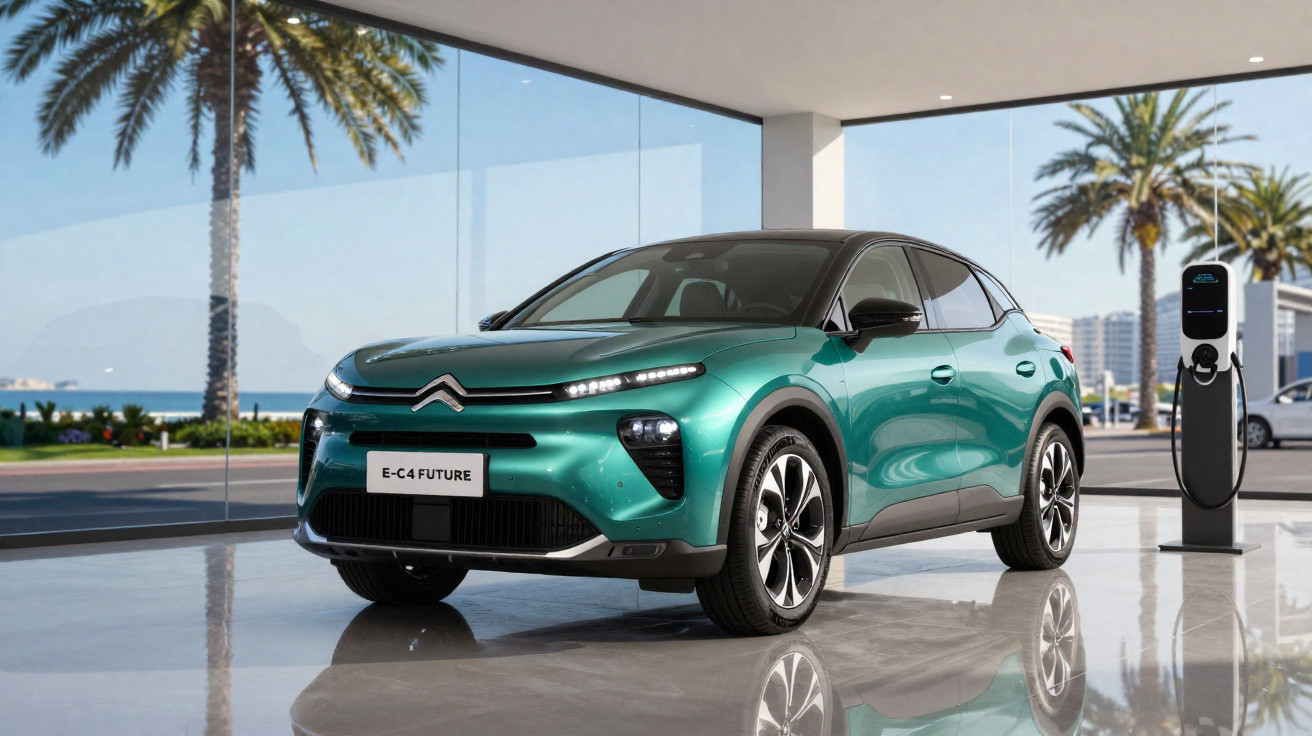
The Citroën ë-C4 arrives in Portugal in the very first month of 2021, using the same electric drivetrain as the Peugeot e-208/e-2008 and Opel Corsa-e. The result is real-world range that sits below 300 km and merely average performance, though with a more even-handed dynamic balance than the petrol or Diesel versions.
I’ll start by “getting out of the way” what this 100% electric C4 shares with the 1.2 petrol version I tested not long ago.
On the outside, it’s the divisive styling (some will love it; others will turn up their noses-and I’m in the second camp), with a few lines that recall some less-inspired Asian designs. The body sits higher than a traditional C-segment saloon/hatchback (but lower than a C-SUV), which makes getting in and out easier: you slide in and out rather than having to drop down and climb up.
Inside, there’s notably generous space in the second row, helped by a longer wheelbase than other Stellantis (PSA) models that use the same CMP platform, such as the Peugeot 208/2008 and Opel Corsa. The driving position is high in a very bright cabin, yet rearward visibility is poor-blame the steeply raked rear window with a central spoiler, plus very wide rear pillars to give a coupé-like vibe. The dashboard materials feel decent but could be better; there are plenty of storage areas for small items, including an unusually original mount to secure a tablet in front of the front passenger; and the graphics are minimalist, while the range of digital screen configurations feels underdeveloped.
The good news is that the boot keeps the same 380 litres as the internal-combustion versions.
A “for everyone” electric system in the Citroën ë-C4
The PSA Group has been committed to offering an electric variant of newly launched models in the B and C segments across Peugeot, Opel, DS and now Citroën. It has favoured this approach over creating EVs with distinctly different exterior designs and cabins (as Volkswagen, Mercedes-Benz, and initially BMW did). Both routes make sense, but here the big advantage is that the customer’s final decision can be based on the type of propulsion that suits them best-rather than on other vehicle-specific compromises: petrol, Diesel, or 100% electric.
That said, I think there could have been a few drivetrain variations (as Volkswagen does), so not every model relies on the same 136 cv electric motor fed by a 50 kWh lithium-ion battery. In B-segment cars (Corsa, 208) it feels adequate; here in the C segment it starts to seem a bit too “tight”, both for performance and for range.
On the range question, looking at what’s available in the market (and using type-approved ranges as the benchmark), the ë-C4 still presents well: its promised 350 km betters rivals such as the Kia e-Niro and the Hyundai Kauai Electric (289 km with the 39,2 kWh battery)-which use the same technical base-as well as the Mazda MX-30 (200 km). It also tops the Peugeot e-2008 (325 km) which, despite being “in-house”, is likely to be one of its key competitors.
Clearly stronger is the Volkswagen Group, which goes on the offensive with multiple ID.3 variants. Some exceed 500 km of range and offer 204 CV in the version with the larger 77 kW battery, as well as with the mid 58 kWh pack. And while it’s possible to argue that an ID.3 in these specifications is a more expensive car, that may not necessarily hold true once the Skoda Enyaq reaches the market-much larger (and also positioned as a crossover)-in the first half of 2021.
Middling performance
In terms of performance, the picture doesn’t change much-and that is, of course, down to the power and torque figures. In this competitive set there isn’t an EV that’s less powerful than the ë-C4. It matches the two Korean models and the 2008 on power (those same 136 cv), but it’s outgunned by the Mazda (145 CV) and by Volkswagen (in the mid and top versions, with 150 cv and 204 cv).
And the French car is also the weakest on torque: 260 Nm, which trails the Mazda’s 271 Nm, Volkswagen’s 310 Nm, and… 395 Nm for Hyundai/Kia.
In real terms, that translates into a less competitive 0 to 100 km/h time-9,7s, which can drop by three tenths in Sport mode at the expense of range-for a car with family duties (and which, even with only the driver aboard, already weighs 1616 kg). Again, it lands around the level of the Asian rivals mentioned, but it’s clearly worse than what the similarly positioned Peugeot e-2008 manages (8,1s).
In town driving, the sense of briskness can still be quite convincing, because full torque arrives in one hit and the strongest shove is below 60 km/h. On faster roads, however, the story changes-and not for the better.
A more balanced driving experience
The steering does its job without being particularly engaging, but the suspension genuinely benefits from the extra mass of the batteries mounted beneath the floor of the Citroën ë-C4. The additional 250 kg compared with the 1.2 three-cylinder 130 cv helps cornering stability, which wasn’t a strong suit of the C4 I drove previously. Comfort, by contrast, was-thanks to the double hydraulic bump-stop dampers. Now, with a lower centre of gravity and more weight, the compromise between comfort and stability comes out improved.
Braking is strong and doesn’t show early signs of fade, although it takes some acclimatisation to modulate the brake pedal. It seems to ignore the first 25% of travel when you press it, as happens with many regenerative braking systems.
On that note, it’s worth adding that the driver can choose stronger energy recuperation on deceleration (there’s a B button below the gear selector for this), but it still never enables true “one-pedal driving” using just the accelerator (pressing and releasing it), because the deceleration effect isn’t strong enough. Right next to it, there’s a button that lets you “call up” the most relevant information related to consumption statistics and averages.
There are also the familiar Normal, Eco and Sport drive modes, selected via the switch to the right of the gear selector and the (electric) parking brake. In Eco, the motor’s output is limited (though if you floor the accelerator, maximum levels return to deal with a sudden need for performance). In Sport, the steering gains weight and acceleration is stronger, but you have to wait a while (more than 2 seconds) between selecting the mode and feeling its effect.
Closer to 250 than 350…
By the end of the test, it was clear that the ë-C4’s average consumption-and therefore its range-is worse than the official figure suggests. Over 101 km driven, I used half the battery charge, with only 104 km left “in the tank”, which adds up to just over 200 km.
I accept that, in a test like this, the car is driven faster and more demanding than an owner would in day-to-day use, and that the 22 kWh/100 km shown by the trip computer was inflated as a result. Even so, in “real life”, only in a record-attempt run would it drop below 18,5 kWh/100 km-around 2 kWh above the official number. That means a full charge will rarely let you go beyond 250 km, unless you mostly stay in an urban environment.
We already know EVs are considerably more expensive than internal-combustion cars, and that holds here too. The new Citroën ë-C4 costs 7000 euros more than a C4 1.5 BlueHDi with 130 cv (both with Feel Pack equipment) and automatic transmission (39 400 euros versus 32 400 euros).
For a business customer, though, the calculation can look very different. With a 48-month agreement (80 000 km total and 1667 km/month), factoring in payments, energy, maintenance, insurance and taxation, the electric car comes out 100 euros per month cheaper than the Diesel (405 euros versus 505 euros). That’s a meaningful gap.
Technical specifications
| Item | Citroën ë-C4 |
|---|---|
| Electric motor | |
| Position | Front transverse |
| Power | 136 cv (100 kW) |
| Torque | 260 Nm |
| Battery | |
| Type | Lithium-ion |
| Capacity | 50 kWh (46 kWh “usable”) |
| Transmission | |
| Drive | Front-wheel drive |
| Gearbox | Single-speed reduction gearbox |
| CHASSIS | |
| Suspension | FR: MacPherson; TR: Torsion beam. |
| Brakes | FR: Ventilated discs; TR: Discs |
| Steering/Turning circle diameter | Electric assistance; 10,9 m |
| No. of steering wheel turns | 2,75 |
| DIMENSIONS AND CAPACITIES | |
| Length x Width x Height | 4,36 m x 1,80 m x 1,525 m |
| Wheelbase | 2,67 m |
| Boot | 380-1250 l |
| Weight | 1616 kg |
| Wheels | 195/60 R18 |
| PERFORMANCE, CONSUMPTION, EMISSIONS | |
| Top speed | 150 km/h |
| 0-100 km/h | 9,7s (Sport mode: 9,4s) |
| Combined consumption | 16,6 kWh/100 km |
| Combined CO₂ emissions | 0 g/km |
| Charging | |
| Maximum DC charging power | 150 kW |
| Maximum AC charging power | 11 kW |
| Full charging times | 230 V: more than 24 hours; 3,7 kW: 15 hours; 7,4 kW: 7,5 hours; 11 kW: 5 hours; 0-80% on DC, 100 kW: 30 minutes. |
Comments
No comments yet. Be the first to comment!
Leave a Comment