
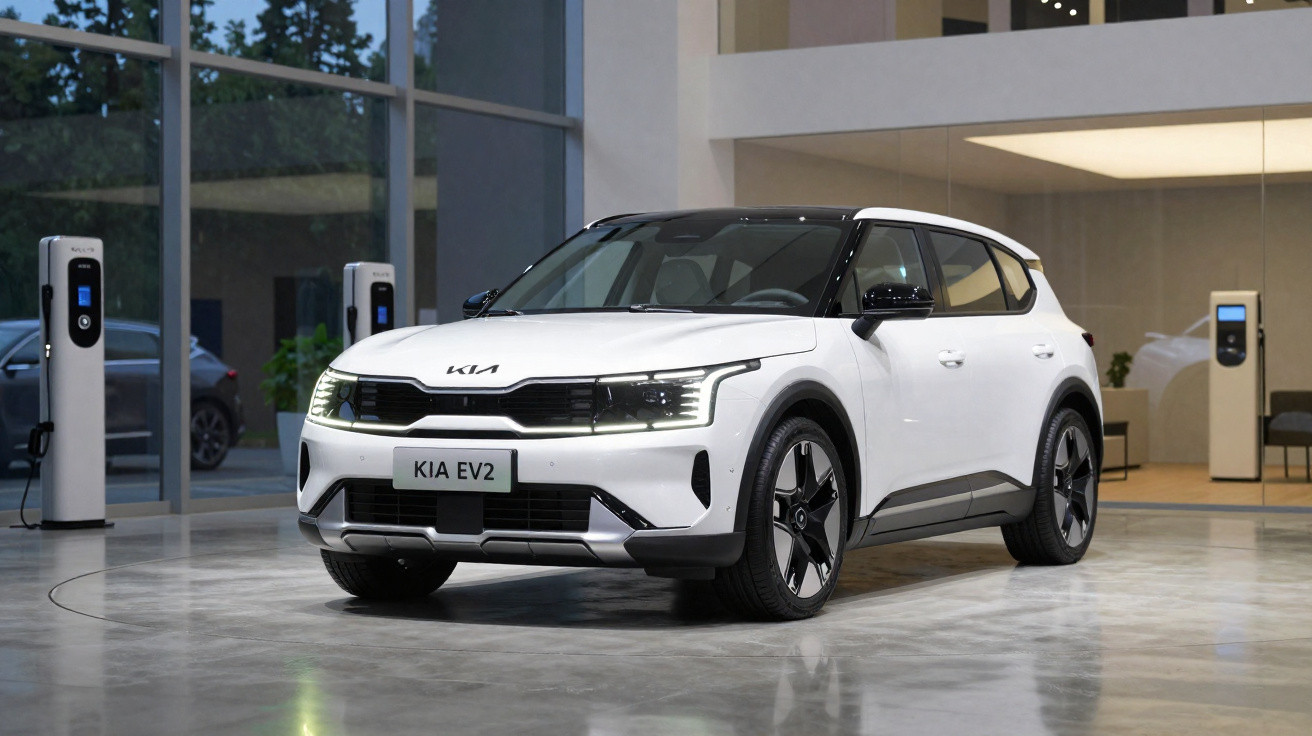
Although the Kia EV2 has already been seen on Portuguese soil - it appeared at the ECAR Show and Miguel Dias has already had the chance to drive it in Portugal - the prices for the South Korean brand’s most affordable electric model have only now been officially announced.
Designed with Europe in mind, the EV2 joins what is already one of the broadest 100% electric line-ups on the market. Kia says its range covers around 90% of the EV market and, with the EV2, it enters one of today’s most important and hotly contested areas: the B/B-SUV segment, which accounts for 46% of sales in Portugal.
Kia EV2 positioning in the B/B-SUV segment
With a sturdy look and styling that clearly draws from the SUV world, Kia’s smallest electric car ends up in a particularly compelling spot. On one side, it goes up against more conventional options such as the Renault 5, the Opel Corsa or the Dongfeng Box; on the other, it “winks” at buyers who prefer a more adventurous aesthetic.
Even so, Kia is keen to stress that if you want to compete head-on with models like the Ford Puma Gen-E or the Renault 4 E-Tech, the most suitable choice in its line-up remains the EV3.
Two batteries and record range
Built on the dedicated E-GMP electric platform and using a 400 V electrical architecture, the Kia EV2 reaches the market with two battery options and different powertrain proposals.
Entry-level battery: 42,2 kWh LFP
The entry version uses an LFP (lithium iron phosphate) battery with 42,2 kWh of capacity, paired with an electric motor delivering 108 kW (147 cv) and 250 Nm of torque. In this configuration, the EV2 claims up to 315 km of range, accelerates from 0 to 100 km/h in 8,7s and reaches a top speed of 161 km/h. The stated consumption ranges between 10,8-15,2 kWh/100 km.
Larger battery: 61 kWh NMC
In the higher-capacity option, the EV2 uses NMC chemistry (Nickel, Manganese and Cobalt) with 61 kWh. The headline figure is its maximum quoted range: up to 453 km per charge, a number that places the EV2 among the segment benchmarks.
Interestingly, this version is paired with a less powerful motor rated at 100 kW (136 cv), while keeping the same 250 Nm of torque. That translates into a 0 to 100 km/h time of 9,5s and the same 161 km/h top speed. For consumption, Kia points to figures between 10,3-15,2 kWh/100 km.
Charging power and times
For charging, both batteries support alternating current (AC) charging up to 11 kW. Under these conditions, the smaller battery can be fully charged in 4h05min, while the 61 kWh pack requires 5h35min.
On direct current (DC), maximum charging power is set at 118 kW, enabling a 10% to 80% charge in around 30 minutes, regardless of the version chosen.
Simplified line-up
Backed by a general warranty of seven years or 150 thousand kilometres, plus eight years or 160 thousand kilometres for the battery, the Kia EV2 is offered with a straightforward range structure.
The line-up is split into three trim levels: Urban, Dynamic and Drive. Urban and Dynamic are available exclusively with the 42,2 kWh battery, while the flagship Drive can be specified with either the smaller pack or the higher-capacity option.
The Urban version, which serves as the entry point to the range, also stands out for being the only one offered with just four seats. As for the prices of Kia’s most affordable electric model, you can find them in the table below:
| Version | Battery | Price |
|---|---|---|
| Urban | 42,2 kWh | - |
| Dynamic | 42,2 kWh | - |
| Drive | 42,2 kWh / 61 kWh | - |
Comments
No comments yet. Be the first to comment!
Leave a Comment