
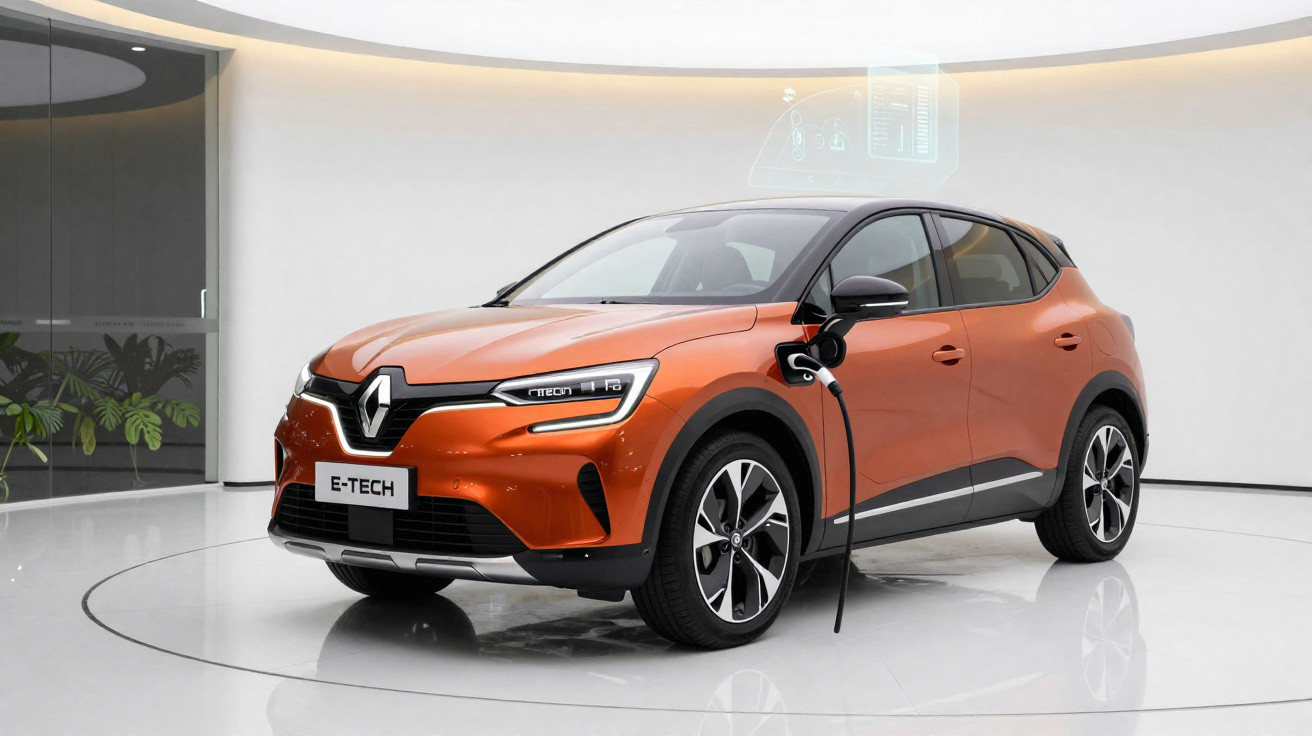
Variety certainly isn’t lacking. After putting the Captur through its paces with diesel, petrol and LPG power, we turned our attention to the Renault Captur E-TECH, the French SUV’s first electrified version.
Visually, I genuinely challenge you to spot what sets it apart from its stablemates - honestly… it’s the kind of task that can be as tricky as it is frustrating.
Why? Because the changes are almost non-existent, limited to a few (very) subtle badges and, naturally, the charging flap. That said, the Captur still looks appealing: familiar, attractive, and with the youthful edge you’d expect in this class.
Inside, (very) little changes
Much like the exterior, the cabin differences are mainly in the details: E-TECH logos and the addition of hybrid-related graphics in the instrument cluster (with a 10.2-inch screen) and in the infotainment system (a 9.3-inch vertically oriented display).
When it comes to space, the benefits of the CMF-B platform are still evident. The only real casualty is boot capacity - the batteries take up a fair amount of room - dropping from 406 to 536 litres down to a far more modest 265 to 379 litres.
Quiet please: it’s time to drive the Captur E-TECH
If, on the outside and inside, there’s little to separate the Renault Captur E-TECH from the rest of the range, the moment you sit behind the wheel the differences become clear. For a start, when you open the “Multi-Sense” menu, instead of the familiar “My Sense”, “Sport” and “Eco” modes you get “Pure”, “Sport” and “E-Save”.
The first mode - selected by default whenever the 9.8 kWh, 400 V battery has charge - prioritises full-electric driving and lets you see that the claimed 50 km of range in this mode (65 km in urban use) is realistic. To give you an idea, on a route with plenty of dual carriageway running I managed roughly 45 km using the battery alone.
Switch to “Sport” and the steering weights up and, whenever you bury the accelerator, all three motors work together, delivering almost instant torque.
Finally, “E-Save” is the setting you’ll want when, like me, you know you’ll finish your journey in the city and you’d like to keep some battery in reserve to drive there on electric power. In this mode you set a battery charge level to preserve for later; once that target is reached, electric assistance is restricted and the system favours the combustion engine.
Whichever mode you choose, the Captur E-TECH’s plug-in hybrid system stands out for how smoothly it operates, with the handover between the different motors being almost imperceptible. The one exception is when you accelerate flat-out.
Thrifty and quick?
As you may already know (particularly if you read that article), the Renault Captur E-TECH shares its powertrain with the Mégane ST E-TECH we tested a few months ago.
In other words, it combines a 1.6-litre petrol engine producing 91 hp and 144 Nm with two electric motors. The larger unit, rated at 67 hp and 205 Nm, provides propulsion, while the smaller one, with 34 hp and 50 Nm, acts as a starter motor and generator, harvesting energy during deceleration and braking.
The end result is 160 hp of maximum combined output, enabling the most powerful Renault Captur to run from 0 to 100 km/h in 10.1s and reach 173 km/h. Explosive performance? Not really - but that isn’t the Captur E-TECH’s purpose.
Its mission is efficiency, emitting as little CO₂ as possible, and with official figures of 1.5 l/100 km and 33 to 35 g/km, at least on paper, the Captur appears to deliver.
In real use - focusing purely on consumption - it’s easy to stay close to the quoted average while there’s battery charge (I managed 1.9 l/100 km without making a particular effort).
Once the battery was depleted and the Captur E-TECH was operating as a conventional hybrid, I recorded averages ranging from 3.9 l/100 km (with a lot of motorway and A-road driving) up to 5.8 l/100 km on urban and suburban routes.
As for performance, even if the numbers don’t look especially dramatic on paper, out on the road it doesn’t disappoint: there’s more than enough power for brisk progress, even with the Captur E-TECH loaded with passengers and luggage.
Finally, in dynamic terms, the Renault Captur E-TECH inevitably “pays the price” for its higher kerb weight, a consequence of the electrified drivetrain - 1639 kg versus a little over 1300 kg for the Captur TCe 140.
While the handling remains in line with other Captur versions (comfort-biased, yet predictable and effective), its limits arrive a bit earlier. You can feel the extra mass, which also shows up in body movements - it rolls and shifts more than the combustion-only Captur models.
Is it the right car for me?
Able to cover long distances without using a drop of petrol, the Renault Captur E-TECH is, like all plug-in hybrids, a car that demands “discipline” from its owner: frequent charging is essential for it to make sense.
And it’s not just that - you also need to run the numbers. After all, it may be the most economical to run, but it’s also, by a clear margin, the most expensive model in the line-up.
Look at your daily routine: how many kilometres you typically drive, and whether you can charge the Captur E-TECH whenever needed. If most of those kilometres are in town, then despite the higher purchase price it may pay off over the medium to long term through the savings you’ll make on petrol.
If, on the other hand, most of your driving involves a lot of dual carriageways and motorways, or access to charging points still isn’t ideal, the Renault Captur range includes another very cost-effective option: the LPG version, which is far more affordable.
It’s true it has 60 hp less and is slower, but it also weighs less, by around 364 kg (coming in at 1275 kg), offers more luggage space, and runs on a fuel that’s cheaper than petrol. Comparing Intens trim levels, it costs around 10 thousand euros less (23 690 euros “against” 33 940 euros).
With that in mind, and paraphrasing the former Prime Minister and now UN Secretary-General, António Guterres, when it comes to choosing the Captur E-TECH, the best advice is “to do the sums”.
Comments
No comments yet. Be the first to comment!
Leave a Comment