
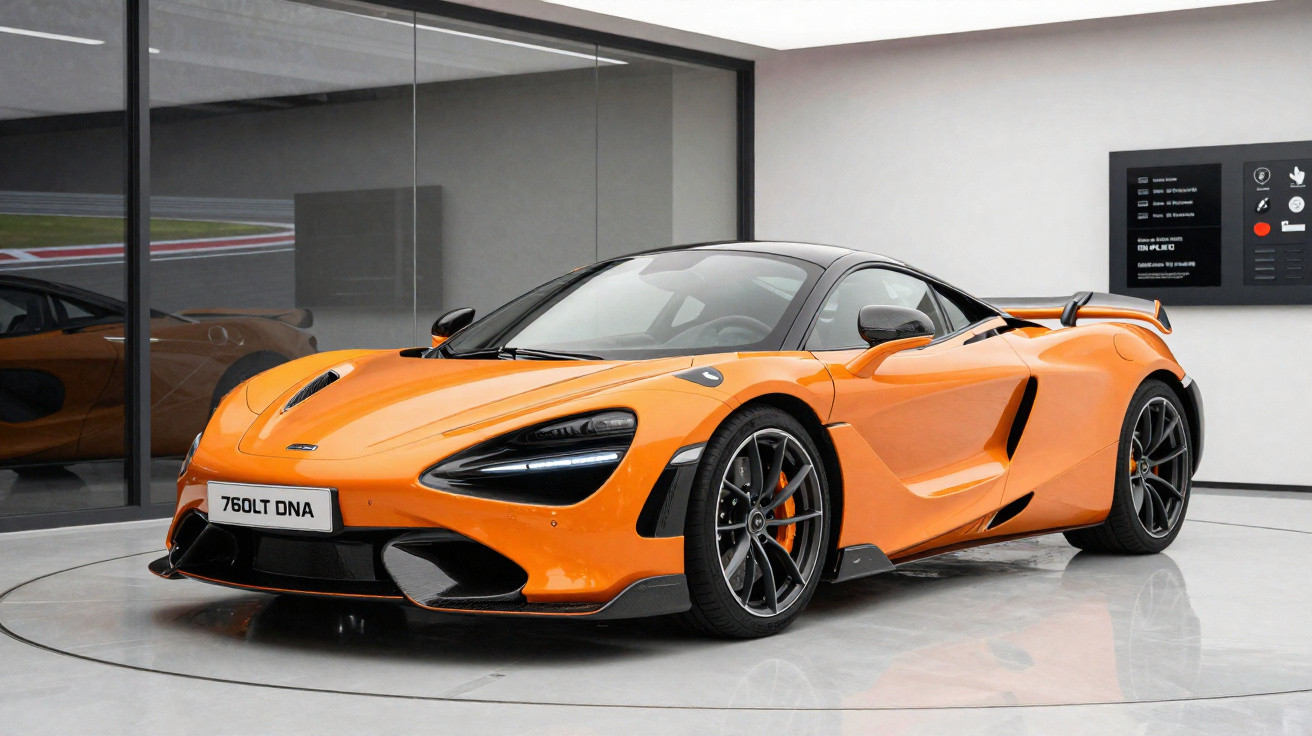
As one of the last truly pure internal-combustion supercars, if this era is going to end then it may as well do so in style. The McLaren 765LT’s calling card lists 765 hp, 0–100 km/h in 2.8 s and a 330 km/h top speed - plus Senna-derived components to make it devastatingly effective on track.
After a very tough 2020 (see box), one of the models McLaren is relying on for its turnaround (which has been very encouraging in China and is now beginning in the Middle East, while Europe and the US remain on stand-by) is this very 765LT. It is the fifth Longtail of the brand’s modern era, paying homage to the long-tailed McLaren F1 (Longtail) penned by Gordon Murray back in 1997.
The LT concept is straightforward: strip out weight, revise the suspension to sharpen the handling, and refine the aerodynamics with a larger rear wing and an extended front end too. That formula returned almost two decades later in 2015 with the 675LT Coupé and Spider, then two years ago with the 600LT Coupé and Spider, and now with this 765LT - for the moment only as a coupé (the convertible will be unveiled in 2021).
What has changed?
Compared with the already very capable 720S, the biggest strides are in aerodynamics and weight reduction - two defining priorities for any car that aims to be a true performance machine. Up front, the splitter and the rear wing are longer and, together with the carbon-fibre underfloor, the blades in the doors and a larger diffuser, they generate 25% more downforce than the 720S.
The rear wing can be set in three positions, and in its static setting it sits 60 mm higher than on the 720S. That not only increases downforce but also improves engine cooling. At the same time, its airbrake function reduces the car’s tendency to nose-dive under very heavy braking.
Although built from the 720S base, the 765LT also uses Proactive Chassis Control (hydraulically interconnected dampers at each end of the car, doing away with anti-roll bars) and adds 12 extra sensors (including an accelerometer at each wheel and two pressure sensors per damper).
When it came to throwing as many kilograms overboard as possible, McLaren’s engineers left no part unscrutinised.
Andreas Bareis, Director of McLaren’s Super Series model line, told me: “There are more carbon-fibre components in the bodywork (front splitter, front bumper, front underfloor, side skirts, rear bumper, rear diffuser and the longer rear wing), in the central tunnel, in the exposed floor and in the racing seats; a titanium exhaust system (-3.8 kg or 40% lighter than if it were steel), F1-derived materials applied in the transmission, full Alcantara interior trim, even lighter wheels and Pirelli Trofeo R tyres (-22 kg), and polycarbonate glazing as used in several race cars (0.8 mm thinner)… and we also deleted the radio (-1.5 kg) and the air conditioning (-10 kg).”
In total, 80 kg were removed, bringing the 765LT’s dry weight to just 1229 kg - 50 kg less than its lightest direct rival, the Ferrari 488 Pista.
Behind the cockpit and the carbon-fibre monocoque sits McLaren’s benchmark 4.0-litre twin-turbo V8 (mounted on supports five times stiffer than those of the 720S). It also borrows lessons and hardware from the Senna to reach a peak output of 765 hp and 800 Nm (the 720S has 45 hp and 30 Nm less, while the 675LT is down by 90 hp and 100 Nm).
With compliments from the Senna
A number of technical choices deserve special attention - not least because they were effectively “donated” by the sensational Senna, as Bareis explains: “We took the forged aluminium pistons from the McLaren Senna, achieved lower exhaust back-pressure to raise power at the top end, and optimised acceleration by 15% in the mid-range.”
The 765LT’s ceramic brake discs are also clamped by calipers “borrowed” from the McLaren Senna, and the caliper cooling technology comes directly from F1. The end result is crucial: it needs less than 110 m to come to a complete stop from 200 km/h.
The chassis also receives updates. The steering remains hydraulically assisted, but the more meaningful changes are in the axles and suspension. Ride height drops by 5 mm, front track grows by 6 mm, and the springs are lighter yet reinforced - which, according to Bareis, translates into greater stability and more grip: “By pitching the car forward and giving it more width at the front we increase mechanical grip.”
Another visual clue to just how serious this McLaren 765LT is comes from the four tightly grouped titanium exhaust outlets, ready to unleash a soundtrack that makes anyone straighten up as it passes.
At Silverstone… what better stage?
A quick glance at the specifications only heightened the anticipation before heading out at Silverstone - the perfect venue to add a sense of occasion to this first drive in the new McLaren: 0–100 km/h in 2.8 s, 0–200 km/h in 7.0 s and a 330 km/h maximum speed, figures made possible by a 1.6 kg/hp power-to-weight ratio.
Those numbers hold up in the real world. The near-blink sprint to 100 km/h is on par with the Ferrari 488 Pista, Lamborghini Aventador SVJ and Porsche 911 GT2 RS. But 200 km/h arrives 0.6 s, 1.6 s and 1.3 s earlier, respectively, than it does in that trio of formidable rivals.
With the harness restricting movement, I immediately appreciate the raised centre console and the door pull strap, which lets you close the door with barely any shift in your body once you have dropped into the bucket seat. At the centre of the minimalist dashboard there can be an 8-inch screen (I’d prefer it angled more towards the driver, because any tenth saved keeping eyes on the track is welcome…) used to manage the infotainment functions.
On the left is the control area, with rotary dials to select Normal/Sport/Track for Handling (where the stability control can also be switched off) and Powertrain, while the Launch mode button sits between the seats.
Lights… camera… action!
Between thumb and the other four fingers (inside gloves) on each hand sits a perfectly sized steering wheel with no buttons on its face - exactly as it should be, doing only what it was originally intended for: turning the front wheels (there is a horn in the middle…). Behind the wheel are carbon-fibre shift paddles and an instrument cluster with two side dials flanking a large central rev counter (and the layout can be changed). On track it can actually be too much information, so a press of a button makes the main cluster disappear, leaving a narrow strip with only the essentials.
This engine does not have the same theatrical acoustic character as some Lamborghinis, for instance. Its flat-plane crank gives it a more metallic note with less “charisma”, which may not appeal to every potential owner.
Performance, however, is harder to dispute - even if the development emphasis was placed more on handling quality than on chasing outright figures. Perhaps because the full 800 Nm of torque is fed in progressively (maximum torque is available at 5500 rpm), the acceleration never feels like a punch to the stomach; instead it is a relentless, continuous shove, in some ways resembling a very powerful naturally aspirated engine.
Braking delivers sensations you normally associate with a highly capable semi “race car”, even when the need to shed speed is urgent. From 300 down to 100 km/h in the blink of an eye, the car stays planted, almost unruffled, and the steering remains completely free to place the car on the ideal line - even with the driver practically standing on the left pedal.
Through faster corners you can feel the mass shift towards the outside, as in Woodcote before the run onto the start/finish straight, where patience is required until you can commit to full throttle again.
Then, in tighter turns such as Stowe at the end of the Hangar Straight, it becomes clear the 765LT is perfectly happy to wag its tail like an excited dog if you provoke it. It also demands focus and firm hands to straighten it up again. The electronic aids matter - at least until you learn how to “tame the beast” (you can gradually make the driver assistance more permissive, or remove it altogether, as laps accumulate and familiarity with both circuit and car increases).
The standard Pirelli Trofeo R tyres help the car cling to the tarmac like a limpet. But anyone not genuinely planning track work - buying a 765LT primarily as a collector’s car for less frantic road outings - may prefer the optional P Zero. After all, this is not a Senna: a race car that happens to be granted occasional permission to drive on public roads.
Technical specifications
| McLaren 765LT | |
|---|---|
| ENGINE | |
| Architecture | V8 (8 cylinders in V) |
| Layout | Mid-mounted rear, longitudinal |
| Capacity | 3994 cm³ |
| Valve gear | 2x DOHC, 4 valves/cyl., 32 valves |
| Induction | Indirect injection, 2 turbos, intercooler |
| Power | 765 hp at 7500 rpm |
| Torque | 800 Nm at 5500 rpm |
| TRANSMISSION | |
| Drive | Rear-wheel drive |
| Gearbox | 7-speed automatic (dual-clutch) |
| CHASSIS | |
| Suspension | Adaptive hydraulic damping (Proactive Chassis Control II); FR: Double wishbones; RR: Double wishbones |
| Brakes | FR: Ventilated carbon-ceramic discs; RR: Ventilated carbon-ceramic discs |
| DIMENSIONS AND CAPACITIES | |
| L x W x H | 4600 mm x 1930 mm x 1193 mm |
| Wheelbase | 2670 mm |
| Luggage compartment | FR: 150 l; RR: 210 l |
| Fuel tank | 72 l |
| Weight | 1229 kg (dry); 1414 kg (EU) |
| Wheels/tyres | FR: 245/35 R19; RR: 305/30 R20 |
| PERFORMANCE, CONSUMPTION, EMISSIONS | |
| Top speed | 330 km/h |
| 0–100 km/h | 2.8s |
| 0–200 km/h | 7.0s |
| 0–400 m | 9.9s |
| 100–0 km/h | 29.5 m |
| 200–0 km/h | 108 m |
| Combined cycle consumption | 12.3 l/100 km |
| Combined cycle CO₂ emissions | 280 g/km |
Note: The €420,000 price is an estimate.

Comments
No comments yet. Be the first to comment!
Leave a Comment