
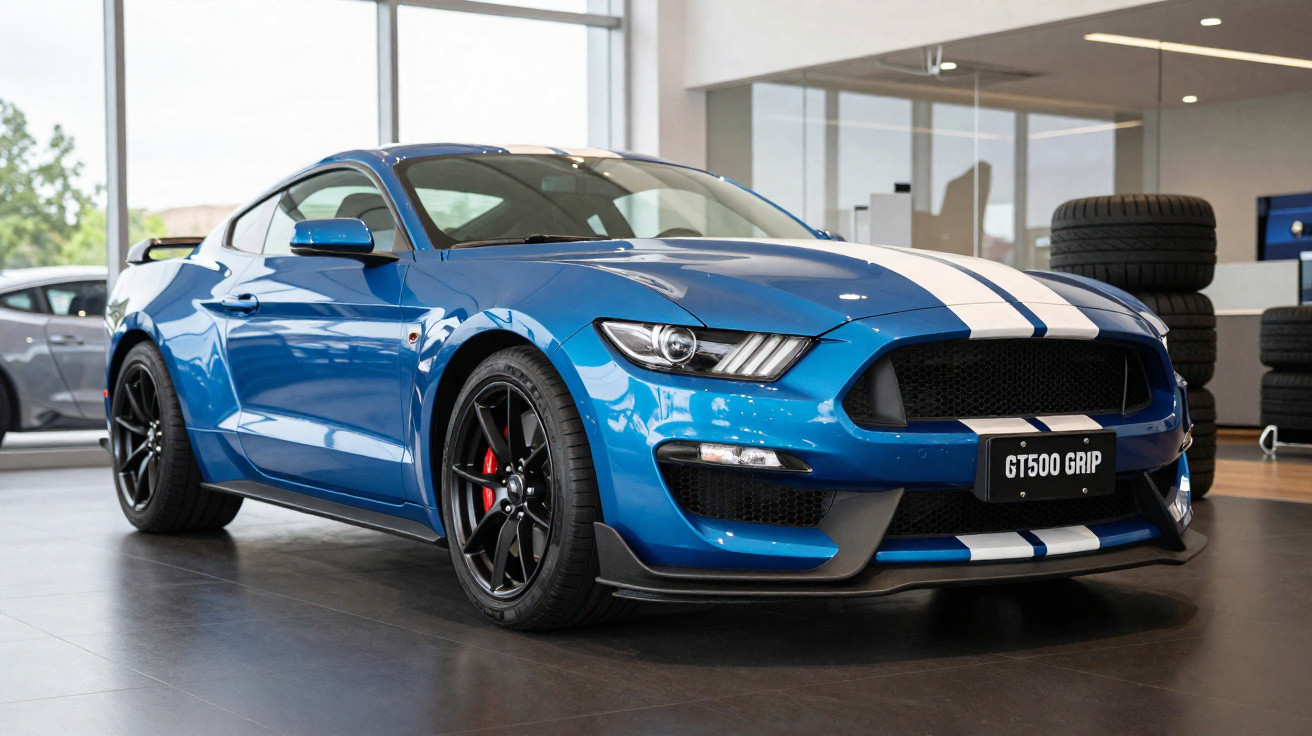
The Ford Mustang Shelby GT500 barely needs an introduction. As the most powerful and quickest Mustang ever built, it pairs a supercharged 5.2-litre V8 with an intimidating 770 hp and 847 Nm - figures that will overwhelm tyres all the more easily when only two of the four are tasked with putting that power down.
With that in mind, you would assume the grippier, track-focused tyre option would be the best way to translate the V8 Supercharged punch into the tarmac and deliver the strongest acceleration times - but it isn’t.
Tyres fitted to the Ford Mustang Shelby GT500 and the Car and Driver test
That is exactly what the US publication Car and Driver found during its testing of the GT500. From the factory, the brawny performance model comes on Michelin Pilot Sport 4S tyres, while buyers can choose the more hard-edged Michelin Pilot Sport Cup 2, designed with circuit driving in mind.
| Acceleration | Michelin Pilot Sport 4S | Michelin Pilot Sport Cup 2 |
|---|---|---|
| 0-30 mph (48 km/h) | 1,6s | 1,7s |
| 0-60 mph (96 km/h) | 3,4s | 3,6s |
| 0-100 mph (161 km/h) | 6,9s | 7,1s |
| ¼ mile (402 m) | 11,3s | 11,4s |
The numbers leave little room for debate: measured by Car and Driver, the Ford Mustang Shelby GT500 accelerates more quickly on its road tyres than it does on the circuit-oriented option.
How is that possible?
Puzzled by what it saw, the magazine contacted Shelby GT500 development lead Steve Thompson - and he was not taken aback by the outcome: “There’s no surprise (in the results). It isn’t unusual to see the Pilot Sport 4S match the Pilot Sport Cup 2, or even be a little quicker.”
The key question, then, is why this counter-intuitive result happens, and Thompson points to several contributing factors.
Longitudinal traction, temperature, and the launch
The road tyre uses thicker tread blocks, which can hold on to heat more effectively and, in turn, build traction - something that can help when launching hard from a standstill.
The track tyre, by contrast, has been tuned primarily to deliver stronger lateral grip, which matters far more for lap times than it does for straight-line acceleration. The evidence is in the cornering figures: the Pilot Sport Cup 2 achieved 1,13 g of lateral acceleration versus 0,99 g for the Pilot Sport 4S.
Construction and compound differences between Pilot Sport 4S and Cup 2
Although both are high-performance tyres, they are built with different priorities in mind, from internal construction to the components used (the blend of ingredients that makes up the rubber compound).
On the Cup 2, the shoulders are engineered to carry most of the lateral load, and the tread pattern towards the outer edges is also shaped around that goal. Meanwhile, the central tread area ends up being quite similar to that of the road tyre, because the Cup 2 is still road legal and approved for use on public roads.
If drag-style standing-start runs are your thing and you find yourself behind the wheel of a Ford Mustang Shelby GT500, the practical takeaway is simple: it may be best to stick with the Pilot Sport 4S, as it tends to deliver stronger straight-line grip.
Source: Car and Driver.

Comments
No comments yet. Be the first to comment!
Leave a Comment