
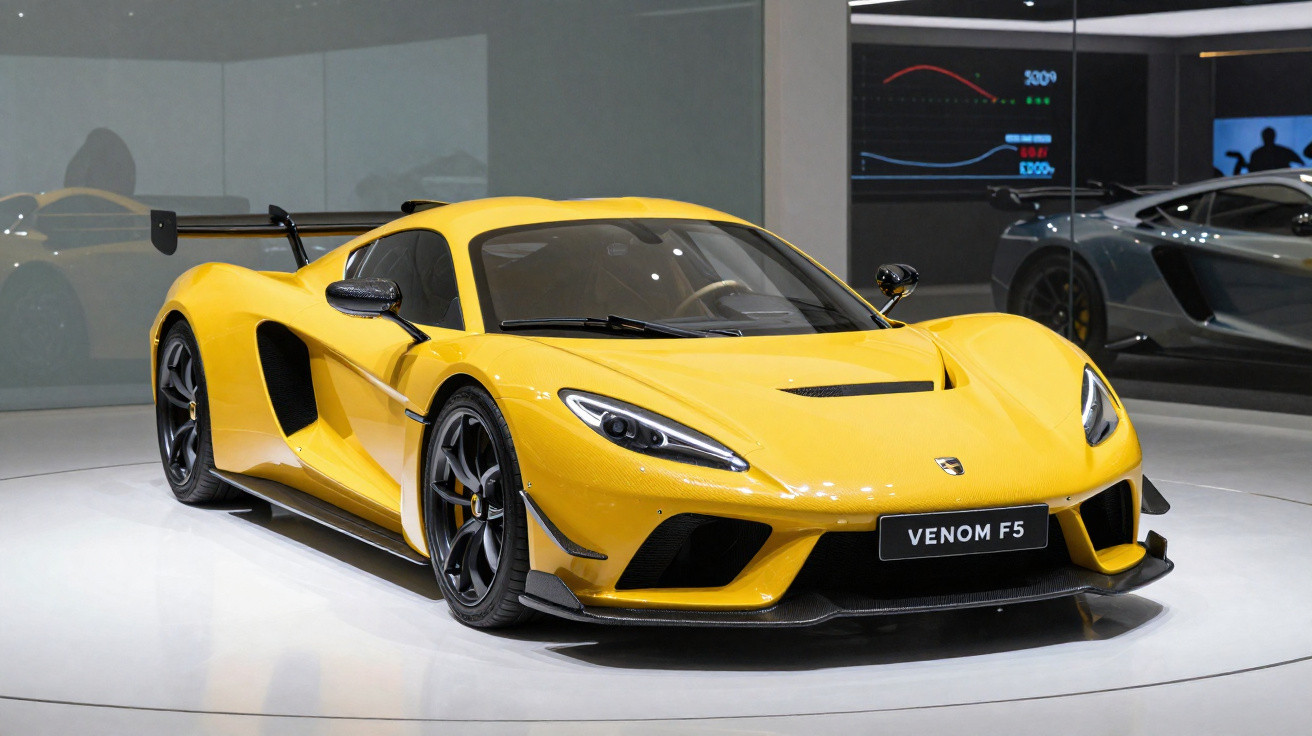
The Hennessey Venom F5 was first unveiled back in 2017 and, at the time, it came with a bold pledge: reach 300 mph (483 km/h) and claim the crown of the world’s fastest car - a lot has happened since then…
After a modified Bugatti Chiron pushed past that landmark (in only one direction, it’s worth pointing out) - 304,773 mph or 490,484 km/h - the various would-be contenders for the world record, including this new Venom F5, effectively had to raise their targets to (at least) 311 mph, which equates to a neat 500 km/h.
More recently, we watched the SSC Tuatara assert that it had secured the record with an average speed of 508,73 km/h and a peak of 532,93 km/h - figures that looked unbelievable at first glance… and, in the end, they were. What followed became one of the most extraordinary sagas in recent record-attempt memory: from the official video being picked apart and showing the Tuatara could not have achieved that speed, to SSC’s pushback featuring claims that later proved misleading, and finally to the unavoidable conclusion that credibility could only be restored by repeating the run.
So, for now, the title still belongs to the Koenigsegg Agera RS. Set in 2017, the official figures stand at 446,97 km/h for average speed and a recorded peak of 457,49 km/h. Koenigsegg itself intends to hold onto the accolade with the Jesko Absolut - a version of the Jesko developed specifically for this purpose.
Against this still-turbulent backdrop, the American firm Hennessey has now revealed the final version of the Venom F5, with development said to be almost complete and deliveries promised during 2021. Production of the hypercar will be capped at just 24 units, with prices starting at 2,1 million dollars (approx. 1,722 million euros).
More than 500 km/h
To deliver the promised 500+ km/h, the Hennessey Venom F5 relies on a hefty twin-turbo V8 nicknamed Fury - and it sounds as fierce as the name suggests. With 6,6 l of displacement, the 90-degree V8 produces 1842 PS and 1617 Nm of peak torque. Those enormous figures are sent exclusively to the rear wheels - wide, sticky Michelin Pilot Sport Cup 2 tyres, 345/30 ZR20 at the rear and 265/35 ZR19 at the front - through a seven-speed semi-automatic transmission.
The Fury tips the scales at 280 kg, and, intriguingly, its block is made from iron. Even so, lighter (and more exotic) materials feature heavily: aluminium cylinder heads, titanium for parts such as the crankshaft, pistons, connecting rods and valves, and Inconel for the exhaust system. Lubrication is handled by a dry-sump setup.
With Hennessey quoting a dry weight of 1360 kg, even once you add all required fluids and fuel, plus a driver, the Venom F5 should still offer more power than weight - under 1 kg per PS - pointing to truly extraordinary performance.
Despite being rear-wheel drive, the sprint to 100 km/h is claimed at just 2,6s. What really stands out, however, are the 4,7s needed to hit 200 km/h, 8,4s to reach 300 km/h and, 15,5s after the initial “launch”, you’re already travelling at 400 km/h - fury and madness? Without question.
To rein in all that… fury and insanity, the Hennessey Venom F5 is fitted with 390 mm x 34 mm carbon-ceramic discs front and rear, clamped by six-piston calipers at the front and four-piston calipers at the rear.
As with rivals such as the Jesko and Tuatara, two aerodynamic packages will be offered. The first reduces drag and lowers negative lift (downforce) to help reach 500 km/h, while the second increases downforce for circuit use. The stated drag coefficient (Cₓ) is 0,39.
Steering wheel… or control yoke?
The quoted 1360 kg dry figure is largely achieved through extensive carbon fibre use, including the monocoque - just 86 kg - and the body panels. Inside, the priorities are equally clear: everything is centred on the driver. The cabin is deliberately minimalist, and the standout feature is the steering wheel, styled like an aircraft control yoke, with no upper rim (improving forward visibility and encouraging a more correct head position for the driver in the seat).
The wheel also takes cues from Formula 1, grouping a wide range of controls - from switching on the headlights and wipers to selecting driving modes. On that subject, there are five modes: Sport, Track, Drag, Wet and F5. The full 1842 PS is only completely unleashed in the F5 mode, and each setting brings different calibrations for multiple parameters (power delivery, traction and stability control, and so on).
Even in this stripped-back interior, everyday essentials are included, such as air conditioning, Apple CarPlay and Android Auto - and Hennessey says the Venom F5 will offer a respectable level of civility in normal use. That’s not something we could have said about its predecessor, also called Venom, which was based on the more modest Lotus Exige.
Will the Hennessey Venom F5 take the world’s fastest car title?
We will need to wait a little longer to find out - it will happen at some point during 2021 - but Hennessey is already preparing the attempt. The run will be independently verified by Racelogic using VBOX GPS data acquisition systems. Racelogic and VBOX engineers will validate all recorded data and the speeds achieved.
For the attempt, Hennessey will have independent witnesses present, along with media and Venom F5 customers. The GPS data and uninterrupted video recording of the run will also be made publicly available - nobody wants a repeat of what happened with the SSC Tuatara.

Comments
No comments yet. Be the first to comment!
Leave a Comment