
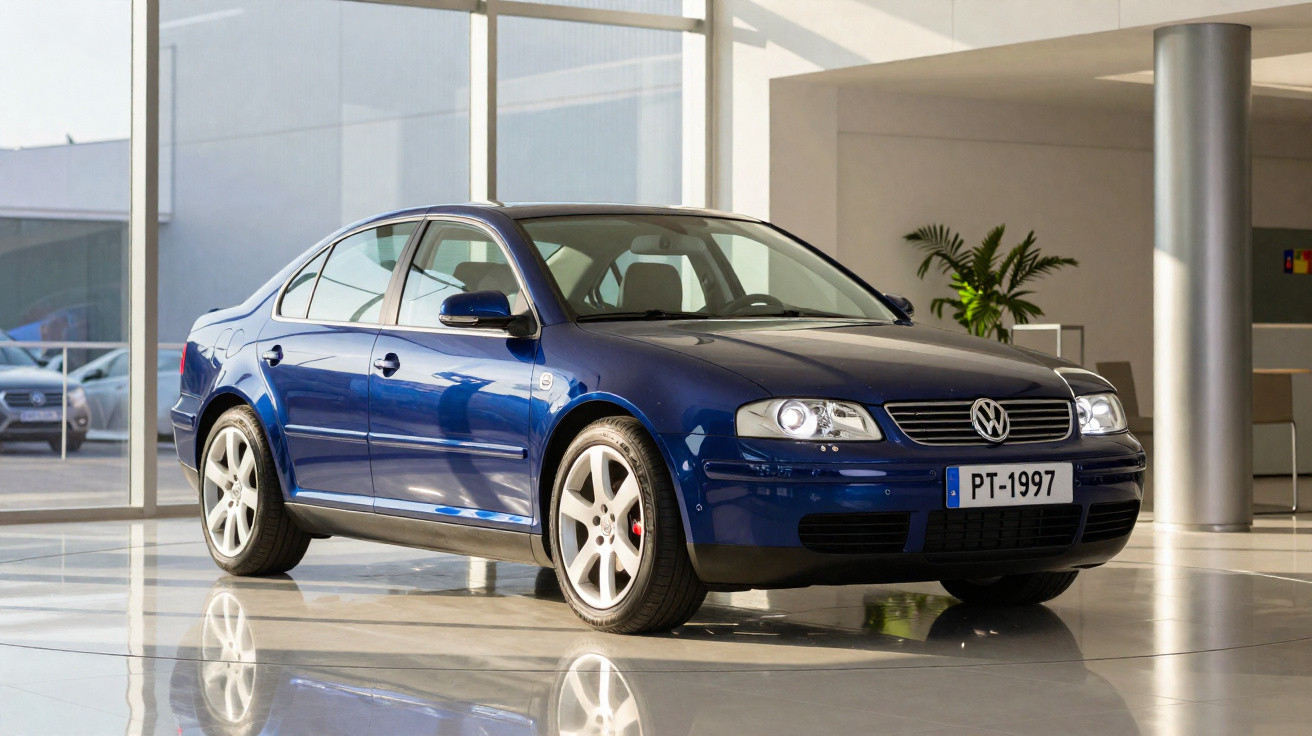
The Volkswagen Passat returned as Car of the Year in Portugal in 1997 (the B5, the 5th generation, launched in 1996) after having won the same award in 1990 (the B3, the 3rd generation) - spoiler alert: it would do so again in 2006 and 2015. It was the first time in the history of the Portuguese event that a model achieved that feat.
This iteration of the Passat was arguably the most pivotal of them all - it marked the opening chapter of a new era not only for the model, but for the brand itself. A few years before the Passat B5 arrived, in 1993, Ferdinand Piëch took charge of the brand and the wider group, tasked with restoring profitability while also setting bold targets for Volkswagen and Audi in both product ambition and market positioning.
While it was evident that Audi would be the marque positioned to take on Mercedes-Benz and BMW most directly, Piëch’s aspirations for Volkswagen did not appear any less far-reaching than those planned for Audi. He launched a strategy to push the Volkswagen badge into territory that many in the industry would have called unrealistic. Piëch, however, was not known for modest goals - his ambition and resolve were unwavering.
Passat, the first act
Against that backdrop, the fifth-generation Volkswagen Passat emerged as the first tangible step in that vision, laying foundations for everything that followed - from the seminal Golf IV through to models such as the Touareg and, above all, the Phaeton.
And what a leap this fifth Passat represented. “Rigor” could have been the sole guiding principle behind its development, with a sense of quality that seemed to radiate from every detail. That discipline showed in the crisp, solid and precisely executed geometry of the styling - conservative by today’s standards, yet highly influential at the time and entirely aligned with Volkswagen’s ambition to move upmarket. Inside, the cabin was spacious and echoed the same disciplined approach: controls and components were laid out logically, ergonomics were notably strong, surfaces were finished in higher-grade materials, and everything was assembled with a robustness that left much of the competition behind.
The “cherry on top of the cake” was the decision to draw on the underpinnings of its Audi A4 “cousin” - the same A4 that had won Portugal’s Car of the Year trophy just one year earlier - instead of relying on the more modest Golf-based foundations used by its predecessor. Those shared fundamentals played a decisive role in the greater refinement and sophistication that defined this generation. More than merely a step ahead of its mainstream rivals, this was the first time a Passat could be compared, with relatively little hesitation, to so-called premium offerings.
It is no surprise that the Passat B5 reshaped perceptions of what the model could be. That shift in image was mirrored in sales results, helping propel the Passat to the top of its segment - a lead it has retained through to the present day.
Volkswagen Passat B5 engines and engineering
Available with two body styles - a saloon and an estate (Variant) - the engine line-up also appeared to have been lifted straight from the A4 “cousin”. Choices ranged from the most workaday 1.6 l petrol, through the 1.8 l five-valves-per-cylinder unit (with and without turbocharging), and up to a 2.8 l V6.
Diesel versions would prove the biggest success, at a time when diesel power was rapidly gaining momentum across Europe - most notably with the enduring 1.9 TDI, offered in numerous outputs (90, 100, 110, 115 cv) and widely regarded as one of the most revered engines ever to leave Wolfsburg. The range also included Audi’s 2.5 V6 TDI, producing 150 cv.
That close technical relationship with Audi also brought the Passat a galvanised bodyshell and a sophisticated aluminium multi-link front suspension (four arms), just like the A4. The Passat’s clean, disciplined lines also turned out to be notably aerodynamic, with a Cₓ of 0.27 - a figure that remains competitive even today.
More style and exclusivity
With the facelift in 2000 came a stronger dose of style - visible in the more streamlined design of the grille, headlamps and their internal detailing - and even a touch more “shine”. Under a new head of design, the original hard-edged pragmatism was softened slightly, helped along by decorative chrome accents.
Yet Piëch’s determination to elevate both model and brand status did not waver. How else to explain the arrival, in 2001, of a Passat fitted with an eight-cylinder W engine - because a V configuration would have been too “common” - if not as a statement of pure ambition and determination, with practicality all but set aside?
Had Piëch pushed too far, too quickly? The limited sales of the Passat W8 suggest as much - around 11 thousand units sold - although the sheer presence of that engine, with 4.0 l of displacement, and a matching price tag, may have intimidated prospective buyers just as much as it fascinated them.
Volkswagen Passat B5 legacy in Portugal
Even today, many consider the fifth-generation Volkswagen Passat to be the model’s “peak” - and its long list of awards and strong commercial performance make that view easy to understand. None of the generations that followed truly managed to recreate the impact of the Passat B5, even if they benefitted from the platform it established.
The Volkswagen Passat B5 remained in production for nine years, with output ending in 2005, making it the most successful generation of a nameplate that has now surpassed 30 million units produced.
Do you want to discover the other winners of Car of the Year in Portugal? Follow the link below:
Comments
No comments yet. Be the first to comment!
Leave a Comment