
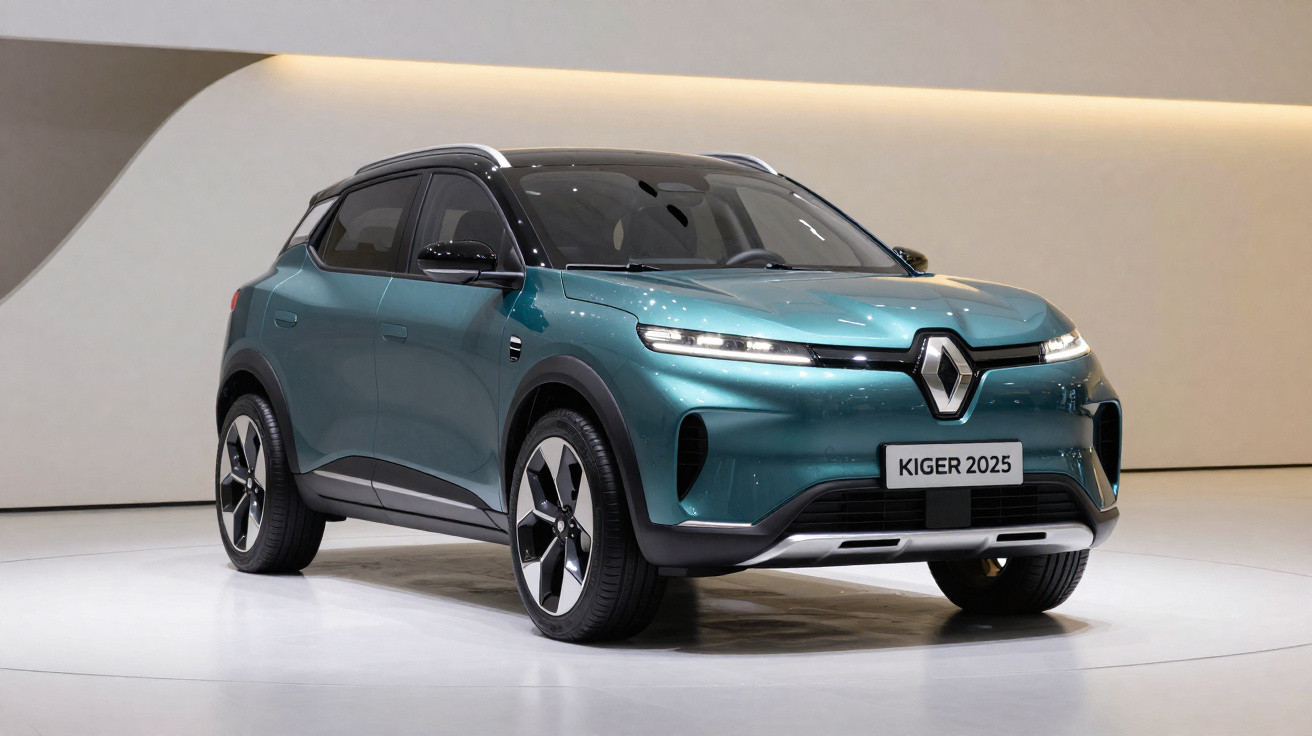
Renault’s line-up in India keeps expanding. Around two years after launching the Triber there, the French brand has now unveiled the Renault Kiger.
Beyond the Triber’s seven-seat layout, the key distinction between these two models is their intended reach: the Triber is aimed solely at the Indian market, while the Kiger arrives with a promise attached-taking it to international markets.
That pledge, however, raises a few questions. Which overseas markets will the Kiger actually be sold in? Will it come to Europe? If it does, where would it fit within Renault’s range? Or could it ultimately be rebadged as a Dacia, as happened with the Renault K-ZE, which we will know in Europe as the Dacia Spring?
Small on the outside, spacious on the inside
Measuring 3.99 m long, 1.75 m wide, 1.6 m tall and with a 2.5 m wheelbase, the Kiger is smaller than the Captur (4.23 m long; 1.79 m wide, 1.58 m tall and a 2.64 m wheelbase).
Even so, this new French SUV offers a notably large boot with 405 litres of capacity (the Captur ranges from 422 to 536 litres) and class-leading figures for the urban SUV sub-segment.
To be specific: up front, the Kiger provides the best seat-to-seat distance in its segment (710 mm). In the rear, it claims the biggest legroom (222 mm between the rear and front seats) and the most elbow room (1431 mm) in the segment.
Renault Kiger styling: unmistakably Renault
Visually, the Renault Kiger makes no effort to hide what it is: a Renault. At the front there’s a Renault-typical grille, while the headlights bring to mind those of the K-ZE. Around the back, the Renault identity is even clearer, thanks to the “C”-shaped lamps that have become an instantly recognisable brand signature for the French manufacturer.
Inside, although it doesn’t follow the current design approach seen in models such as the Clio or Captur, it still uses characteristically European solutions. In practice, that means an 8” central display compatible with Apple CarPlay and Android Auto, USB ports, and a 7” screen serving as the instrument cluster.
What about the engines?
Built on the CMFA+ platform (the same as the Triber), the Kiger will be offered with two engine options, both 1.0 l three-cylinder units.
The first is naturally aspirated, producing 72 hp and 96 Nm at 3500 rpm. The second is the same turbocharged 1.0 l three-cylinder engine already familiar from the Clio and Captur. Delivering 100 hp and 160 Nm at 3200 rpm, it will initially be paired with a five-speed manual gearbox, with a CVT planned for later.
Shared across both transmissions is the “MULTI-SENSE” system, allowing drivers to choose between three drive modes-Normal, Eco and Sport-which adjust engine response and steering sensitivity.
For now, we still don’t know whether the Renault Kiger will make it to Europe. With that in mind, here’s the question: would you like to see it sold here?
Comments
No comments yet. Be the first to comment!
Leave a Comment