
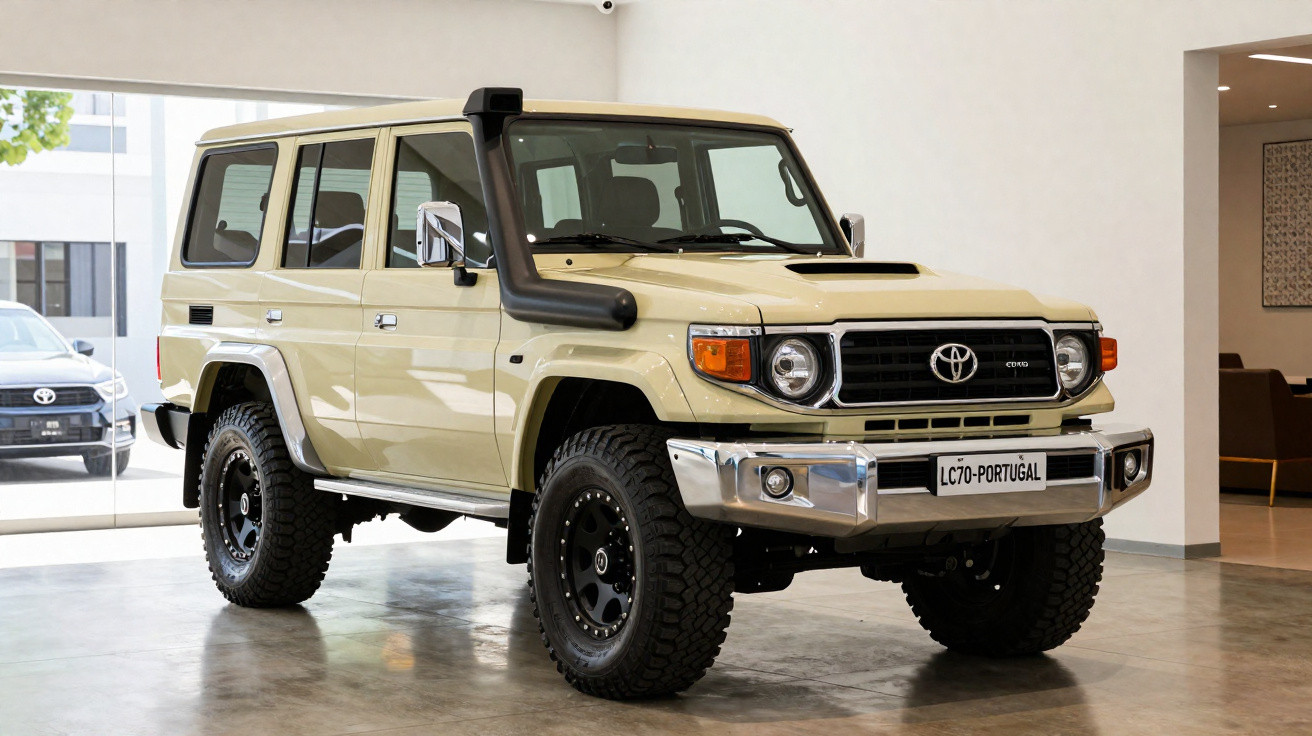
The Toyota Land Cruiser 70 is a living fossil with the soul of a Swiss Army knife - or an Alentejo pocketknife.
Few vehicles shrug off time like the Toyota Land Cruiser Series 70. And it’s not just time, as you’ll see in a moment. First launched in 1984, it’s still being built, sold and put to work in some of the harshest conditions on Earth.
It’s a kind of rolling relic of automotive engineering, where the word “evolution” is used sparingly - and only when the job demands it. Think of it as a Swiss Army knife that can get you out of almost anything. Or, if you prefer, as an Alentejo pocketknife, since it’s also made in Portugal - more on that shortly.
We travelled to New Zealand for a quick first taste of the 2025 Land Cruiser Series 70. The drive was short, with less off road time than we’d have liked. Even so, it confirmed what we already suspected: the Land Cruiser 70 hasn’t been modernised. It’s been refined. Slowly.
I can’t remember the last time I smiled so much while filming a video. Perhaps the footage speaks for itself:
Tough outside, modern heart
From the outside, it remains unmistakably itself. The straight-edged bodywork looks like it was drawn with a ruler, the panels resemble steel sheets shaped with a hammer, and the whole design instantly takes you back to when 4×4s were tools, not lifestyle accessories.
In this Toyota Land Cruiser Series 70, everything is governed by the most basic requirement of all: to endure, endure and endure. In some of the markets where it’s sold, that’s not a marketing line - it’s the entire point.
Even so, there have been a few updates. The 2025 Toyota Land Cruiser Series 70 versions aimed at markets such as Australia now include autonomous emergency braking, blind-spot warning, and even wireless Apple CarPlay.
The most significant change, however, is under the bonnet. The new 2.8-litre four-cylinder Turbo Diesel - the same unit used in other Toyota models such as the Hilux - now produces 204 hp and 500 Nm of torque.
It almost makes it feasible to sell this model in Europe - almost…! Unlike the other Land Cruiser engines: naturally aspirated six- and eight-cylinder units developed with Africa and the Middle East in mind. They’re less powerful and thirstier, but also simpler, tougher and less complicated.
Road manners are a surprise
As the video shows, the sense of toughness is hard to put into words. The sound of the doors shutting, the way the chassis trembles over broken tarmac, how exposed and honest everything feels - from the analogue instrument cluster to the visible bodywork details. It all conveys a kind of mechanical certainty, as if this Toyota were an agricultural implement designed to work for decades without complaint.
Unfortunately, the trails available during our short test didn’t allow us to properly probe its off-road ability. But one look at the model’s track record - and its typical users, from Australian mines to African expeditions - is enough to understand that this Toyota has nothing to prove.
On the road, meanwhile, it’s surprisingly acceptable given what it is. The suspension remains firm, the brakes need a bit of room (the tyres don’t help), and the steering… well, it’s best not to let go of the wheel.
But nobody buys a Land Cruiser Series 70 for sharp handling. They buy it for trust. And trust is something it certainly won’t be short of.
Made in Portugal and sold worldwide (except Europe)
Today, the Toyota Land Cruiser Series 70 is built in five factories around the world. One of them is in Ovar, Portugal, where Toyota Caetano assembles units with specifications tailored to demanding markets such as Africa.
It’s one of the few vehicles produced in Portugal with genuine global reach, which says a great deal about this model’s industrial importance - even if most people in Portugal (or Europe) barely know it exists.
So why isn’t it sold here? The answer is straightforward: emissions and safety regulations. The Series 70 doesn’t meet several current European standards, and re-engineering it would cost too much for the likely return. Even so, given how niche this vehicle is, there really ought to be an exemption.
It’s a work vehicle - does it make sense to hold it to the same rules as vehicles that spend most of their lives in cities? I don’t think so, and I’m sure I’m not alone. European bureaucrats see it differently. It feels like Europe has taken away a highly capable model from those who genuinely need it: toughness above all else.
The end still isn’t in sight
Toyota has already confirmed it will keep the Series 70 in production for as long as there is demand. And demand remains very much alive. In a world where SUVs have become softer, more tech-heavy and increasingly indistinguishable, the Land Cruiser 70 stands for the opposite: tough, simple and effective.
It doesn’t have giant screens, it doesn’t offer driving modes, and it doesn’t come with voice assistants. But it does have something few cars can claim: character. It’s a story still being written near Ovar - but far away from Portuguese roads.
I loved driving it, and I’m sorry I may never sit behind its wheel again. That’s exactly why this video matters so much to me: it proves there are still cars designed for the whole world. The whole world except Europe…


Comments
No comments yet. Be the first to comment!
Leave a Comment