
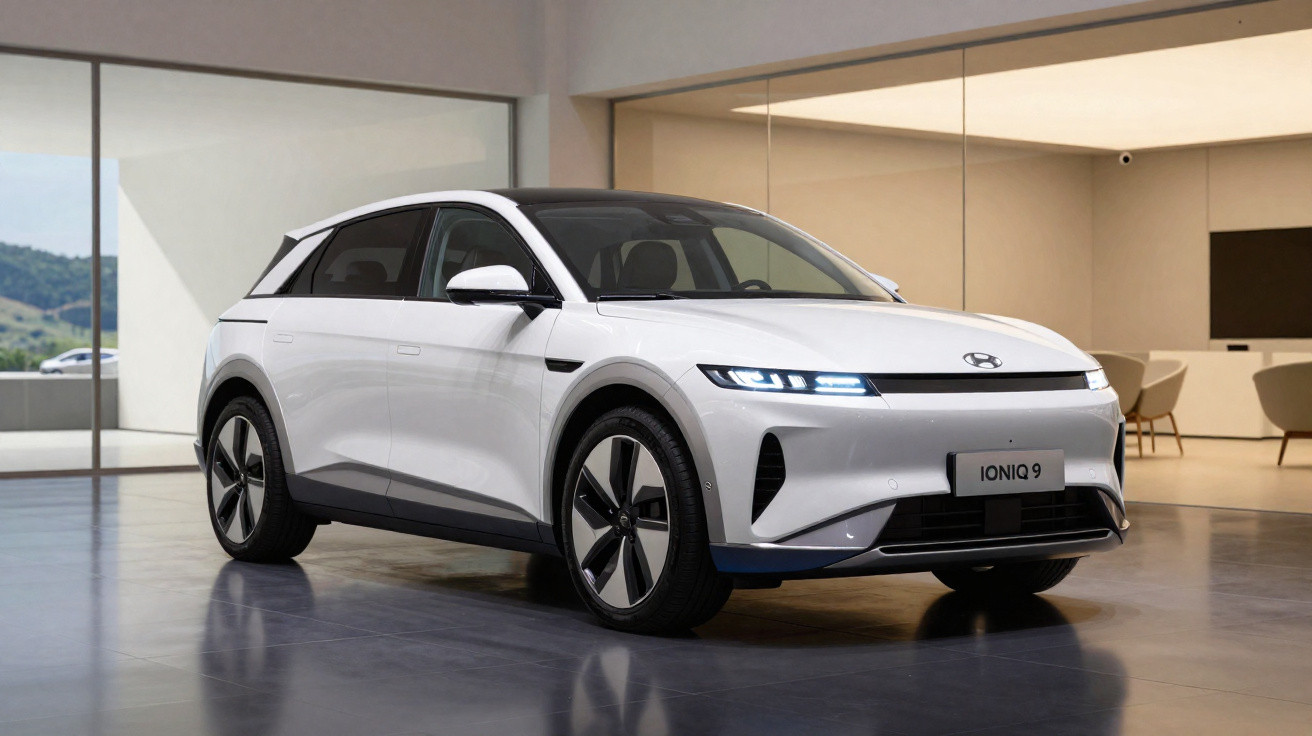
The Hyundai Ioniq 9 is huge inside and out - on the scale of the Alentejo plains, and then some.
It’s called the Hyundai Ioniq 9 and, as the number suggests, it’s the largest electric model in the Korean brand’s line-up. It is already on sale in several European markets, but Portuguese families will have to wait until the start of 2026.
We chose not to wait and headed to the magnificent plains of Alentejo for a first encounter with this SUV - a car that’s impossible to ignore as it goes by, thanks to both its styling and its sheer size.
Set against the backdrop of Alentejo’s traditional villages, the contrast could hardly be greater. The Ioniq 9 is a concentrated showcase of technology, bringing together the best solutions Hyundai currently has to offer.
From a design point of view, this five-metre-long SUV follows the Ioniq family template: pixel-style lighting joined by a translucent section across the entire front, plus vertical LED elements and rear lights that are also positioned “upright”.
If this blend of SUV and MPV DNA is already apparent on the outside, it’s inside where the surprise really lands.
The cabin is so generous that it can be configured in multiple ways: seating for six (2+2+2) or seven (2+3+2), with second-row seats that slide fore and aft and can rotate 180 degrees to create a social lounge area for passengers.
Depending on the version, the seats may be manually or electrically adjusted - including the third row - which can have their backrests folded fully to help create a completely flat load bay, using an additional structure.
This is one of the most modular interiors on the market. More and more, the choice of the Alentejo plains for this first drive seems to make perfect sense…
Ioniq 9 has room for everything
Even in the seven-seat layout, there’s still space left for some luggage (338 litres). Fold the third row and capacity rises to a vast 908 litres; with only the front seats upright, it stretches to an almost endless 2419 litres.
There’s also a second, smaller boot under the front bonnet which, at 52 litres (4×4) to 88 litres (rear-wheel drive), can hold far more than just battery charging cables. But we’ll come back to the cabin.
The centre console, which can slide over a range of 19 centimetres, opens from the front seats (as you’d expect) but, thanks to a clever mechanism, can also be opened by second-row occupants.
On the steering wheel, green light points illuminate more or less depending on how full or empty the battery is. It also has paddles to vary regenerative deceleration, adding an extra layer of driver engagement.
Thankfully, it isn’t only the rear-seat passengers who are pampered. The driver and front passenger seats also come with massage, heating, ventilation and a wide range of adjustments. It’s an open invitation to travel.
The dashboard follows the familiar layout of Hyundai’s latest models, featuring two 12.3” digital screens side by side (instrumentation on the left and infotainment on the right) housed beneath a curved surround. Centrally, below the dash, there are physical buttons for the most frequently used functions (audio, navigation, home) and, beneath that, a digital panel for climate control - which is genuinely welcome.
On the centre console there’s a button for selecting drive modes: Eco, Normal and Sport, plus a secondary menu for special surfaces such as Snow, Mud or Sand.
The driver can also fine-tune driving parameters to create an individual set-up (although this has to be done through the central screen menus).
Living room on wheels
The top section of the dashboard uses soft-touch trim, as does the upper part of the doors, though harder plastics dominate lower down. Even so, the build quality remains consistently high.
Eric-Yann Coulouvrat, the Ioniq 9’s head of interior design, prefers to highlight the South Korean concept of chabak that shaped the cabin: “it’s a mobile living room, where occupants can face each other and socialise or recline the seats and look at the sky through the huge panoramic roof… like the night-time show here in the starry Alentejo night”.
It would be good news to see more soft-touch surfaces in the door pockets, the compartment between the front seats and the glovebox - above all to cut down on noises from items moving around - which is what you’d expect in a car that will always cost more than €70,000.
By contrast, the velvety trim on the A, B and C pillars, along with the finish quality around the interior rear-view mirror, leaves a very positive overall impression.
On the subject of mirrors, the test car’s mirrors were digital (they take some getting used to) - both the side mirrors and the upper centre mirror - which is particularly useful when the Ioniq 9 is carrying a full load and the heads of second- and third-row passengers steal rearward visibility.
The seats, trimmed in synthetic leather with good front lateral support, are wide and comfortable. Second-row seats have their own climate control panel, heating and cooling, and provide ample space for passengers taller than 1.90 m. They also sit higher than the front seats, improving outward visibility.
Choosing between three motors
The new Hyundai Ioniq 9 will be offered with three powertrains. Rear-wheel drive (160 kW or 218 hp), 4×4 all-wheel drive (250 kW or 313 hp), and Performance (also all-wheel drive) which combines two motors for a total of 435 hp.
The battery is always the same gross capacity (110.3 kWh), with claimed long ranges of 620 km for the rear-wheel-drive version and 600 km for the four-wheel-drive versions.
Performance figures vary, naturally, with output: the entry version needs 9.4s to reach 100 km/h. At the opposite end, the most powerful one plays the sports-car role with 5.2s and 3.4s for the same benchmarks. In the middle sits the sweet spot: 6.7s and 4.8s for the 313 hp version.
On the electrical side, the E-GMP platform runs at 800 V, enabling higher charging power. In this case it reaches 240 kW on direct current (DC) - far higher than most direct European or Asian rivals - but is limited to 11 kW on alternating current (AC), which is lower than several of those same competitors.
Hyundai says that, on DC, the battery can be boosted from 10% to 80% in just 24 minutes - the same figure quoted for the EV9, which is surprising given Kia claims that car’s battery is smaller at 100 kWh.
Behind the wheel
In Portugal, the more powerful versions are expected to arrive, because the price gap to the entry model is unlikely to be significant. The focus here was on the mid-spec version, which should remain the most balanced choice, and with more than 300 hp and 600 Nm it will be more than enough even for families or groups of friends in a hurry.
In Eco mode, response in this 313 hp version is still lively enough, but it quickens in Normal and becomes sharper again in Sport, as you’d expect. Those differences are noticeable with the accelerator at mid travel, and they’re even clearer when you press it fully.
Steering response also changes with drive mode: it’s light in Eco (ideal for town driving) and gains weight in Normal and Sport, though it always feels quite synthetic.
It’s also possible to adjust the electric motor “presence” sound between low, moderate, high (or off), but Hyundai seems to have relied on the kind of software translation seen in Chinese brands, because the terms in that menu were incomprehensible in Portuguese. These details may well be resolved by the time the Ioniq 9 arrives in Portugal.
There’s also room for improvement in braking feel. The brake pedal has a long travel, although it begins slowing the car earlier than some electric models that barely brake in the first 25% of pedal movement. Choosing one of the stronger regeneration levels should be enough for almost all everyday decelerations.
The suspension is much better: independent at all four wheels, with a multi-link rear axle. It also benefits from the mass of the huge battery and - on the test car fitted with 285/45 tyres on 21” wheels - the pneumatic equipment helps counter what would otherwise be the usual tendency towards excessive body movement, both due to its weight (more than 2.6 tonnes) and its height.
The cabin sound insulation deserves praise. Hyundai’s engineers have done a careful job of keeping outside much of the tyre roar, wind noise and even the sounds from other vehicles the Ioniq 9 meets on the road. Double glazing in the front and rear doors is one of the measures that contributes to this strong result, helped too by polished aerodynamics (Cx below 0.26 on this version with digital mirrors).
Consumption figures from a test drive are always higher than everyday use, and this was no exception - the heavier demands placed on the two electric motors made themselves felt.
In this Ioniq 9’s recorded history, there was 27.3 kWh for a cumulative distance of 206 km, and 25.3 kWh for a 1553 km journey (even though motorway running was the majority - the car came from Madrid - which hurts the averages). So it wouldn’t be unreasonable to expect an average close to 23 kWh/100 km for someone doing mixed routes each month and, therefore, an effective real-world range near 450 km (WLTP).
When does it arrive?
Launching a little later than its “cousin”, the Kia EV9, Hyundai’s electric flagship has now begun its commercial life in the main European markets. Its debut in the Portuguese market is scheduled for the start of 2026.
Hyundai Ioniq 9 pricing has not yet been announced.

Comments
No comments yet. Be the first to comment!
Leave a Comment