
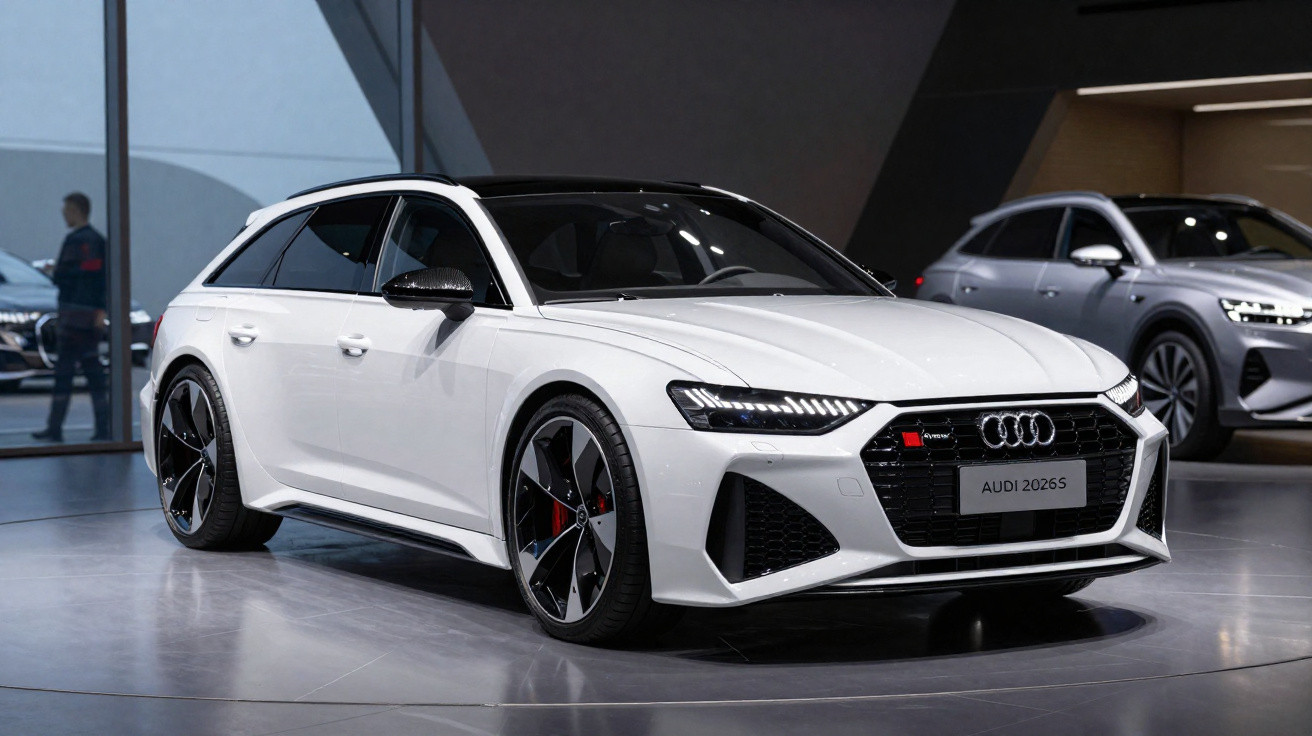
Over the past two years, Audi has had a relentless run: refreshing its key ranges and widening its 100% electric line-up. That pace looks set to continue into 2026. Fresh generations are on the way alongside all-new models - but it’s the pull of the RS badge that’s impossible to ignore: the coming year should be a big one for Audi’s high-performance cars.
In one sweep, three Audi RS arrivals are expected: a new generation of the RS 6 Avant, the queen of high-performance estates; a new RS 5 (Sportback and Avant); and a special edition of the RS 3, which will also serve as the model’s send-off.
Goodbye RS 3 and… five cylinders
This farewell is set to be a symbolic one, because it also means waving goodbye to the iconic inline five-cylinder engine that has shaped and defined Audi’s story for the past 50 years.
Audi is expected to mark the end of the Audi RS 3 - and its five-cylinder - with the kind of ceremony given to the RS 6 Avant GT. The talk is that the 2.5 TFSI could push beyond 400 cv - enough to sit ahead of the Mercedes-AMG A 45 S rival with 421 cv - paired with a revised aerodynamic package and a “sharpened” chassis.
Audi has not yet confirmed a launch date for the Audi RS 3 GT, but it should not be far away. The five-cylinder’s final chapter is closely tied to the arrival of the Euro 7 standard, which takes effect on 28 November.
First electrified RS 6 Avant
For high-performance estates, the Audi RS 6 Avant plays a role much like the Porsche 911 does for sports cars: it’s a benchmark and an icon. With that in mind, expectations for the next generation could only be sky-high - especially knowing it will be the first in its history to be electrified.
To be clear once again: it’s electrified, not fully electric. An internal-combustion engine will remain. A battery-electric version came very close to production - it was being developed alongside it - but the all-electric RS 6 was cancelled, for what appears to be a straightforward reason: the market isn’t interested.
For performance to be accepted, it needs a combustion engine - the market dixit. In the case of the upcoming RS 6 Avant, that means a twin-turbo V8 with plug-in hybrid assistance, mirroring its Munich arch-rival, the BMW M5 Touring.
Expect substantially more power than today’s car - more than 700 cv - and, inevitably, a lot more mass. The current petrol-only model already tips the scales at over 2100 kg…
It won’t be the only plug-in hybrid RS. The successor to the Audi RS 4 and RS 5 is also due in 2026 as a plug-in hybrid. The main change lies under the bonnet, where a twin-turbo V6 will sit - with no radical downsizing to four cylinders in the way AMG has done with the C 63.
Successor to the Q7 - and something bigger is coming
Audi’s 2026 story won’t be made up of high-performance models alone. After updating the ranges that deliver its highest volumes, it’s finally time to give the Q7 a successor - after 10 years on sale, it was starting to feel overdue…
The third generation will use the same PPC platform as the combustion-engined A6, and it’s expected to share most of its powertrains too. Every option will be electrified: mild-hybrid and plug-in hybrid (2.0 turbo), while all signs suggest diesel will remain.
The surprise is that the Q7 will be joined by an all-new Q9, the missing piece in Audi’s line-up to take on the Mercedes-Benz GLS and BMW X7 “eye to eye”. Like those giants, it will focus on luxury and sophistication - and also keep combustion engines. It uses the same platform as the Q7, but is set to be larger in every direction and will offer V6 and V8 engines, always with multiple levels of electrification.
A more affordable electric model - but what will it be called?
Last but not least, Audi will keep expanding its EV family in 2026, adding what will become the entry point to its electric range.
For a time, speculation suggested Audi might bring back the A2, but spy shots show a vehicle that’s noticeably bigger than a typical B-segment car (around 4.1 m long). Gernot Döllner, the brand’s chief executive, cleared up the uncertainty: the new EV will sit one level higher, in the C-segment (compact family cars), where the A3 and Q3 live. It will therefore be significantly larger, measuring 4.4 m in length.
Even so, will it still be called the A2? That remains unclear. The car’s shape looks closer to an MPV silhouette than an SUV, yet rumours persist around an alternative name: Q2 e-tron.
Whatever the final badge, its confirmed positioning settles the platform question for good. It won’t use MEB+, as on the new Volkswagen ID. Polo; instead, it will ride on the original MEB architecture that underpins many Volkswagen Group EVs, including the Audi Q4, the Skoda Elroq, the Volkswagen ID.3, among others.
Technical details are not yet known, but the range with the largest-capacity battery is expected to approach 600 km. It will be the brand’s most affordable EV, but it won’t be cheap: pricing is not expected to stray far from an equivalent Q4 e-tron - in Portugal, that starts at almost €50,000.
The arrival of this new EV will also feel like the closing of a chapter. After an intense launch cycle that began roughly two years ago, Audi is already lining up the next wave, previewed by the Concept C revealed at the Munich Motor Show 2025.
Comments
No comments yet. Be the first to comment!
Leave a Comment