
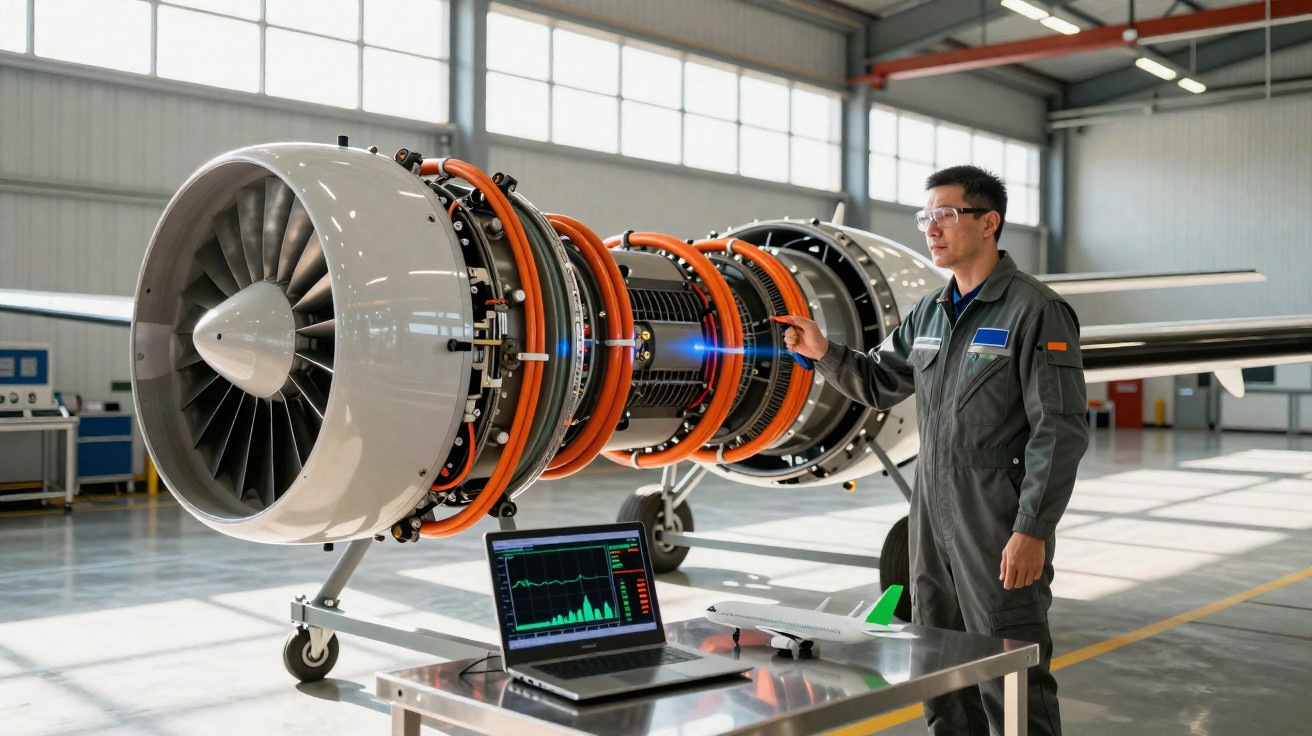
GE Aerospace said this week it has finished ground testing of a megawatt-class hybrid-electric engine system created under NASA’s Electrified Powertrain Flight Demonstration (EPFD), clearing the way for flight testing.
Ground test validates a full hybrid-electric powertrain
The company described the campaign as its first ground test aimed at validating the complete integrated system. The setup brought together GE Aerospace’s own motor/generators with power converters and inverters, control systems, Dowty propellers, Avio Aero gearboxes and a CT7 engine. BAE Systems supplied the batteries used in the trials, while Aurora Flight Sciences (a Boeing subsidiary) delivered the complete nacelle.
“Step by step, we are proving hybrid-electric engine technology for next-generation commercial aircraft,” said Arjan Hegeman, Vice President of Future of Flight at GE Aerospace. “This latest full hybrid-electric powertrain ground test positions GE Aerospace to have the technologies ready to meet customer needs for greater durability, efficiency and range in future propulsion systems.”
Simulated flight phases at Peebles Test Operation, Ohio
During the test campaign at the Peebles Test Operation in Ohio, teams replicated multiple flight phases, including taxi, take-off, climb and cruise. GE Aerospace said the electric powertrain successfully helped drive the propeller and also produced electrical power for the battery.
As part of the effort to mature a commercial-grade hybrid-electric engine system, the company used flight-ready components designed to meet safety and reliability thresholds higher than those normally expected of typical test hardware.
GE Aerospace noted that the achievement builds on more than ten years of component and module testing and maturation.
“The ground test is an important turning point in our understanding of hybrid-electric powertrains for aviation and a fundamental building block for the future,” Hegeman said.
How a hybrid-electric engine system works
A hybrid-electric engine system pairs an electric powertrain with a conventional gas turbine, enabling more optimised power management across different operating phases. According to GE Aerospace, hybrid-electric systems are well suited to a range of fuel types and to advanced aircraft engine architectures, including Open Fan technology.
Hybrid-electric experience: GE Aerospace and NASA EPFD milestones
GE Aerospace said it was the first company to receive the NASA EPFD contract in 2021, aimed at demonstrating flight readiness of hybrid-electric technologies for narrowbody (single-aisle) aircraft.
Over the past decade, GE Aerospace highlighted several major milestones in hybrid-electric development:
- 2016: a ground test of a propeller driven by an electric motor.
- 2022: what it described as the world’s first test of a megawatt-class, multi-kilovolt hybrid-electric propulsion system under altitude conditions up to 13,700 m at NASA’s Electric Aircraft Testbed, simulating commercial narrowbody flight.
- 2025: a successful demonstration of a narrowbody hybrid-electric configuration featuring power transfer and injection into a modified high-bypass turbofan engine (with no energy storage required) under NASA’s HyTEC project.
GE Aerospace also pointed to a strategic partnership and capital investment announced in 2025 with BETA Technologies to accelerate hybrid-electric aviation, including plans to co-develop a hybrid-electric turbogenerator for Advanced Air Mobility (AAM) applications.
Information from GE Aerospace

Comments
No comments yet. Be the first to comment!
Leave a Comment