
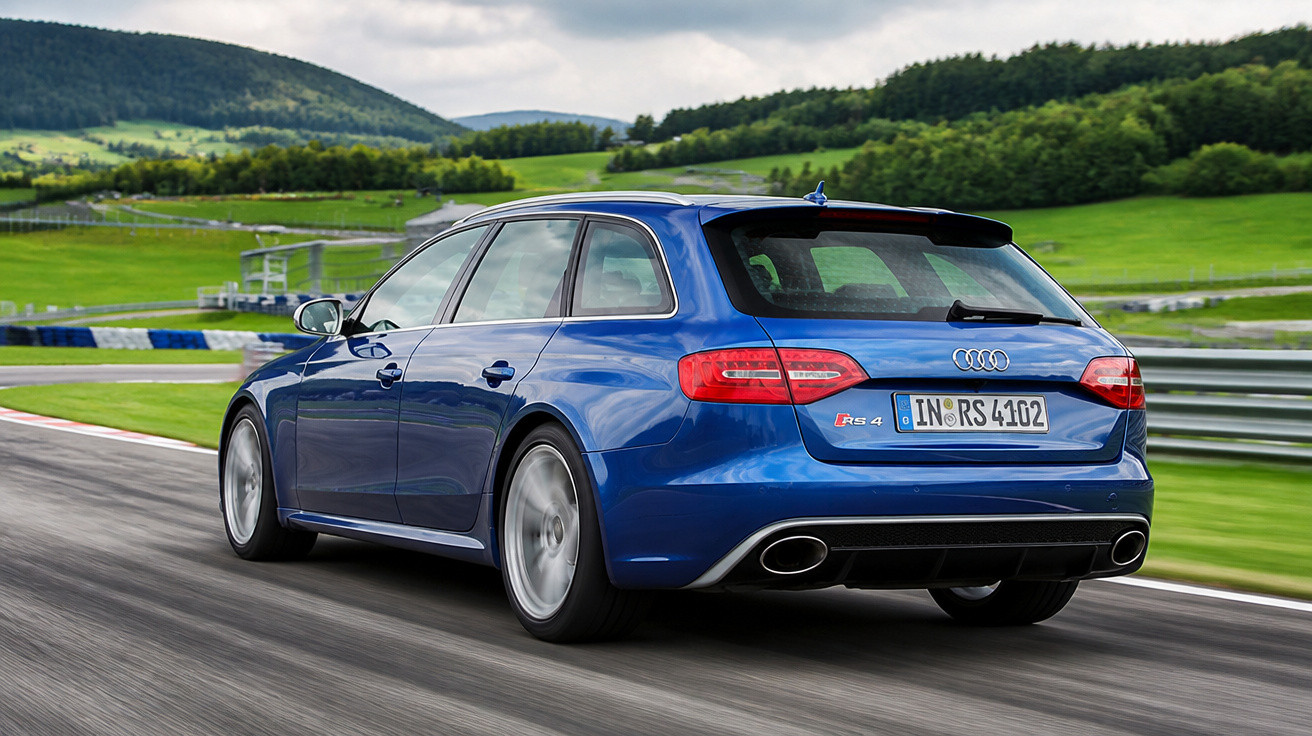
Not all that long ago, Audi would field just one RS car at a time, with the RS2, RS4 and RS6 each standing out as lone heroes in their respective periods. Then Audi-never one to ignore an opportunity-decided the RS badge deserved far more airtime, and began spreading those two letters across a broader slice of the range. Today that means the RS3, RS6, RS5 and TT RS, with the latter two offered as both coupé and convertible. And now there’s another to add to the list: the RS4 Avant.
Audi RS4 Avant: estate-only strategy
The “Avant” bit matters more than ever, because this RS4 comes solely as an estate. Audi’s view is that the RS5 coupé and convertible already cover the other body styles, and it isn’t keen to steal sales from within its own line-up. There’s a lot to unpack with this car, so it’s worth taking it in stages.
Styling, stance and the RS4 Avant details
Visually, it sticks to the familiar RS formula: restrained, but clearly serious. Up front you get a new, Bauhaus-severe single-frame grille, paired with the sharp-eyed look of the facelifted A4 headlights and a deep front bumper cut through by substantial air inlets. Along the sides are the expected swollen squircle arches and more pronounced sills, while the rear features a diffuser-style bumper and the classic oval RS exhausts, one at each side.
Compared with the A4 it sits 20 mm lower, riding on standard 19-inch ten-spoke forged aluminium wheels. Those wide 265/35 tyres help deliver a properly planted posture straight out of the box.
Overall, it comes across like an irate robot: discreet enough to pass unnoticed, yet unmistakably purposeful to anyone who’s paying attention-which is exactly the point.
quattro hardware, DRC suspension and brakes
Beneath the bodywork lies the expected pile of quattro hardware, with a number of mechanical changes aimed at making it more engaging to drive. The default front-to-rear torque split is 40/60, but the system can send as much as 85 per cent of the available drive to the rear axle, or up to 70 per cent to the front.
A sport differential adds active torque vectoring. In practice, it can shuffle torque towards the wheel with the most grip as conditions change, and it can also bleed a little drive across to an outside diagonal wheel to calm understeer when required.
As on the RS5, an optional DRC (Dynamic Ride Control) set-up is available. This links diagonally opposed dampers via hydraulic lines and a central valve, helping the car stay flatter under load by keeping tighter control of the front outside wheel when you’re really leaning on it. Even so, the standard suspension tune deserves credit: it feels impressively resolved.
Braking is equally distinctive. The standard discs are the unusual-looking “wave” items-similar to what you’ll see on plenty of sports bikes. They have a cookie-cutter outline, are internally ventilated to manage heat, and while stopping performance is comparable with a conventional steel disc, they cut roughly three kilograms of unsprung mass thanks to the missing sections. If you’re truly committed, full carbon-ceramic brakes are optional and trim more weight again, although you’re unlikely to need them unless your routine involves the Nordschleife or the Stelvio Pass.
V8 power and the 7-speed S tronic gearbox
So far, it’s classic RS theory. The headline twist is the engine: a naturally aspirated, FSI direct-injected 4.2-litre petrol V8. It develops 444 bhp at 8,250 rpm, spins to an 8,500 rpm red line, and produces peak torque of 317 lb ft (around 430 Nm) from 4,000 to 6,000 rpm. It’s essentially the same unit as the RS5’s, with a handful of tweaks.
Drive goes through the only transmission offered: Audi’s seven-speed S tronic dual-clutch gearbox. An estate with a sky-high-revving V8 and rapid-fire DSG-style shifts sounds like a very Top Gear sort of proposition.
On the road: refinement first, then serious pace
That’s why the first few miles can catch you off guard, prompting the thought: "This is very... nice." Around town the RS4 feels fairly firm-even in Comfort mode-but the gearbox glides between ratios without fuss, and the engine settles into a contented murmur. It’s easy to imagine you’re in a much more ordinary S line model.
There’s a brief V8 “whuff” on start-up, but with the standard exhaust (a louder sports system is optional) there isn’t a great deal to announce what it’s capable of. Inside, too-outstanding “batwing” sports seats aside-it’s largely the familiar, high-end Audi environment.
Push harder, though, and the RS4 begins to show its character. Our drive took place in streaming rain on some genuinely excellent Austrian mountain roads, which turned out to be the perfect proving ground. With standing water mid-corner, broken surfaces and some uncomfortably serious drop-offs, the quattro system earned its keep.
The most telling praise is how natural the whole, very complicated arrangement feels. Grip is huge-particularly through long, loaded corners-and the car has a hefty, mildly understeer-leaning balance that inspires confidence in the wet. Feed in extra throttle smoothly and you can even coax oversteer (helped by a self-locking crown-gear centre differential), though it never pretends to be rear-wheel drive, and it doesn’t really feel like it either. Nor should it: that sense of security is a major part of the RS4’s appeal.
In conditions where something like a C63 AMG would have you constantly flashing the traction-control warning, or sliding about like a rally driver, the RS4 tends to just hook up and launch, or else drift into a gentle, manageable push wide of the apex. Be more abrupt as you come off straight-ahead, and if the surface is slippery enough it can become more dramatic, but it’s clearly happier when you’re smooth and accurate.
The gearbox is fast and decisive, swapping ratios with a clinical efficiency that makes a manual start to seem faintly agricultural. It also fires out wonderfully crisp downshift blips-some of the best this side of a Ferrari. Perhaps most impressive is how it masks real speed behind a layer of such precise control that you might only truly appreciate its pace by trying to follow an RS4 in something else. It’s genuinely quick, and it feels unshakeably assured.
There is, however, one small snag: to fully exploit the chassis you have to work the engine extremely hard. Normally, a vocal V8 repeatedly smashing into an 8,500 rpm limiter would be a delight-and it’s undeniably addictive, if only for the noise. Yet on this brief encounter it feels just a shade too extreme for an estate. There’s a persistent sense the RS4 might suit a torquier, more muscular engine rather than a full-on screamer. It isn’t slow, not at all, but you keep finding you need one or two gears lower than you expect. And then you remember Audi also builds a thumping bi-turbo six-cylinder diesel, and suddenly all sorts of RS-flavoured heresy starts creeping in.
Options, Sport Package and pricing
On the plus side, the specification is strong and the price looks sensible for its performance bracket-largely because the built-in practicality means an RS4 genuinely could serve as your only car. Add the Sport Package, which bundles DRC and dynamic steering (it changes steering weight and, in certain situations, even counter-steers), the black-tipped sports exhaust (essential), and larger 20-inch rotor wheels, and it’s all yours for £2,250 (saving just under three grand versus selecting the items individually). Beyond that, there isn’t much else you’d feel compelled to add.
In the round, it’s a difficult car to criticise: everything is carefully honed and beautifully engineered. It’s simply that the engine doesn’t quite synchronise with the rest of the package. That’s a picky complaint, but when Audi offers this many variants to choose from, it seems fair to be picky. Audi describes the RS4 as a "paradox of practicality and extremity". It certainly is. I’m just not convinced the paradox resolves itself in quite the way Audi intended.
Comments
No comments yet. Be the first to comment!
Leave a Comment