
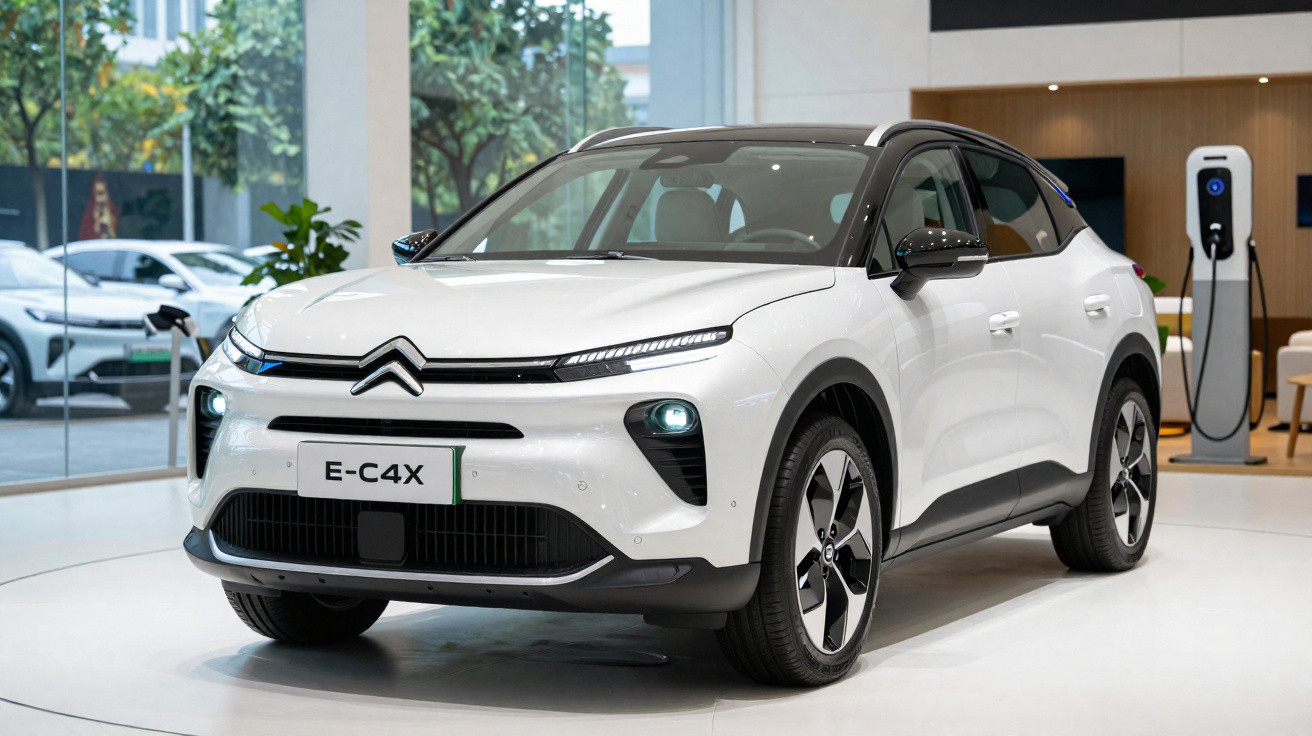
After first meeting the Citroën ë-C4 in its fully electric guise, the Double Chevron brand now serves up a fresh take with “fastback” vibes-despite the drivetrain and underpinnings being exactly the same.
From the front, the ë-C4 X doesn’t look dramatically different, but view it in profile or from the rear and the changes are immediately obvious. The roofline is smoother and flows into the boot, which is enough for Citroën to describe it as a “liftback”.
Even so, this is “simply” a four-door bodystyle that now comes with a more conventional boot shape. Compared with the five-door Citroën ë-C4 (without the X), it gains an extra 24 cm in length, bringing the total to 4.6 metres.
When the first images of this new format surfaced around a year ago, plenty of people said it was “doomed” from the outset. But if you consider that its predecessor could be, for example, a C-Elysée, you have to admit the step forward is significant.
Like that car, the new Citroën ë-C4 X was conceived as a global model for multiple markets, ours included. In the UK line-up there’s a more traditional petrol version, plus a 100% electric variant-the one we tested.
Bold, but not too bold
Up front, it adopts the familiar family look seen across most of the French brand’s range. The daytime running lights form a kind of “X”, and the main headlamps are split into separate elements. The Double Chevron badge sits neatly within the overall design and is very much centre stage.
Lower down, and around the wheel arches, dark plastic cladding gives the Citroën ë-C4 X a hint of SUV-style attitude. That impression is reinforced by a more generous ride height, helping it look tougher.
Naturally, the most noticeable visual changes are at the rear, where that roof-derived “liftback” line defines the shape. The light clusters look thoroughly modern and use LED lighting. At the top of the boot lid there’s also a subtler take on a “ducktail”.
Cabin with no surprises
Slip into the driver’s seat of the Citroën ë-C4 X and you’ll find leather seats with electric adjustment and a sound driving position. That said, the higher-density seat foam takes a little getting used to.
On the dashboard, there are-once again-no differences compared with the five-door model. In other words, this C4 uses a very compact instrument display and a central touchscreen mounted high up. It does feature the newer user interface, although it isn’t always straightforward to locate the function you want.
The gear selector and drive-mode controls are the same items we’ve already seen in dozens of other Stellantis Group models. On the plus side, the main climate controls thankfully remain physical buttons and are easy to reach.
Some cabin materials also feel overdue an upgrade, as they’re too hard to the touch and the finish is a bit untidy at certain edges.
Rear-seat space
While it isn’t class-leading, rear passenger room is adequate, both for legroom and headroom. However, when set against other 100% electric cars-which often benefit from a long wheelbase designed to accommodate the battery pack-the ë-C4 X fell short of what we expected.
Further back, the boot is genuinely generous: it offers 510 litres, and it leaves you feeling as though you could fit “everything and anything” in there. The compromise is that it remains a third-box boot, even if it’s visually disguised. Access is via the boot lid, whose limited opening makes it harder to load bulkier items.
Simplicity takes centre stage
From behind the wheel of the Citroën ë-C4 X, “simplicity” is the watchword in almost every situation. The three available drive modes (Eco, Normal and Sport) alter power, torque and top speed, with three clearly separated steps.
The real headline, though, is comfort-and the effort to create the calmest possible on-board atmosphere. It’s the sort of car that feels ideal for getting you home after a long, tiring day.
On the other hand, because there’s no “authorisation” to use higher-grade, more expensive materials, we noticed more aerodynamic noise than we’d like, for instance.
To offset that, the money spent developing a reinforced suspension capable of “surviving” in more “austere” conditions seems well judged. The end result is the Citroën ë-C4 X’s ability to absorb many of the “atrocities” you encounter around the city centre, with impressive ease and without undermining the sense of comfort inside.
Range and consumption
In this configuration there’s a single electric motor producing 136 hp, 260 Nm of torque and driving the front wheels. With a 50 kWh battery on board, the claimed maximum range is around 360 km. In practice, you’ll need to drive moderately and avoid heavy acceleration to get close to that figure-otherwise the Citroën ë-C4 X will end up some way off it.
During our test, for example, we covered 43 km using only 15% of the battery, leaving an indicated range of 286 km. After a few more kilometres split between town driving and motorway work, always with the air conditioning on, the range dropped to 128 km and the battery percentage to 48%, while the trip counter still showed 135 km.
As for energy use, Citroën quotes an average of around 16 kWh/100 km. We suspect that figure is recorded in the most economical drive setting and with no additional consumers running (such as the air conditioning).
At a more typical pace, we measured 17.4 kWh/100 km, rising to 18.7 kWh when the motorway proportion was higher-meaning fewer opportunities for energy regeneration.
The “price” of electricity
There’s no question that the Citroën ë-C4 X was engineered around a must-meet list of requirements, to make it one of the most rational and appealing options across the different markets it targets.
Even so, being a fully electric car-with its motor, battery, charger and other modern components-still means the price isn’t as attractive as many would like, exceeding €40,000 in base form.
In Shine Pack trim, positioned at the top of the Citroën ë-C4 X range, the tested car already comes very well equipped, including items such as leather seats with electric controls and massage, for example. The downside is that this pushes the price to very close to the €45,000 mark.
Comments
No comments yet. Be the first to comment!
Leave a Comment