
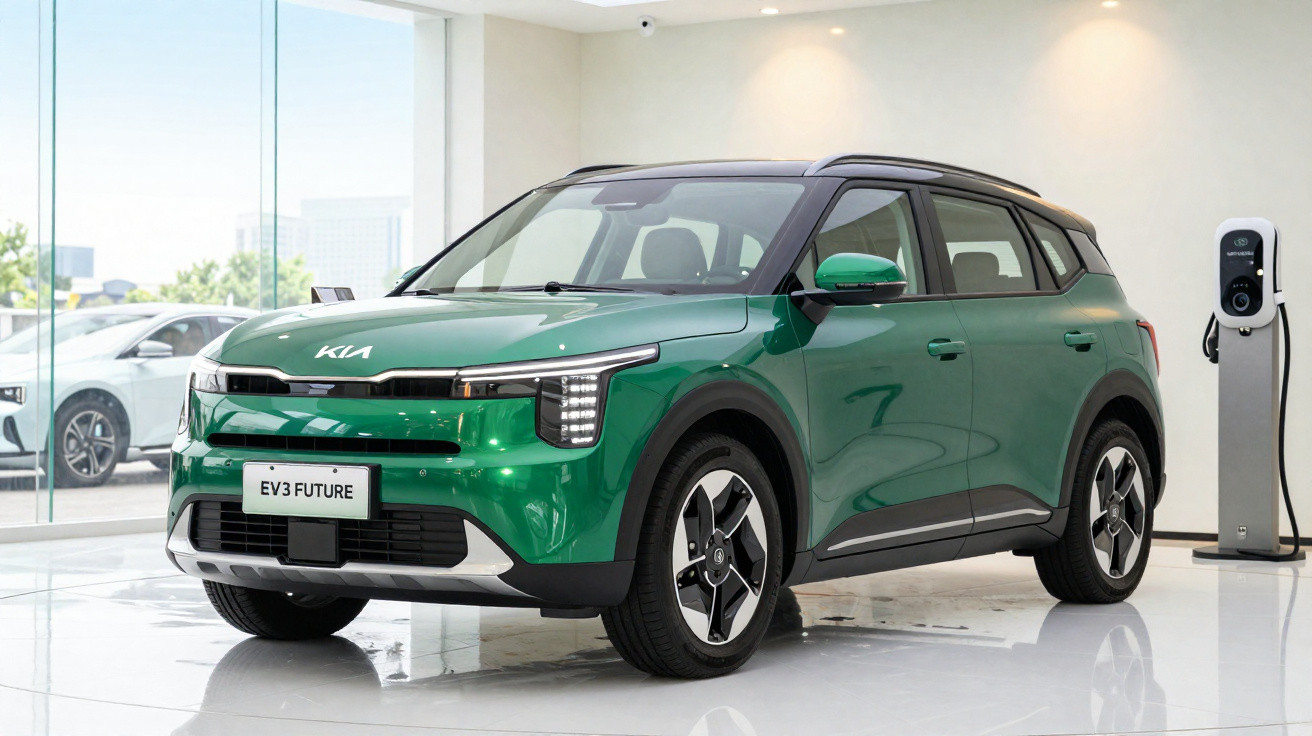
Kia is tightening its grip on the EV market with the EV3. This small SUV is aimed squarely at European best-sellers such as the Peugeot e-2008 and BYD Atto 3, yet it counters with an unusually large battery, a notably roomy cabin, and charging figures you would normally associate with a class above. The real question is whether that is enough to justify the steep asking price.
Compact on the outside, unexpectedly spacious on the inside
At roughly 4.30 metres long, the Kia EV3 looks fairly unthreatening in a car park. In town it is easy to place and simple to thread through traffic, and in multi-storey car parks it never feels unwieldy. It is only once you climb aboard that you notice just how effectively Kia has packaged the space.
The 2.68-metre wheelbase matches what you see in larger classes and delivers rear legroom that makes many rivals look dated.
In the back, even tall adults can settle in comfortably. For a small SUV, knee room is close to generous, and three people can sit across the rear bench reasonably well-provided nobody is a professional basketball player. Families with teenagers will particularly appreciate this.
Boot space is also strong: 420 litres beats the class average. Beneath the adjustable boot floor there is an additional storage area around 14 centimetres deep, handy for bags, charging leads or more delicate items you would rather keep out of sight. Under the bonnet, Kia also provides a small 25-litre front compartment, ideal for cables and odds and ends.
The downside is that flexibility is fairly basic. The rear seat splits 60:40, but it does not slide, and there are no clever load-bay tricks such as movable seats or a folding front passenger backrest.
Minimalist cockpit with a small weakness
Up front, the EV3 clearly takes its cues from the larger EV9. The dashboard design is clean and airy, with an almost floating look. There is no tall centre console; instead, you get a wide armrest module with a pull-out tray-nice to look at, but more of a novelty in day-to-day use than a genuine breakthrough.
The digital layout comprises two 12.3-inch screens, with a small 5.3-inch display between them dedicated to the climate controls. That particular screen exposes a flaw: depending on steering wheel position, your right hand or the rim can obscure parts of the display, meaning you may need to lean forward slightly to hit the correct on-screen areas.
The infotainment system itself feels slick and responds promptly. While the menus can be a touch nested in places, key features such as battery preconditioning and route planning with charging stops are easy to access-an advantage for frequent long-distance drivers.
Technical foundations: e-GMP light rather than high-end
On paper, the EV3 uses a version of the e-GMP platform found under the EV6 and EV9. In reality, it is a heavily revised technical base that sits closer to the Niro EV than to Kia’s larger 800-volt flagships.
The EV3 runs a 400-volt architecture, yet uses what it has with surprising efficiency-especially at DC rapid chargers.
Regardless of battery size, there is always a single electric motor driving the front axle, producing 204 PS and 283 Nm of torque. It accelerates from 0 to 100 km/h in 7,7 seconds, while the 80 to 120 km/h in-gear surge takes 6,1 seconds. That is plenty for confident overtakes, without pretending to be sporty.
On the road, nothing about the EV3 feels dramatic, but the overall set-up is cohesive. Steering is on the light side and does not deliver much feedback, yet the responses are predictable and well judged. The suspension is tuned more for comfort; the body leans noticeably in corners, but in return the EV3 deals convincingly with poor road surfaces.
At motorway speeds, it reveals one of its stronger cards: refinement is impressively high, with wind noise and tyre roar kept well in the background. The EV3 feels more mature at speed than its exterior dimensions would suggest.
Regenerative braking with fine control: i-Pedal 3.0
Kia uses an adaptable approach to deceleration. Behind the steering wheel are paddles that allow you to adjust the regeneration level. The standout detail is that all four stages can be paired with the so-called i-Pedal, enabling true one-pedal driving right down to a standstill-if that is how you want to drive.
- Level 0: near-coasting, minimal deceleration
- Middle levels: clear braking effect, ideal for town and A-roads
- Maximum level with i-Pedal: driving largely on the accelerator pedal, right to a stop
This means the EV3 suits drivers who prefer to coast just as much as those accustomed to strong regeneration. It is evident Kia is drawing on experience from earlier models here.
Consumption: not a hypermiler, but the big battery masks the appetite
In efficiency terms, the EV3 does not quite match the old e-Niro. On A-roads, energy use settles at around 17 kWh per 100 kilometres, while at a steady 130 km/h on the motorway it sits at roughly 24 kWh per 100 kilometres. Note that these figures apply to the more aggressively styled GT-line on 19-inch wheels, which are not ideal for aerodynamics or rolling resistance.
The large Long Range battery with 81,4 kWh usable capacity offsets the thirst and gives the EV3 ranges that stand out in this segment.
With that battery, the EV3 is rated at up to around 605 kilometres (WLTP), while the tested GT-line comes in at about 563 kilometres. In the real world, the following appears more plausible:
- roughly 380 kilometres on A-roads
- about 340 kilometres on the motorway
- approx. 240 kilometres between 80 and 10 percent SoC at typical motorway pace
That last figure is the practical one: between two rapid-charging stops, you can usually cover a little over two hours of driving-exactly the kind of stint length many experts consider sensible.
Rapid charging: impressively quick for 400 volts
A peak charge rate of 128 kW does not look remarkable on a spec sheet. Plugged in, however, the story improves: the EV3 Long Range sustains more than 115 kW across a wide window, up to well beyond 65 percent state of charge. The result is a very strong average of around 107 kW from 10 to 80 percent.
Charging from 10 to 80 percent takes about 32 minutes-putting the EV3 in the company of much more expensive electric SUVs.
At home or on AC public points, the onboard charger supports up to 11 kW. A full charge then takes a bit more than seven and a quarter hours-well suited to overnight charging in a home garage or at a workplace.
Kia also offers an optional V2L function. This turns the EV3 into a mobile mains socket-for example, to power e-bikes, tools or camping kit-via an adapter at the charging port, which will appeal to anyone who spends time outdoors.
Second battery option for shorter journeys
If you do not often travel long distances, there is a smaller battery to choose. The standard version stores 58,3 kWh net. It is tied to the entry and Earth trims and is rated at up to 436 kilometres (WLTP).
In everyday use, it is more realistic to plan around:
- motorway range in practice: around 260 kilometres
- 80 to 10 percent stint: about 180 kilometres
DC charging peaks at up to 108 kW, and the typical 10 to 80 percent rapid-charge stop takes around 29 minutes. That will do for holiday trips, but anyone regularly covering big distances will find the larger battery more relaxing.
The price gap is notable: depending on configuration, the smaller pack can save around 4.700 to 5.000 Euro. For households using the car mainly for local and regional driving, this can be the more appealing option.
Prices, equipment and expensive extras
A glance at the price list reveals the downside to the strong engineering. In Germany, the Kia EV3 starts at about 41.500 Euro in base form. The tested GT-line is just under 46.800 Euro-and even then, it still does not include everything you might expect at this level.
| Variant | Battery | Range (WLTP, approx.) | Price level |
|---|---|---|---|
| Entry / Earth | 58,3 kWh | up to 436 km | from approx. 41.500 € |
| Long Range Earth | 81,4 kWh | up to around 600 km | clearly above 45.000 € |
| Long Range GT-line | 81,4 kWh | up to approx. 560 km | around 46.800 € plus options |
The options strategy is where it starts to look awkward: the heat pump-an important range saver in winter for any EV-is not standard, but only available as part of a pack with V2L for around 1.550 Euro. If you want comfort extras such as electric, heated and ventilated seats, a head-up display or a glass roof, you quickly end up in the GT-line plus the additional Inspiration package.
The upshot is that Kia technically offers few true stand-alone options, yet in practice the structure steers many buyers towards the higher-spec GT-line-even if they are not particularly interested in the sportier styling.
Who the Kia EV3 really suits
The EV3 is clearly aimed at drivers who want a compact electric SUV with genuine long-distance capability. In urban areas you benefit from its manageable footprint; on the motorway you gain from its range and its refinement. Families, long-distance commuters and high-mileage drivers are likely to feel most at home in the Long Range version.
If most of your driving is in the city or the surrounding area, the smaller battery deserves serious consideration. It reduces the purchase price without severely compromising usability. What matters is your own driving pattern: how often do you truly cover 400 kilometres or more in one go each year?
Another look at tech terms and day-to-day usability
Many manufacturer marketing phrases sound impressive but remain vague. With the EV3, two items have a direct effect on daily driving:
- Regeneration: If you consistently drive with strong energy recovery, you can noticeably reduce consumption in town. In stop-start traffic, one-pedal driving can feel more relaxed, although it takes some getting used to.
- Heat pump: It uses ambient heat for cabin conditioning and reduces load on the battery. In cold winters, consumption without a heat pump can increase by several kWh per 100 kilometres, cutting range.
Battery size also benefits from a clear-eyed view: a very large battery is tempting, but it adds weight and cost. If you only do a handful of long trips per year, mostly charge at home and typically drive short distances, a smaller pack can be the more economical choice-both at purchase and in energy use.
The Kia EV3 underlines how far compact electric SUVs have come: interior space that feels half a class up, rapid-charging performance suitable for touring, and comfort that rarely becomes wearing on long journeys. The biggest obstacle is still the price-and deciding how much that sense of security is worth when a relatively small car can take you a long way.
Comments
No comments yet. Be the first to comment!
Leave a Comment