
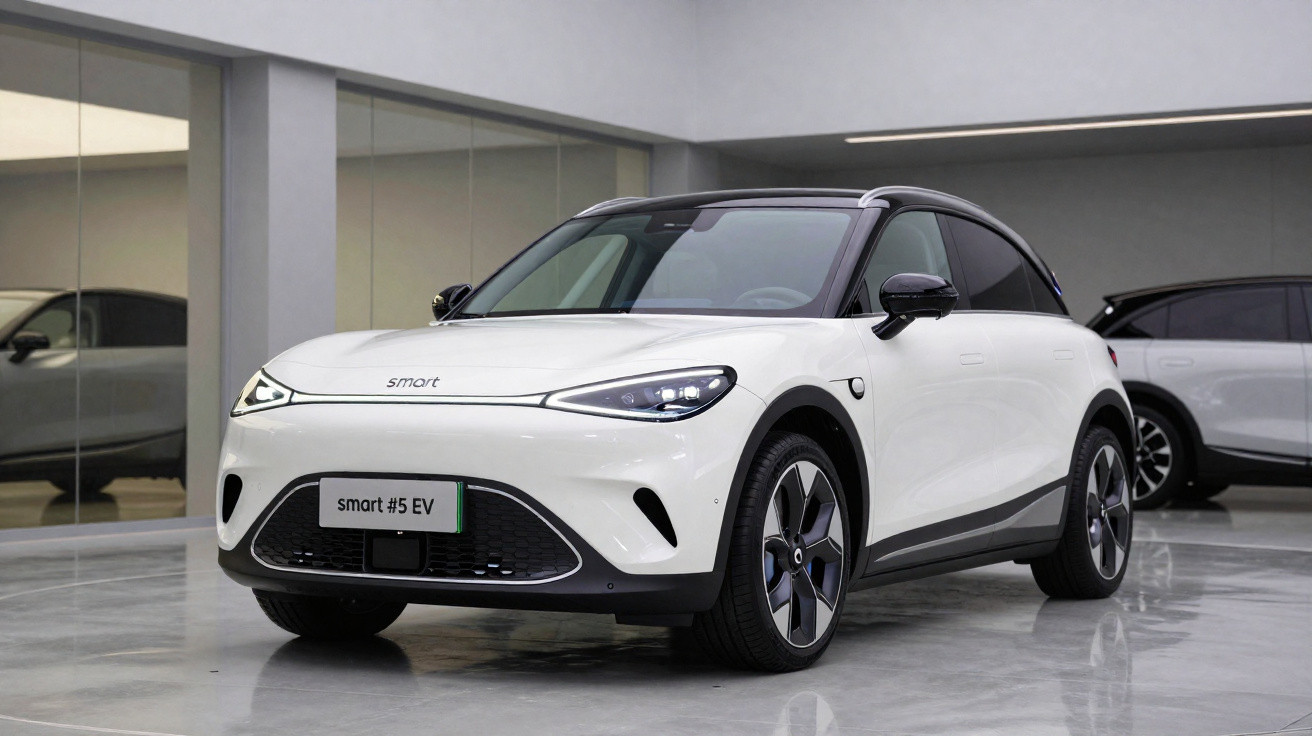
Smart has never been this large, this powerful or this expensive. The brand that, in the late 1990s, put a car just 2.5 metres long on the road has since transformed itself - and is now targeting the premium end of the market with a line-up that looks nothing like its earlier products.
Smart #5: the brand’s biggest step up
The shift began in 2022 with the #1, a B-SUV that shares its underpinnings and technical solutions with the Volvo EX30. In 2024, Smart introduced the #3, a coupé-inspired crossover aimed at the C segment. Now it has climbed another rung with the #5: a 4.7-metre SUV that is already on sale in China.
Within Smart’s history, the #5 is a string of firsts. It is the biggest, most powerful and heaviest model the brand has ever built - and also the most expensive. More than that, it stands in stark contrast to the ideas Smart championed when it was founded in 1994.
What started as a niche brand built around urban mobility is now positioned across the three segments with the strongest demand in Europe.
A much tougher competitive landscape for Smart
Where Smart once operated with very little direct competition, it now faces dozens of manufacturers. The #5 makes that reality clear, as it will be landing in a space that has, up to now, largely been defined by the Tesla Model Y.
Back to its roots?
Even with this premium push, Smart has not forgotten the cars that originally defined it: city cars. That is why the brand could yet return with a model aimed at customers who still make the fortwo such a sought-after option on the used market.
That is what Dirk Adelmann, CEO of Smart Europe, told us during a conversation at the press presentation of the new Smart #5 in Stuttgart, Germany.
“Right now, we are present in segments B, C and D. So there is still one segment open for us, which is segment A, where we were extremely successful until the middle of last year,” said the head of Smart in Europe, before offering a clear commitment:
“If we come back with a two-seater (…) it will be a true Smart, it will be a unique proposition and it will not be retro. That is a promise.”
Dirk Adelmann, CEO of smart Europe
As Adelmann explained, the brand is not looking backwards when it comes to a potential return to the A segment.
“We don’t look to the past; generally, we look to the next thing customers expect from us in that segment.”
He also set expectations about what such a car would have to be.
“If we decide to launch a successor (to the smart fortwo) or a new two-seater, it will be a true Smart, with decent range and 100% electric, that is guaranteed.”
Even though he appears to have a clear view of what the brand would want from this future model, Adelmann stressed - more than once - that no decision has yet been made on a possible fortwo successor. Still, confirmation could arrive sooner than many expect:
“It’s not decided yet, but I am optimistic that we will have something to communicate still this year.”
It is worth recalling that last year, speaking to Automotive News Europe, Adelmann said that bringing a fortwo successor to market would require a new platform capable of underpinning a car up to 2.8 m long, while still meeting today’s safety requirements and the quality standards expected of a model from the German brand.
Smart is said to have reviewed various platforms that might meet those criteria, but, according to Adelmann - again quoted by Automotive News Europe - “none was found”.
So what is the alternative? Building a new architecture from scratch: “We have already started working on a new dedicated platform to serve as the basis for a future two-seat Smart for the city, but we need partners to make this investment viable,” he told Automotive News Europe in 2024.
Alliance with Renault on the cards?
We asked whether that investment partner could once again be Renault - given that the last generation of fortwo and forfour was co-developed with the Twingo - at a time when Renault is preparing a new, purely electric generation of the Twingo. Adelmann’s answer was unequivocal:
“ We have been working on this project for two years. That was, of course, one of the angles we explored, but, for now, I can exclude it. And that is part of the problem in this segment: if we do it on our own, then we have to develop a platform that doesn’t exist,” he said.
“If we want a viable business case (a car with a competitive price), it is extremely difficult. That’s why nobody is currently present in an active way in that part of segment A where we want to be,” he added.
Comments
No comments yet. Be the first to comment!
Leave a Comment