
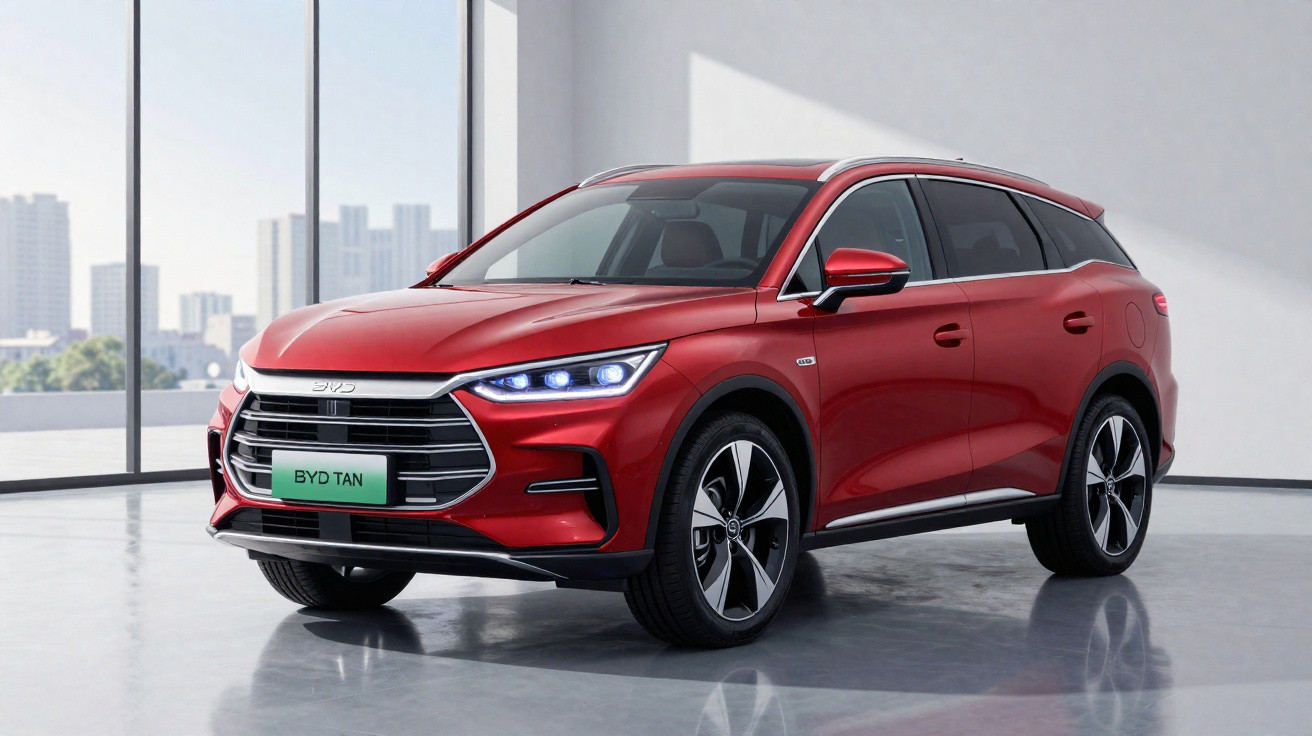
There must surely be something wrong with this BYD Tang, but we’re still trying to find it.
If you’re the sceptical sort-tired of hearing yet more talk about SUVs, EVs and Chinese cars-then the BYD Tang probably isn’t the gentlest way to start changing your mind.
The trouble is that once you’ve driven it, you’ll be tempted to tune out the noise. More likely, you’ll find any excuse to add miles behind the wheel of the Tang. Brand and country of origin aside, BYD’s flagship SUV piques your interest from the very first encounter.
From the outside, it’s clearly related to the rest of the range, but everything is scaled up: 4,97 m long, 1,95 m wide, 1,75 m tall and with a 2,82 m wheelbase. Even the wheels are oversized-21″ items shaped to help airflow.
Top-of-the-range feel
Step inside and the strong first impression continues. Dark trims paired with brown leather seats create a cabin that feels both premium and relaxing. There’s room for seven occupants, too.
As usual, the third row is better suited to short trips or smaller adults and children, even though it offers above-average space for the class.
The drawback is the boot. With every seat in use, you’re left with just 235 litres-enough for a few bags, some rucksacks and not a great deal more. Fold the third row and the volume jumps significantly, although the higher load floor does limit some flexibility.
Up front, space is plentiful across the five forward seats. The driver gets a comfortable driving position with electric adjustment, heating, ventilation and even a massage function. Material quality and build feel are at a level that leaves little to criticise.
In the second row, you can adjust the backrest angle, there’s a dedicated screen to manage the air conditioning (ventilation and temperature), and-naturally-you get the best view of the vast panoramic roof.
Technology at the centre
The tech headline is the 15,6” central touchscreen, which can rotate between portrait and landscape-handy mainly for showing off to friends. In practice, I kept it in landscape, as it interferes less with forward visibility.
The instrument cluster is a 12,3” digital display, but most controls live in the central screen. You can see BYD has worked to tailor the system to European tastes, even if there are still a few rough edges.
For instance, setting up Apple CarPlay or Android Auto is straightforward, but tuning the radio is another matter. The number of settings and customisations is huge-from the indicator sound to how the BYD Tang greets you or says goodbye.
Before you even move off, a few figures stick in your mind: the BYD Tang weighs 2630 kg-partly thanks to its huge Blade Battery (LFP) pack of 108,8 kWh. BYD claims up to 530 km of range on the combined cycle, rising to 680 km in urban driving.
Números de respeito
On our test, we recorded energy use of 21,5 kWh/100 km-better than the official 24 kWh/100 km on the combined WLTP cycle-which puts us close to a real-world range of around 500 km.
Charging times are equally clear-cut: allow 14 hours for a full charge on AC (11 kW). On a rapid charger (up to 170 kW), you can go from 30% to 80% in roughly 30 minutes.
Peso? Qual peso?
With nearly 2,7 tonnes to shift, you wouldn’t expect the Tang to shine on a twisty road. Yet the 380 kW (517 cv) produced by two motors (one per axle) and a well-judged suspension with “intelligent” damping work wonders.
Even with its locomotive-like bulk-something you’re always aware of from the driver’s seat-the Tang never feels intimidating. If anything, it’s the sort of car that makes you want to drive “só porque sim”. From behind the wheel it comes across as strong, smooth and impressively stable.
A Brembo braking system (with large ventilated and drilled discs) adds reassurance and delivers the confidence you want.
Que equipamento escolher? Sim.
The standard equipment list for the BYD Tang 2025 runs to several pages and, in the European market, there’s only one trim available: Flagship. As for paid options, there aren’t any. The 73 702 euros asked in Portugal already includes everything there is to include.
Against likely rivals, it’s hard not to see the Tang as a strong value proposition. Take the Kia EV9, another huge, fully electric seven-seater SUV: it costs more-starting at 77 500 euros-but comes only with rear-wheel drive and 150 kW (204 cv), while claiming a longer range of 563 km.
If you look at the EV9 GT-Line AWD, which competes more directly with the Tang, the price jumps to almost 90 000 euros, yet it still offers less power-283 kWh (385 CV)-and it also drops to slightly less range: 510 km.
Comments
No comments yet. Be the first to comment!
Leave a Comment