
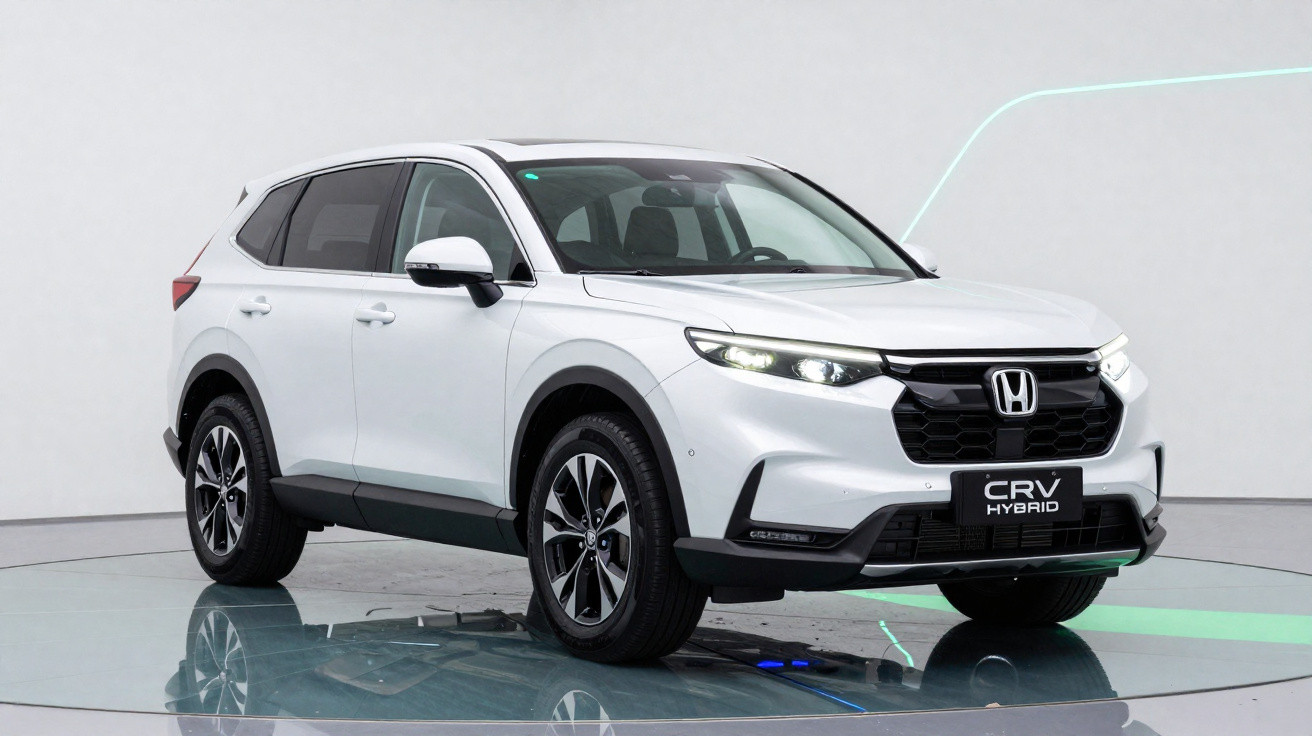
Honda’s return to hybrids in Europe comes via the new CR-V Hybrid, which is also the first hybrid SUV from the Japanese brand to be sold in the Old Continent.
We say “return” because hybrids have long been part of Honda’s world. Many of you will remember the Insight, a compact estate that paired a small petrol engine with an electric motor to deliver higher efficiency and lower fuel consumption.
The first-generation Insight debuted in 1999 and became Honda’s first futuristic proposal to combine hydrocarbons with electrons. That original Insight was a three-door, two-seat hatchback with smooth, low-drag styling and very low weight, ranging from 838 kg to 891 kg. The second generation would later evolve into a fully fledged estate.
The experimental nature of the first Insight helped pave the way for many more Honda hybrids over the following decades, from more family-focused models such as the second-generation Insight and the Civic IMA, to sportier offerings like the CR-Z, culminating in the NSX supercar.
The new Honda CR-V Hybrid is the latest chapter in this 20-year story.
Honda CR-V Hybrid, Honda’s first hybrid SUV in Europe
The Honda CR-V needs little introduction. It is the brand’s best-selling SUV and one of the best-sellers worldwide. The fifth generation now arriving has grown inside and out and gained sophistication on several fronts - and it is the first to showcase the potential of Honda’s new hybrid system, i-MMD, or Intelligent Multi-Mode Drive.
As a hybrid, the Honda CR-V is moved by two power sources: a 2.0-litre internal combustion engine running on the more efficient Atkinson cycle, plus two electric motors - one acting as a generator and the other as the drive motor.
The i-MMD system is not the same as other hybrid set-ups, yet its benefits are clear. It is not a plug-in hybrid, so there is no need to connect it to a socket; it enables all-electric driving and helps keep fuel consumption and emissions low.
How does the i-MMD system work?
What sets this system apart is the way it operates: in practice it behaves more like a 100% electric vehicle than many other hybrids. That is because, in most driving situations, the Honda CR-V Hybrid is propelled exclusively by the electric drive motor, while the combustion engine works mainly as a generator for the electric motor.
The resemblance to a pure EV goes even further, as it does without a conventional gearbox. Drive is sent to the wheels through a fixed ratio, which results in a smoother delivery of torque.
That EV-like simplicity also shows in day-to-day use, because the “intelligent” in i-MMD refers to automatic management of how the two different power sources interact - creating three distinct driving modes (Multi-Mode Drive):
- EV - electric mode, in which the electric motor draws energy solely from the batteries and operates mainly at low speeds. This mode is short-lived, only 2 km in total. Even so, it is engaged frequently, alternating with Hybrid mode. We can force this mode using a button on the centre console.
- Hybrid - the combustion engine starts up, but it is not connected to the wheels. Its role is to generate power for the electric generator motor, which then supplies the electric drive motor. If there is surplus power, that energy is redirected to the batteries.
- Combustion Engine - the only mode in which the combustion engine is connected to the wheels, via a lock-up clutch.
In most real-world situations, the Honda CR-V Hybrid switches between EV mode and Hybrid mode. This can be monitored on the 7-inch digital instrument display via the Driver Information Interface (DII), which shows the energy flow between the combustion engine, the electric motors, the batteries and the wheels.
Combustion Engine mode is triggered at higher cruising speeds - the most efficient choice according to Honda - and even then it may still move into EV mode. Why? The electric motor produces more power and torque than the 2.0 Atkinson unit - 181 cv and 315 Nm versus 145 cv and 175 Nm, respectively. In other words, the two engines never work together.
Once you understand the i-MMD set-up in the Honda CR-V Hybrid - and how closely it mirrors the operating logic of 100% electric cars - you could almost describe it as an electric car… powered by petrol.
Battery charging is not something we need to worry about. As noted, the batteries can be replenished by the combustion engine, but the Honda CR-V Hybrid also features regenerative braking: when we lift off or brake, kinetic energy is converted into electrical energy and sent back to the batteries.
We can also fine-tune the strength of deceleration using the Deceleration Selector Paddles mounted behind the steering wheel.
Low fuel consumption
The real-world outcome of the i-MMD system is low fuel consumption alongside strong performance, with Honda quoting 5.3 l/100 km (NEDC2) for the CR-V Hybrid, and 5.5 l/100 km for the CR-V Hybrid AWD with four-wheel drive.
Pricing for the Honda CR-V Hybrid starts at 38 500 euros for the two-wheel-drive version and at 51 100 euros for the AWD, four-wheel-drive version, which is offered exclusively with the highest equipment grade, Executive. When fitted with Via Verde, the two-wheel-drive CR-V Hybrid is class 1 for tolls.
Comments
No comments yet. Be the first to comment!
Leave a Comment