
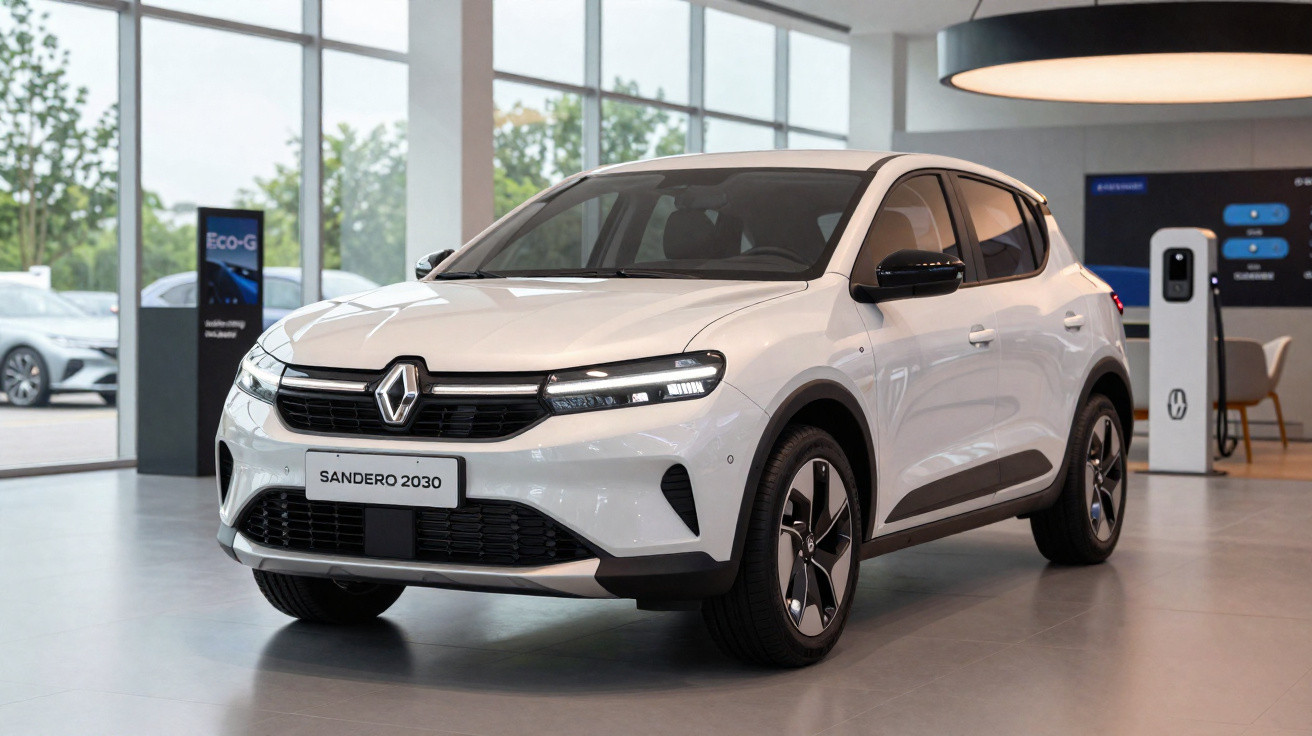
Dacia is tightening up its strategy for the years ahead, following the Renault Group’s newly presented roadmap. The direction is clear: greater electrification, a wider spread of powertrains – and the key question of where that leaves the Sandero, the brand’s best-seller. One thing is settled: the affordable supermini is not going away, but it definitely will not stay exactly as we know it.
Renault plan reshapes Dacia – and that includes the Sandero
Renault’s future programme puts Dacia more firmly in the spotlight. The brand is still meant to stand for tough, straightforward and affordable cars, yet it also has to respond to stricter CO₂ targets and shifting customer expectations.
"Dacia promises: low prices remain the goal, even if getting there becomes more complicated thanks to electrification."
Right now, Dacia has only one fully electric model, the small Spring. Under the group strategy, three additional battery-electric models are due to arrive by 2030. At the same time, conventional combustion engines will remain in the line-up – but increasingly alongside alternative drivetrains.
More variety in the engine line-up
Rather than switching everything to electric overnight, Dacia is relying on a combination of different drivetrain solutions. Even today, many models are offered with LPG (autogas) and hybrid technology.
- Petrol engines remain the core entry-level option.
- Eco-G (petrol/LPG) is intended to deliver low-cost driving with reduced running costs.
- Hybrid versions will be introduced step by step – first on larger vehicles, and later in the supermini class.
Already, Dacia shows this multi-energy approach across Jogger, Duster and the upcoming Bigster. Joining them is the Striker, a crossover measuring around 4.62 metres, positioned between a traditional saloon and an SUV and also expected to be offered with multiple powertrains.
Where the Sandero sits in Dacia’s future portfolio
For many buyers, the most important update is simple: there is no “retirement notice” for the Sandero. On the contrary, within the brand it is considered essential. Across Europe it is Dacia’s top-selling model and in some cases it even outperforms well-known small cars from larger groups.
In France, for example, more Sanderos were registered at the start of the year than current supermini models from the parent company’s own range. For Dacia, that success sends a clear message: the entry-level supermini remains at the heart of the brand.
"As long as the Sandero leads the registration tables, Dacia will not give it up without a fight."
In internal documents, Dacia describes what comes next as the model’s “next chapter”. That may sound matter-of-fact, but it still reveals the key point: the story continues, and it does so with a distinct shift in drivetrain strategy.
Why the model change is still some way off
Anyone expecting an all-new generation will need patience. The current Sandero has only recently received a facelift. Design elements were revised, equipment levels were adjusted, and the car now feels fresher again versus its rivals.
While that update is still new in the market, a clean-sheet replacement is not realistically on the immediate horizon. Development budgets are tight and Dacia has to spread investment across several projects. As a result, the current generation is likely to remain on sale for a few more years before the next major step arrives.
What the next Sandero generation could look like
There are no official images or technical specifications for the future Sandero yet. Even so, Dacia’s statements point to several clear themes. The central term is “multi-energy offering”.
| Likely powertrain | Role in the next Sandero generation |
|---|---|
| Petrol | Remains the entry option with the lowest possible purchase price. |
| Eco-G (petrol/LPG) | Aimed at high-mileage drivers focused on keeping costs down. |
| Hybrid | Intended to reduce CO₂ figures and improve comfort, especially in urban use. |
A pure electric Sandero has not been confirmed at present. It appears more likely that Dacia will assign the role of all-electric city car to another small model, one that eventually replaces the Spring. In that scenario, the Sandero could act as a kind of “bridge” between traditional combustion engines and an electrified future.
Why a hybrid Sandero matters so much to Dacia
The manufacturer has set itself an ambitious target: by 2030, around two thirds of all vehicles sold are meant to include some form of electrification – hybrid, plug-in hybrid or fully electric. Hitting that goal will be difficult without an electrified high-volume model in the supermini segment.
"A Sandero with a hybrid drivetrain could become the decisive lever to push the brand’s electrification share upwards."
Hybrid systems can cut consumption particularly in town, where drivers repeatedly brake and accelerate. Energy recovered during braking is stored in a small battery. In stop-start traffic, the electric motor often handles much of the work, reducing the load on the combustion engine.
What buyers in Germany can realistically expect
For buyers in Germany, the Sandero remains attractive above all because of its price. As other manufacturers make their superminis significantly more expensive – or drop them entirely – Dacia looks like a counter-model. However, the brand must ensure that added technology does not send prices spiralling.
That makes tiered specifications a plausible approach:
- simple entry trims with petrol engines for price-focused buyers,
- Eco-G versions for high-mileage drivers and commuters with LPG filling stations nearby,
- more premium-positioned hybrid variants with extra comfort and driver-assistance features.
This would allow Dacia to serve different customer groups without completely abandoning the Sandero’s identity as an “affordable car without unnecessary extras”.
The challenge: more technology, the same simplicity
This is where the real balancing act sits. Electrified drivetrains bring additional components, more software and often extra weight. Dacia has been successful partly because its cars are kept simple, which helps them stay inexpensive. Any added feature has to pay its way.
Dacia is therefore likely to look for solutions that allow one drivetrain to be shared across multiple models to keep costs down. A hybrid system used in Jogger, Duster and Sandero, for instance, would significantly improve economies of scale. At the same time, it would make servicing and parts supply easier for workshops.
What terms like “Eco-G” and “multi-energy” actually mean
Many shoppers see these labels in price lists and wonder what they refer to in practice. Two terms are currently central to Dacia: Eco-G and multi-energy.
Eco-G refers to an engine that can run on standard petrol as well as LPG (autogas). In everyday use, that means:
- you can refuel at either petrol pumps or LPG pumps,
- fuel costs per mile are often lower,
- CO₂ emissions are slightly reduced compared with running on petrol alone.
Multi-energy means a model is not restricted to a single drivetrain type, but offered with a choice. When ordering, a customer can decide between a pure combustion engine, a gas variant or a hybrid. For the Sandero, that would mean far more freedom in the long term – and more configurations for retailers to manage.
The risks and opportunities of the next Sandero generation
For Dacia, handling the Sandero is a tightrope walk. On the one hand, the brand cannot afford to lose its low-cost point of entry. On the other, without electrification it risks penalties if its CO₂ fleet figures do not meet requirements. The next generation has to satisfy both demands.
For customers, there are upsides and downsides at the same time:
- Opportunity: more modern powertrains, lower consumption, improved emissions results.
- Opportunity: wider choice of engines and equipment levels.
- Risk: higher entry prices, particularly for hybrid versions.
- Risk: more complex technology, which could be more expensive if something fails.
Anyone driving a very simple, inexpensive Sandero today may find themselves in a noticeably more tech-heavy class of car in a few years’ time. That does not have to be negative, but it does shift the character of the car to some extent.
For many prospective buyers, it can be worthwhile to check early which drivetrain fits everyday life best. If you mainly do short urban trips, a hybrid tends to deliver more benefit than for someone who mostly covers long motorway distances. Conversely, Eco-G makes most sense where LPG is easy to find and you can refuel regularly.
Comments
No comments yet. Be the first to comment!
Leave a Comment