
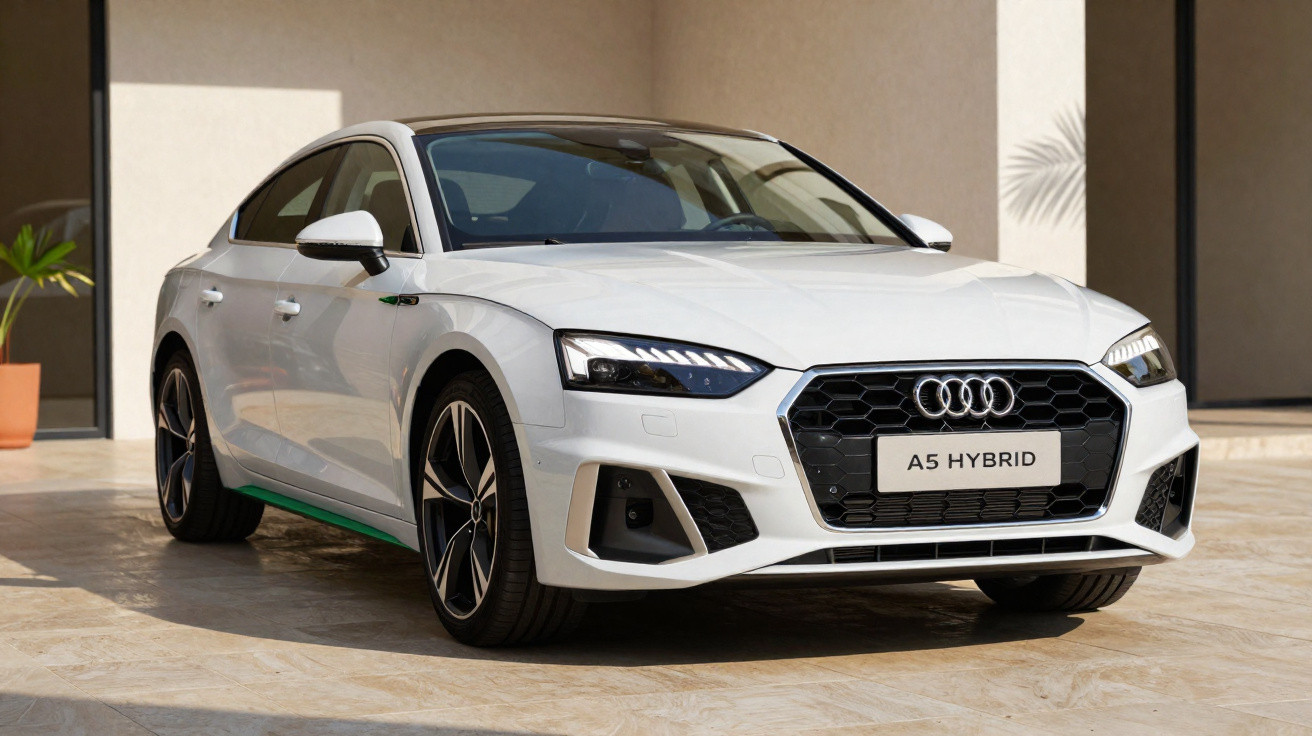
The new Audi A5 now takes the place of both the old A4 and A5. More versatile than ever, the saloon is now joined by a plug-in hybrid variant. Audi claims it blends the best of electric and petrol power. We went to find out whether that holds true.
Brrr… France is in the grip of an icy weekend, and Saturday 22 November was even the coldest day of the year since 14 January. So why not swap the frost for a little Andalusian sunshine for the duration of this read? Our steed is a thoroughly revised Audi A5 e-hybrid. The mission? Achieve the lowest possible consumption over a 306 km route… while enjoying some spectacular scenery, too.
It’s 9 o’clock and the thermometer is already reading 24°C. We set off from the Finca La Bobadilla hotel, tucked away in the Andalusian countryside north of Malaga. After a quick walkaround, it’s time to head out in Efficiency mode, naturally. The black saloon pulls away on electric power and shows a 92 km zero-emissions range. The track leading out of the estate isn’t especially demanding, but it does reveal a few early jolts.
An Audi A5 that’s firm yet composed at speed
Unsurprisingly, our S line test car-with its lowered chassis and 19-inch wheels-never promised limo-like suppleness, particularly without adaptive dampers. It’s not unbearable, even so, although nasty speed bumps are dispatched rather harshly. The springs can also feel a little wooden over the broken tarmac of the local autovías. With its taut set-up, this A5 isn’t the last word in comfort, and our spines would agree if they could talk.
On the upside, straight-line stability is beyond reproach, and the careful sound insulation makes long distances easy going. Your eyes are quickly drawn to the region’s trademark plains, constantly alternating between ochre, desert-like stretches and cultivated land. And the economy challenge? We’ve got a useful ally: linked directly to the sat-nav, the hybrid system carefully manages electric running phases according to the route’s topography.
Intelligent regeneration
Regenerative braking strength varies to help maintain speed limits and safe distances to other vehicles, which in turn tops up the 20.7 kWh battery in a smart way. Audi even quotes up to 88 kW recovered through regeneration. Eco-driving prompts also suggest easing off as you approach a roundabout, crest a hill, or enter a built-up area. Speaking of towns, we soon roll into the superb white village of Overo for a photo stop.
The traditional architecture is well worth the detour, but squeezing through narrow cobbled lanes is anything but relaxing because the A5 is broad-2.10 m including the mirrors. It’s immediately obvious why locals favour small city cars. Still, the turning circle feels decent for a 4.83 m car, while the petrol engine staying on standby keeps progress calm and quiet. The electric motor’s 143 hp is even enough to climb steep gradients without waking the cylinders-ideal when you’re busy admiring the immaculate façades.
A very digital Audi A5
Sensors start chirping, cameras get to work, and you find yourself leaning on the brake pedal to manoeuvre. After a few sweaty moments in lanes where passing was impossible, we finally escape the maze and reach our lunchtime stop at Finca la Fuensanta. Dieting is not on the agenda: lunch is hearty, and we use the post-meal lull to inspect the German car’s cabin. With a trio of displays up front, the atmosphere is undeniably modern.
Two curved screens measuring 11.9 and 14.5 inches wrap around the driver’s area. The graphics are crisp, though the colours look a little muted. The same applies to the front passenger, who can have an optional 10.9-inch display-perfect for belting out karaoke to their favourite tracks. Ouch, our ears… There’s also a learning curve to the interface: it’s comprehensive, but not especially intuitive, with ventilation controls buried inside the screen.
Uneven build quality
Another potential sticking point is build quality, which is slightly worse than on the previous models. Yes, the starting point is high, but it’s fair to expect improvements with each new generation. Here, that hasn’t really happened: the dashboard padding feels too thin, and hard plastics show up quickly lower down. The door-bin lining also seems rather stingy on this version, which costs exactly €81,286.
Is everything falling apart? Not quite-key Audi strengths remain, including solid assembly, seats that feel pleasant to the touch, smart Alcantara trim, and a satisfyingly muted door thud. Rear space is respectable, although the middle passenger has to contend with a sizeable transmission tunnel. The boot is reached via a handy tailgate, but it reveals a fairly modest 331 l capacity-similar to a supermini. With 417 l, the purely petrol versions are better suited to carrying loads.
A particularly agile Audi A5
Don’t click away yet. If the Audi A5 has so far delivered a mixed scorecard, it makes up ground when it comes to driving dynamics. Gone are the low-speed squeezes. The horizon opens up and a fine B-road bordered by citrus fields appears ahead. With a smoother surface than earlier in the day, the road stops upsetting the suspension, and the twisty layout highlights the chassis balance. Quattro all-wheel drive effectively delays understeer and boosts cornering confidence.
Firm suspension and a lowered centre of gravity naturally keep body roll in check. The brake pedal, however, remains tricky to modulate, especially when the car transitions from regenerative braking to friction braking. Fortunately, our challenge requires using the pads as little as possible to maximise regeneration. Better still, the brand says the electric motor handles more than 90% of deceleration. So: hands off the left pedal, then.
Fuel consumption that’s fairly satisfying
Despite our best efforts, the battery starts to run low, the gauge turns red, and the electric range shrinks to almost nothing. The petrol engine cuts in more often, while electric-only phases become increasingly rare. Game over? It’s true that unleaded consumption rises, but refinement remains intact because transitions are still smooth. The petrol engine is particularly quiet, and the S tronic gearbox is gentle. Only acceleration loses some sparkle without a fully charged battery backing it up.
In that sense, the Audi A5 turns into a full hybrid. But what a full hybrid: the 2.0 TFSI’s 252 hp is still more than enough to get speed cameras flashing. So keep an eye out for the Guardia Civil, especially as speed limits change regularly in the kingdom. After 120 km of small roads, we approach Seville with the battery nearly empty. While the final urban kilometres are mostly electric, it becomes impossible to manually force EV mode.
Drum roll… After 306 km, our final consumption figure is 3.1 l/100 km. Impressive. Before celebrating that number with a flamenco, it’s worth remembering that this strong result was made possible by starting with a full battery and driving economically for the entire route. In more typical use, consumption will undoubtedly be higher. After all, who really wants to anticipate every climb, calculate every junction, time every set of lights, and predict what other road users will do? Driving like that takes focus-and can become frustrating when the scenery begs you to simply look around.
Our verdict on the Audi A5 plug-in hybrid
Audi’s plug-in hybrid set-up looks convincing on paper-and it delivers in reality. In the A5, the formula works, combining a strong electric range with restrained consumption. While we did notice a few steps back in perceived build quality, the plug-in hybrid saloon remains a solid, dependable product that should appeal particularly to company fleets. We’d still have liked softer damping and a slightly richer standard equipment list given the price.
Audi A5 e-hybrid S line
€69,500
| Score | 7.5 |
| Verdict | 7.5/10 |
We like
- Restrained consumption
- Quiet cabin
- Effective road holding…
We like less
- …but lacking character
- Harsh suspension
- Uneven build quality
Comments
No comments yet. Be the first to comment!
Leave a Comment