
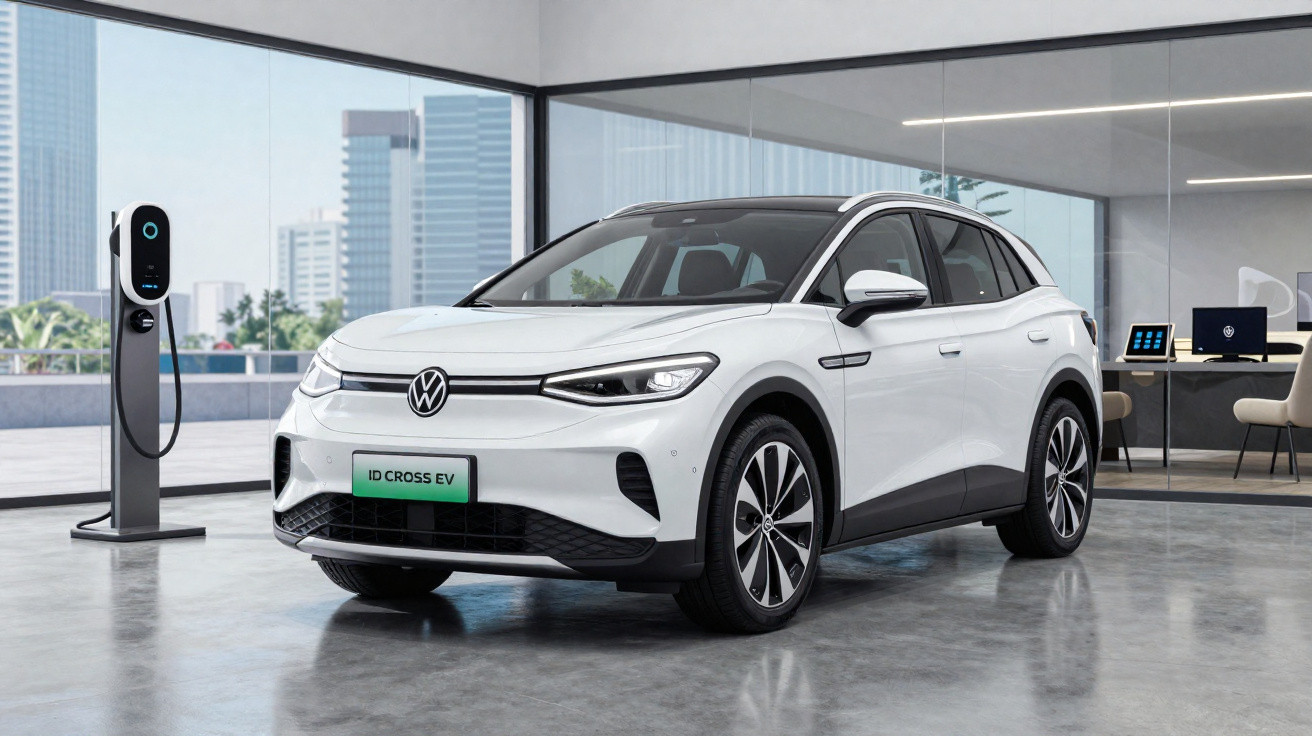
Volkswagen currently leads electric car sales in Europe (first half of 2025). That position reflects sustained effort: after ironing out many of the issues that affected its earliest models, the brand has upgraded and broadened its line-up.
That lead looks set to strengthen over the next two years. The ID.Polo is due in the first half of 2026, followed a few months later by the GTI version. Volkswagen is clearly determined to keep historic names and badges alive, as these two examples underline.
In the second half of next year, the final Volkswagen ID. Cross will arrive, and 2027 will then bring the ID.1, which will be built at Volkswagen’s Palmela plant.
Volkswagen ID. Cross platform and performance
This compact crossover sits on the new MEB Entry platform. Measuring 4.16 m long-almost identical to today’s T-Cross-but notably wide at 1.84 m, it places a 155 kW (211 hp) electric motor at the front and positions the battery beneath the vehicle.
Volkswagen has not yet published the battery capacity. However, with a quoted reference range of 420 km, it is reasonable to expect something around 55-60 kWh, based on consumption that should be close to 13 kWh/100 km. On performance, the only confirmed figure so far is a top speed of 175 km/h.
Design direction: ‘Pure positive’ for the ID. Cross
On styling, it is known that designer Andreas Mindt was recruited from his previous role as Bentley’s head of design to return to Volkswagen. The goal is to reintroduce recognisable brand cues that help inspire confidence-something he quickly signalled with the first concept car (ID2.All), shown just a few months after his return to Wolfsburg.
“With the Cross we are starting a new design language called Pure positive, which is based on our iconic design of the past, the friendliness created by the ‘face’ of each model, and an idea of stability.”
Andreas Mindt, Head of Design at Volkswagen
On this concept, the body’s rounded volumes stand out, along with the sturdy impression created by the widened wheelarches. Those arches house huge 21” wheels (unlikely to feature on the production car) wrapped in 235/40 tyres.
Dark, high-gloss pillars give the impression that the roof is floating over the ID. Cross-an effect that may still appear on the higher-end versions.
A particularly distinctive element in the profile is the front pillar, which is strongly raked backwards. In contrast, the rear pillar leans forwards and reinterprets an iconic feature made up of horizontal slats, previously seen on the ID. Buzz and now making its debut on a Volkswagen SUV. These details help visually lower the centre of gravity of the glasshouse and are notable for having illuminated edges when driving at night.
Spacious and functional
Inside, the first positive impression comes from the generous cabin room, designed to accommodate five adults without major compromises-especially when it comes to legroom.
That space is enabled by the long wheelbase (2.60 m) and the EV layout, which removes several bulky components (exhaust system, propshaft, etc.) and allows for a completely flat floor in the second row.
All five seats in the ID. Cross can recline so a mattress can be placed inside, similar to the arrangement in the ID. Buzz, though it is not yet certain this feature will make it into the final production model.
The boot offers 450 litres, and there is also a small front luggage compartment (frunk) of 25 litres under the front bonnet (intended to hold the battery charging cables).
The dashboard is centred around two screens: an 11” instrument display and a 13” central infotainment screen that controls most functions. But-good news-physical buttons remain for the climate controls (below the central screen), and for adjusting the exterior mirrors and the four windows on the driver’s door. Volkswagen has listened to customers and corrected the single switch setup for front and rear windows that had proved unpopular.
The ID. Cross will introduce a new generation of software on its electronic platform (and this will be rolled out across most other ID models), bringing quicker responses, expanded voice-control capability, and more modern graphics.
When does it arrive?
The public unveiling takes place next week at the Munich Motor Show (IAA 2025). As noted earlier, the production version is scheduled to launch in the second half of 2026-roughly a year from now.
Comments
No comments yet. Be the first to comment!
Leave a Comment