
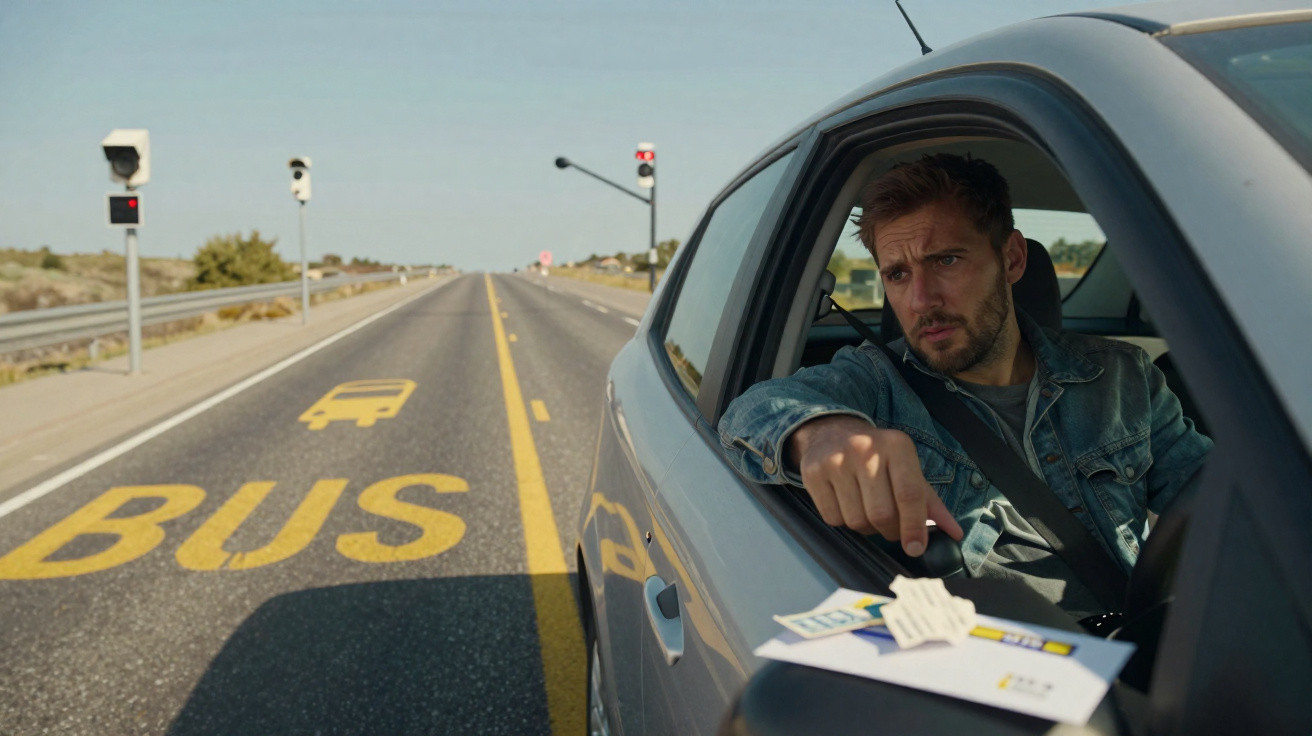
Hazard lights blinking, engine still on, a rapid drop-off on what seemed like a calm bit of road. Then, a few days later, the truth arrived with a heavy thump on the doormat: three penalty notices, logged by three separate systems, all for the same “one‑minute” lapse.
The images left no wiggle room. Same vehicle, same position, slightly different viewpoints, with timestamps separated by only minutes. A bus lane that looked deserted on a dull weekday afternoon ended up being her priciest pause of the year.
And behind those three envelopes was an unseen process doing exactly what it was designed to do - with no allowance for context, pressure or good intentions.
A one‑minute stop that turned into a slow-motion nightmare
It began as one of those everyday urban scrambles. Sarah, 42, was taking her mum to a hospital appointment on the outskirts. The roads were packed, parking was nowhere to be found, and the hospital drop‑off area was already jammed. Up ahead: a red strip of carriageway, a clear “BUS LANE” sign, and not a bus to be seen.
She eased in, hazard lights on. Her mum was slow getting out - one hand on the door, the other clutching her bag. About sixty seconds, perhaps ninety. Sarah stayed in the driver’s seat with the engine running, checking the mirror. No horns. No official intervention. Just the normal city background noise.
She drove off assuming she’d made a sensible, harmless choice. In reality, she’d placed herself right in the path of tightly automated enforcement.
The first notice dropped through the letterbox four days later. It included a crisp black‑and‑white shot of her car, like a studio photograph, sitting partly on the red lane. The charge stung, but it didn’t feel unbelievable. She exhaled, muttered a few choice words, and put it down as an “expensive lesson”.
Two days after that came a second envelope. Same day, same location, different moment. Another camera, capturing a slightly different part of the lane. Another penalty. Confusion quickly turned into anger: how could one brief stop be treated as two separate contraventions?
When a third letter arrived - this time from an entirely different enforcement contractor - she started to wonder whether she was being taken for a ride. The timestamps overlapped. One minute, three viewpoints, three databases operating side by side. Three ways to be recorded, and no way to explain yourself in the moment.
What those letters reveal is increasingly common in many cities: bus lanes aren’t just checked by the occasional traffic warden. They are monitored by layered networks of fixed cameras, mobile enforcement vehicles and ANPR systems, all matched against mapped restrictions.
Each system follows its own rules. One flags entry into a restricted area. Another triggers if you stop where only buses are meant to wait. A third concentrates on particular “pinch points”, such as junctions or routes near hospitals. They don’t always share data with each other. They simply capture, time‑stamp and pass the evidence along.
So the place that feels like a quiet gap can in fact be covered by three invisible spotlights. Legally, the line is straightforward: bus lanes are reserved for buses, and even a short pause counts as using the lane. For drivers like Sarah, it can feel less like proportionate enforcement and more like a trap hiding in plain sight.
How to stay out of the triple‑fine trap
The first blunt takeaway is this: a bus lane is rarely open to interpretation. If the sign says “Bus lane” and lists operating hours, those hours are literal. There’s no allowance for “only a few seconds”, no defence of “but it was empty”, and leaving the engine running doesn’t help. The system cannot weigh your intent - it only records where your car was.
That’s why the sign has to be read before stress dictates the decision. Look for the small print: times, days, whether taxis or cycles are permitted, and whether loading is allowed. Those tiny lines on a pole can decide whether you spend next week filling in an appeal.
A useful gut‑check is simple: if you’re tempted to “just drop someone off quickly”, ask yourself a slightly childish question - if a bus appeared right now, would I be in its way?
More broadly, councils publish detailed online maps of bus lanes and restricted routes, and some are integrated into navigation apps. It’s not thrilling. It is, however, the sort of dull preparation that can save you hundreds of pounds. Many GPS tools now warn you when you are about to enter a bus‑only street or lane during restricted times.
Let’s be honest: nobody really does that every day. We don’t pore over PDFs or memorise enforcement zones before every school run. We go by common sense and what feels acceptable. And that’s exactly where people like Sarah are caught - not through deliberate rule‑breaking, but through assumption.
The other practical step is less about technology and more about timing: build in a small buffer so you’re not forced to take a punt on a red lane outside a hospital entrance or station doors. When you are rushing, boundaries start to blur.
If penalties do arrive, the worst instinct is to panic and pay everything without checking the details. Some councils will treat multiple tickets tied to the same short incident as one continuous contravention - particularly where the photos show no meaningful break in time. Others will not, unless you challenge it.
Appeals are often submitted online. You set out your explanation, upload supporting documents (for example, an appointment letter), and highlight the timestamps that overlap. Be specific. Keep your tone measured. Avoid venting about “money‑making schemes”, even if that’s exactly what it feels like at 2am when you are reading a third notice.
“I wrote like a human to a human,” Sarah told us. “I said: look, here’s my mum’s appointment, here’s the time we got there, here are your three photos that all show the same moment. I wasn’t proud of what I did, but I asked them to see it as one mistake, not three.”
Results vary, but a few sensible steps are worth remembering if you find yourself in something similar:
- Check whether multiple fines cover the same location and an overlapping timeframe.
- Collect evidence: appointment confirmations, dashcam footage, GPS history from your phone.
- Appeal quickly and politely, clearly quoting each notice number.
- Ask directly for the penalties to be treated as one continuous event.
- If one body cancels a notice, inform the others and attach the decision.
When the road rules feel harsher than real life
Sarah’s story lingers because it hits an uncomfortable truth. On a draining weekday - balancing work, family and health worries - the gap between “breaking the rules” and “trying to cope” can become uncomfortably narrow. A strip of red tarmac and a stressed driver becomes a small collision between human chaos and machine certainty.
Some people will argue, fairly, that rules are rules: bus lanes keep cities moving, and fines are the only enforcement that works. They have a point. When buses are stuck behind cars, they lose minutes, and those minutes are paid for in thousands of people’s time, day after day. Efficiency requires discipline.
Yet most of us recognise the impulse: “Just this once, it’ll be alright.” One side street the satnav sent you down. One “loading only” bay while you dash in for a prescription. One bus lane outside a hospital where it looked like nobody cared - until a camera proved otherwise.
If anything, the triple‑fine incident isn’t only about bus lanes. It’s about how cities are quietly filling up with sensors, ANPR cameras, congestion schemes and low‑emission zones - layered like sheets of transparent glass. You don’t notice them until you hit them, and when you do, the consequences are immediate.
That doesn’t mean living in fear of every painted line. It does suggest a slight mental shift: treat certain signs and markings as live wires rather than vague guidance. Red‑painted road. Blue “bus gate” sign. Camera symbol. They aren’t decorative. They’re the points where the invisible grid becomes solid.
So next time you’re tempted to stop “just for a minute” in that oddly empty bus lane, think of the three envelopes on Sarah’s kitchen table. Not as a scare story, but as a prompt - a reminder that the city now watches in ways our instincts have not fully adapted to, and that one hurried choice can echo long after the engine falls silent.
| Key point | Detail | Why it matters to you |
|---|---|---|
| Bus lanes are unforgiving | Even very short stops during active hours can trigger multiple fines | Helps avoid costly “just one minute” mistakes |
| Multiple systems overlap | Different cameras and contractors may capture the same incident | Explains how one action can lead to several penalties |
| Appeals can reduce damage | Clear, documented appeals sometimes merge fines into one event | Offers a way to respond intelligently if it happens to you |
FAQ:
- Can I ever stop briefly in a bus lane without being fined? Only if the lane is clearly outside its active hours or the signage permits specific uses such as loading or taxis. Stopping simply because it is empty is still a contravention.
- Why did I get several tickets for what feels like one stop? Separate cameras or enforcement systems may each record your presence as a distinct contravention, particularly where they cover slightly different parts of the lane.
- Is it worth appealing multiple bus lane fines? Yes - especially if the photos and timestamps show one brief incident. Some authorities will treat it as a single continuous offence and cancel duplicates.
- What evidence should I include with my appeal? Appointment letters, proof of emergencies, dashcam footage, GPS logs and a clear timeline can all strengthen your case.
- How can I avoid this kind of situation in the future? Read bus lane signs and hours carefully, leave a small time cushion for stressful trips, and treat bus lanes and bus gates as no‑go areas unless you are completely sure you are allowed to use them.





Comments
No comments yet. Be the first to comment!
Leave a Comment