
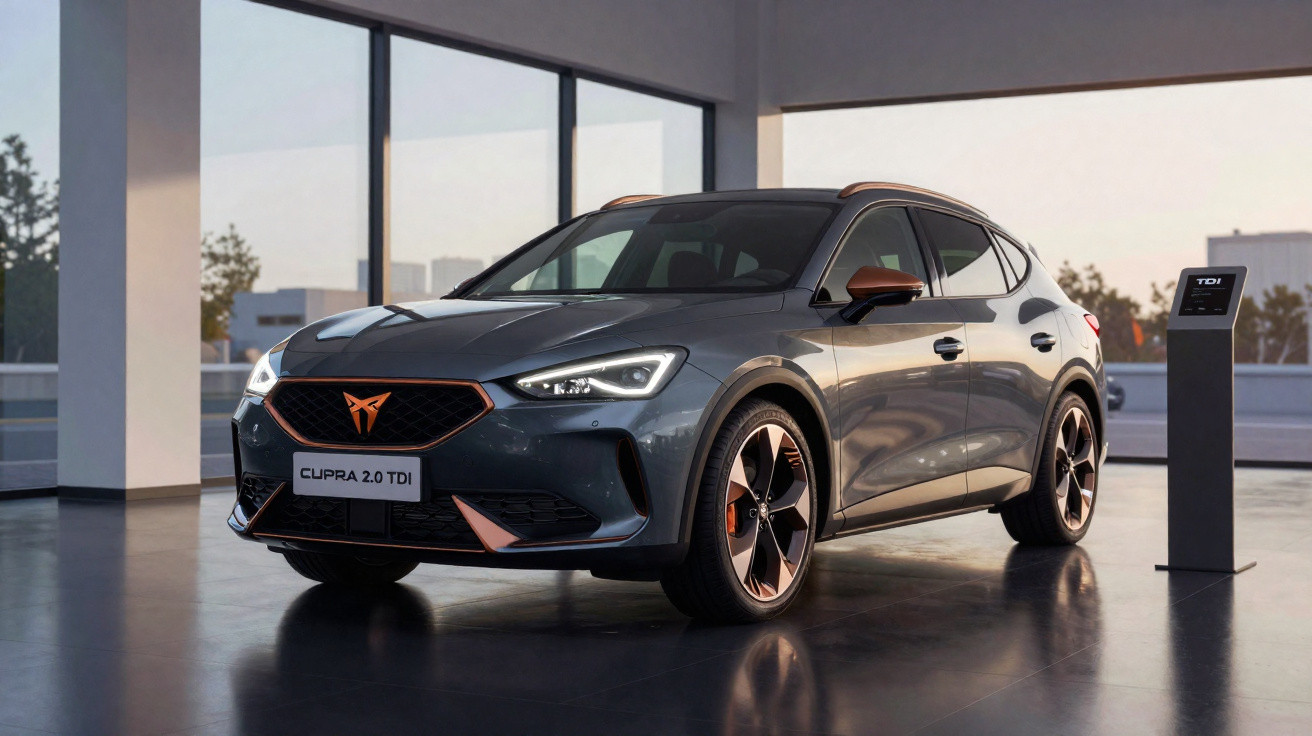
Even though it is close to disappearing, Diesel is still synonymous with efficiency - but in a market packed with electrified choices, does the CUPRA Leon Sportstourer 2.0 TDI still make sense?
“Times change, desires change.” Forgive the wordplay, but I cannot think of a better way to introduce the car I lived with for a few days: the CUPRA Leon Sportstourer. And the reasons are straightforward.
The first is revealed instantly by the name “Sportstourer”, which in CUPRA language means we are looking at an estate. It is a body style that has steadily lost ground to the unstoppable rise of SUVs, even though, for decades, it was the default choice for families wanting space and everyday usability.
The second reason is the engine choice - something that has become increasingly rare across many manufacturers’ line-ups: a Diesel.
Put together, those two points say a lot about where the car market has gone in recent years: a clear preference for higher driving positions and electrified vehicles. With that in mind, it is hard not to see this model as a nod to a very recent era.
Even so, the CUPRA Leon Sportstourer stays true to its DNA. It is aimed at drivers who value stronger sensations at the wheel and a sportier look, while still delivering the family-friendly, long-distance strengths we tend to associate with Diesel estates.
André Mendes has already had the chance to test this model, but it has since been updated for 2025. So, rather than retreading what we already know, here is what has changed.
More CUPRA
The biggest differences are on the outside, with an obvious effort to make the Leon feel more CUPRA and further from its SEAT “twin brother”. There are new, more aggressive bumpers and redesigned headlamps featuring the brand’s latest lighting signature, made up of three triangles.
The Spanish brand’s badge has moved onto the bonnet, while at the rear it is now illuminated and fully integrated into the full-width LED light bar. From the side, the only real change is a new wheel design, available in 18″ or 19″.
The interior has barely changed
Inside, the updates are more understated. You get new materials, a fresh design for the centre console and door panels, plus a new 12,9″ infotainment screen - with Apple CarPlay and Android Auto both connecting wirelessly.
Beyond that, it keeps the familiar CUPRA feel, with various copper-coloured accents and a darker, more sporting ambience, reinforced by the black headlining.
From the driver’s seat, the steering wheel and seats offer plenty of adjustment, resulting in an excellent driving position - low and exactly what you would expect from a model with a more performance-leaning “streak”.
When it comes to space - the single most important point for an estate - the CUPRA Leon Sportstourer performs strongly. While it does not beat its cousin, the Skoda Octavia, it does offer more room than the Volkswagen Golf, thanks to the longer wheelbase.
With the driver’s seat set for my height (1,78 m), there is no question that four adults can travel in comfort. There is loads of legroom and headroom, and the boot provides a generous 620 litres of capacity - only 20 l less than the Czech alternative.
Diesel as the ace up its sleeve
Even if it looks to be heading towards extinction, Diesel still delivers efficiency, range and easy day-to-day usability. That is the key advantage of this CUPRA Leon Sportstourer.
Under the bonnet sits the familiar 2.0 TDI with 150 cv and 360 Nm of torque. Those figures allow for brisk progress and, at the same time, fuel consumption that similar petrol-engined options struggle to match.
Over the days I spent with the Leon, I drove it in a range of scenarios and made the most of its responsiveness: peak torque arrives at 1700 rpm and holds until 2500 rpm. Even so, with a bit of haste “here and there”, I recorded an average of 5,5 l/100 km.
And it is not hard to push that lower. With slightly more care on the accelerator, I achieved consumption figures comfortably below five litres. Paired with the 45-litre fuel tank, that translates into almost 1000 km per tank - a figure that settles just about any argument about range.
Still, this is a CUPRA. And while it is not a high-performance version - for that, there are options such as the new CUPRA Leon Extreme - the brand’s DNA is present. You can feel it in the suspension, which errs on the firm side.
In town, that firmness can sometimes dent comfort, but on twistier roads it pays back with excellent body control and a composed stance, supported by direct, accurate steering.
The seven-speed DSG automatic gearbox also delivers quick shifts, although the engine note is not especially inspiring and can sometimes be too intrusive inside the cabin.
From 44 290 euros
The entry-level CUPRA Leon Sportstourer is powered by the 1.5 TSI (petrol) with 150 cv, with prices starting at 38 860 euros. For the Diesel version tested here, you will need to “fork out” more than 5400 euros, taking the base price to 44 290 euros.
The test car also included several options - Magnetic Tech Grey paint (775 euros) and CUPRA side skirts (357 euros), for example - pushing the price up further. If those two could be seen as non-essential, I cannot say the same about the EDGE Pack (969 euros) which adds, among other items, a reversing camera and proved far more useful in everyday driving.
Is Diesel still the best option?
Even so, there are two situations worth weighing up. If you cover hundreds of kilometres each week, mainly outside cities, Diesel remains the right and most rational choice. That is what Diesel engines were built for.
But if you drive a lot of miles and most of them are within the urban environment, this is not the powertrain for you. Electrified alternatives handle that kind of use better.
A good example is within the brand itself: the CUPRA Leon Sportstourer e-HYBRID, which uses a plug-in hybrid system that allows it to travel more than 130 km in 100% electric mode - as long as you charge it regularly, of course.
Although it is more expensive - 2400 euros and 7800 euros, respectively, compared with the 2.0 TDI and 1.5 TSI - if you have somewhere to plug in and do so often, you can use it much like an electric car. That can substantially reduce the cost per kilometre. The higher upfront outlay will be offset by what you save on diesel fuel, which continues to be more expensive. And for businesses, there are also tax advantages to factor in.
And when it is time for long journeys, the combustion engine takes over without the kind of planning most electric cars still require.
Comments
No comments yet. Be the first to comment!
Leave a Comment