
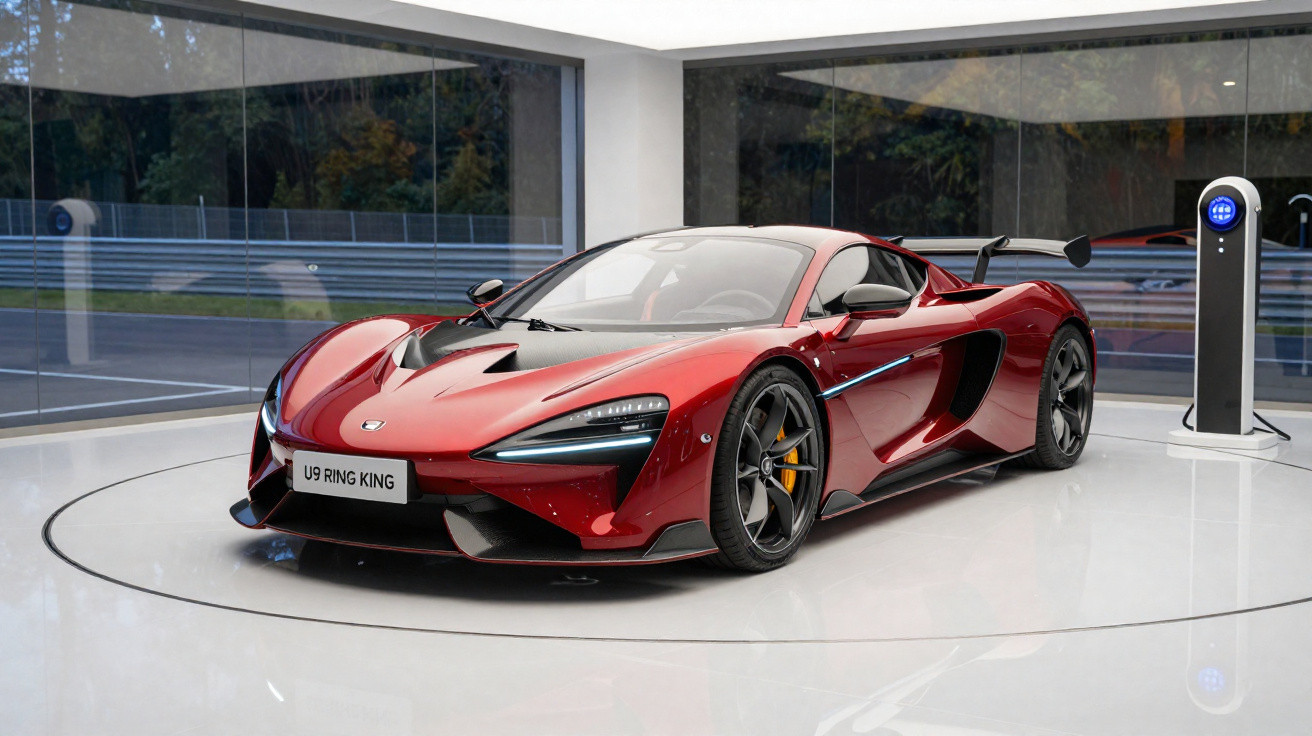
In the world of split-second debates and record-breaking headlines, Chinese electric cars have become a constant talking point - and few have generated as much noise as BYD’s YangWang U9 Xtreme. Late last year, the electric hypercar posted a lap time of 7min17,9s for a full run of the Nürburgring-Nordschleife.
That figure wasn’t enough to beat either the Rimac Nevera or the Porsche Taycan Turbo GT, but it clearly gave the Chinese brand fresh momentum to keep chasing benchmark numbers.
YangWang U9 Xtreme and BYD’s record hunt in Germany
In 2026, the YangWang U9 was also taken to the Automotive Testing Papenburg (ATP) proving ground in Germany to focus on outright speed. There, it reached a top speed of 472,41 km/h. Just a month later, it raised the bar again, recording 496,3 km/h.
Even so, the presence of the car - and a full engineering team - in Germany wasn’t only about maximum velocity. In the car world, the ultimate yardstick for widely recognised records is the lap time over the Nürburgring-Nordschleife’s 20,832 km.
A sub-seven Nürburgring-Nordschleife lap for a production EV
After the latest timed attempt, the outcome was genuinely historic.
The lap itself took place in August, but the brand chose to release the numbers only now. The YangWang U9 Xtreme completed a full lap of the German circuit in 6min59,157s.
With that result, the Chinese machine became the fastest production electric car ever around the Nürburgring-Nordschleife - and the first to break the seven-minute barrier.
It is important to stress the term “production”, because in 2019 the Volkswagen ID.R (also electric) set a lap of 6min05,336s. More recently, in April this year, the Xiaomi SU7 Ultra Prototype covered the same route in 6min22,091s. However, neither of those two vehicles is a production model.
What about internal combustion engines?
Although the YangWang U9 has secured the title of fastest production EV at the Nürburgring, the achievement still isn’t enough to unseat, for instance, a Porsche 911 GT3 with a manual gearbox. Porsche’s iconic Zuffenhausen model completed the very same lap three seconds quicker - an impressive result given the huge power gap between the two.
The Chinese hypercar is said to produce roughly 3000 hp, almost six times the output of the Porsche 911 GT3’s 510 hp. Even so, that advantage translates into only a three-second deficit to the German car. Put another way: for every extra 1000 hp, the U9 still couldn’t claw back even a second on track, underlining how decisive weight, aerodynamics and overall dynamic balance can be compared with raw power.
Watch the lap videos of both cars and the contrast is obvious. The YangWang U9 Xtreme fires out of each corner as if it has been “shot”, demolishing the straights with near-unreal acceleration - and it even manages to reach 350 km/h.
By comparison, the Porsche 911 GT3, flat-out, doesn’t have room to push beyond 300 km/h. What it does have is the precision to attack every corner in a way that compensates for everything else: a smoother, more controlled rhythm, without needing abrupt corrections. And this 911 isn’t even the GT3 RS, which is more extreme and quicker on a circuit.
The 911 GT3’s dynamic balance is the key to its effectiveness. Rear-wheel drive, restrained weight and the instant response of its naturally aspirated engine create a pure connection between car and driver. At the Nürburgring, that matters enormously: more than power, it is control and consistency that define the true records. It may have only a sixth of the power and burn petrol rather than electrons, but it still arrives three seconds ahead of the fastest electric car ever to lap the Green Hell.
Comments
No comments yet. Be the first to comment!
Leave a Comment